




What determines biofuel production capacity at commercial scale?




A commercial plant’s nameplate size is only a theoretical starting point. Biofuel production capacity is the sustained quantity of on-specification fuel a facility can produce over time, not the highest throughput reached during a short trial. A credible capacity assessment therefore asks whether feedstock, conversion equipment, utilities, downstream handling, and operating controls can all support the same production rate under normal conditions.
The limiting factor is often outside the main reactor or conversion unit. A plant designed to process a certain daily volume may run below that level because incoming material is inconsistent, drying capacity is insufficient, hydrogen supply is constrained, distillation becomes a bottleneck, or product storage cannot absorb output. Commercial-scale evaluation should identify the lowest-capacity element in the full production chain rather than relying on a single equipment rating.
Feedstock sets the practical ceiling
Feedstock availability, composition, and handling characteristics usually determine whether a proposed output is achievable year-round. This applies across common routes, including ethanol from sugar- or starch-based materials, biodiesel from oils and fats, renewable diesel from lipid feedstocks, biomethane from organic residues, and advanced fuels from lignocellulosic material or waste-derived intermediates.
Volume alone is not enough. A feedstock supply can appear adequate in annual terms while still failing to support continuous operation because of seasonal collection patterns, competing demand, transport limits, storage losses, or weather-related disruptions. For residues and waste streams, the recoverable fraction also matters more than the total quantity generated in a region.
Quality variation changes both yield and operating stability. Excess moisture increases the thermal load required for drying. High ash, dirt, salts, sulfur, free fatty acids, phosphorus, or contaminants can reduce conversion efficiency, accelerate corrosion, foul catalysts, or create product-treatment problems. A capacity model that assumes one average feedstock specification can overstate output when real deliveries span a wide quality range.
A useful assessment separates three questions:
- How much feedstock can be contracted and delivered consistently?
- What portion meets the plant’s accepted specification without excessive pretreatment?
- How does off-spec material affect yield, downtime, waste generation, and operating cost?
For a facility planned around variable feedstocks, blending capability and feedstock-flexibility limits should be treated as capacity variables, not minor operational details.
Conversion route determines what “throughput” means
Two plants with the same feed rate may have very different fuel outputs. The relationship depends on the selected conversion pathway, the usable fraction of the feedstock, conversion yield, recycle streams, coproduct handling, and final fuel specification.
Biochemical pathways such as fermentation depend heavily on substrate accessibility, microbial performance, nutrient balance, contamination control, and separation duty. Thermochemical routes may depend more on feed preparation, reactor temperature control, gas cleanup, catalyst condition, hydrogen availability, and upgrading performance. Anaerobic digestion is particularly sensitive to retention time, organic loading, feed consistency, and digestate management.
For this reason, capacity should be expressed in at least two linked ways: feedstock intake and finished-fuel output. The first helps size receiving, storage, pretreatment, and transport systems. The second is necessary for commercial planning. Confusing these measures is a common source of inflated production claims.
The bottleneck may be downstream of the reactor
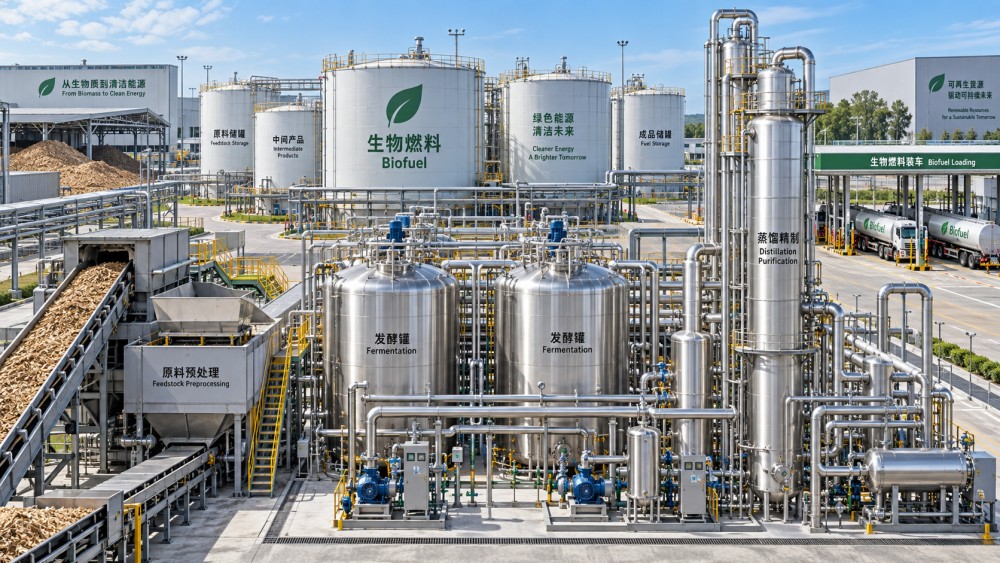
Process diagrams often emphasize the conversion unit, but commercial output is governed by the entire balance of plant. Pretreatment, separation, purification, blending, wastewater treatment, emissions control, solids handling, and loading systems all need matched capacity.
For example, a high-rate conversion unit does not create usable fuel if the distillation or purification section cannot consistently achieve the required water content or contaminant limits. Similarly, a hydrotreating-based route can be limited by hydrogen compression, gas treatment, catalyst changeout arrangements, or product fractionation rather than by the primary reactor.
Utility integration deserves equal attention. Thermal energy demand can rise sharply when feedstock moisture increases. Cooling constraints may reduce operating rates in warm conditions. Water availability and wastewater-treatment capacity can restrict expansion, especially where the process includes washing, fermentation, or wet feed handling. Electrical reliability matters for pumping, controls, refrigeration, compression, and safety systems, even where the process is mainly thermal.
Capacity studies should use mass and energy balances that cover both normal operation and foreseeable upset conditions. The relevant question is not whether a unit can operate at its maximum rating in isolation, but whether the plant can do so with realistic feedstock, ambient conditions, maintenance requirements, and product-quality controls.
Availability converts design capacity into annual production
Nameplate capacity normally assumes a defined operating basis. Annual production depends on how often the facility is actually available. Planned shutdowns, catalyst replacement, cleaning, inspection, equipment failure, feed interruptions, and startup losses all reduce realized output.
Reliability is therefore a design issue, not merely a maintenance issue. Pumps, conveyors, shredders, dryers, heat exchangers, compressors, filtration systems, and control instruments can all constrain the plant when they lack redundancy or are poorly matched to difficult feedstocks. A single non-redundant item in a continuous process can limit overall availability.
Technical evaluation should distinguish between:
- Nameplate capacity: the stated design output under specified conditions.
- Demonstrated capacity: the output achieved during a defined operating period.
- Sustainable capacity: the output that can be maintained while meeting fuel quality, maintenance, safety, and feedstock constraints.
The third measure is usually the most relevant for commercial decisions. It is also the most difficult to establish without clear operating assumptions and evidence from comparable equipment or process conditions.
Fuel specifications and compliance affect usable output
A volume that leaves the plant is not necessarily saleable fuel. The finished product must meet the applicable quality requirements for its intended market and blending route. Those requirements influence purification, testing frequency, traceability, storage segregation, and blending design.
Compliance-related capacity constraints can arise when a facility lacks sufficient laboratory turnaround, tank segregation, contamination controls, or documentation systems. Feedstock origin and process configuration may also affect whether a fuel qualifies for a particular sustainability or carbon-accounting framework. These requirements do not change the chemistry of conversion, but they can determine which output is commercially usable.
Projects should define the target fuel specification early. Designing first for gross volume and resolving quality obligations later often leads to added polishing equipment, slower blending operations, or a narrower range of acceptable feedstocks.
A practical way to evaluate a capacity claim
Before treating a stated output as bankable or operationally credible, map the capacity claim through the full system. Start with the expected feedstock specification and delivery profile. Then trace the material through pretreatment, conversion, recovery, upgrading, quality control, storage, and dispatch. At each point, identify the design rate, operating range, likely downtime drivers, and consequences of feedstock variation.
Next, test the proposal against less favorable but plausible conditions: wetter material, lower conversion yield, a utility outage, delayed product collection, or maintenance on a critical unit. This does not require assuming failure; it reveals whether the design has enough operating margin to sustain production when conditions depart from ideal assumptions.
Structured technical resources can help compare feedstock categories, process equipment, material compatibility, supplier capabilities, production routes, and applicable quality considerations. Platforms such as GEMM are most useful at this stage when they support a side-by-side review of technical information rather than treating capacity as a single catalogue specification.
The strongest commercial capacity assessment is not the one with the largest stated number. It is the one that shows a consistent chain from reliable feedstock supply to compliant fuel dispatch, with each system sized for the conditions the plant is likely to face.
Related News
- 00
0000-00
Terephthalic Acid CAS 100-21-0: The Technical Checks Behind Stable Polyester Supply - 00
0000-00
What determines biofuel production capacity at commercial scale? - 00
0000-00
How to select industrial chemicals for pulp processing by furnish type - 00
0000-00
What Factors Affect Bioprocessing Yield in Small-Scale Plants? - 00
0000-00
Do Metal Physical Properties Change After Welding?
Related tags
Weekly Insights
Stay ahead with our curated technology reports delivered every Monday.