




How to Select a Refining Catalyst for Heavy Crude




When a refinery starts processing a heavier or more variable crude slate, catalyst selection quickly becomes an operating issue rather than a purchasing detail. Higher metals, Conradson carbon, asphaltenes, sulfur, nitrogen, and salt precursors can reduce activity, increase coke, accelerate pressure-drop problems, and make product specifications harder to reach. The practical answer to how to select petroleum refining catalyst for heavy crude is to match catalyst chemistry, pore structure, and deactivation tolerance to the actual feed assay and the limits of the specific processing unit.
There is no single “heavy crude catalyst” that suits every refinery. A catalyst that maximizes conversion in a residue fluid catalytic cracking unit may be unsuitable for hydroprocessing, while a highly active hydrotreating catalyst can lose performance rapidly if its pore system cannot accommodate large feed molecules or if upstream demetallization is inadequate. Start with feed characterization, then define the unit objective, operating window, contaminant burden, and regeneration or replacement strategy.
Begin with the feed, not the catalyst brochure
Heavy crude is not a uniform material class. Two feeds with similar API gravity can behave very differently in a vacuum distillation unit, residue hydrocracker, hydrotreater, or FCC riser. Catalyst decisions based only on density or sulfur content often lead to avoidable performance problems.
A useful feed review should include the full boiling-range distribution and the properties of the fraction that will actually contact the catalyst. For example, a residue catalyst should be evaluated against vacuum residue properties rather than only whole-crude values. The most relevant indicators usually include:
- Metal content: Nickel and vanadium are especially important for residue FCC service because they promote dehydrogenation, dry gas, hydrogen, and coke. Iron, calcium, sodium, and silicon can also contribute to fouling, poisoning, or deposit formation.
- Conradson carbon residue or micro carbon residue: A higher value signals greater coke-making tendency and usually requires stronger coke tolerance or different severity control.
- Asphaltenes and resins: These large, aromatic molecules need accessible pore volume and can create diffusion limits, sediment formation, and rapid catalyst deactivation.
- Sulfur and nitrogen: Sulfur defines much of the hydrotreating duty, while basic nitrogen compounds can suppress acidity and reduce the effectiveness of hydroprocessing catalysts.
- Salt, water, and solids: Even a technically suitable catalyst can fail early when desalting, filtration, or feed conditioning is poor.
- Acidity and compatibility: Blending unstable crudes or residues can precipitate asphaltenes before the feed reaches the reactor, creating a problem no catalyst formulation can fully solve.
The feed assay should also be treated as a range, not a single laboratory number. A catalyst selected for an average feed may be exposed to short-term increases in metals, carbon residue, or nitrogen during crude switching. Selection margins matter when the crude slate changes frequently.
Define what the unit must accomplish
“More conversion” is not always the correct selection target. A refinery may need to protect downstream catalyst life, reduce sulfur in intermediate streams, produce a stable FCC feed, increase distillate yield, lower fuel oil viscosity, or limit coke and gas production. The desired outcome determines the catalyst family and the performance trade-offs that are acceptable.
Before comparing offers, state which performance variable cannot be compromised. In some units, pressure-drop stability and run length are more valuable than maximum initial activity. In others, the primary limitation is product sulfur, hydrogen availability, regenerator temperature, or slurry oil quality. A catalyst package should be judged against the limiting constraint, not against a single headline activity figure.
Match pore architecture to heavy molecules
Heavy feed molecules do not behave like clean gas oils. Large polyaromatic structures and asphaltene-associated material may diffuse slowly into narrow pores, especially after deposits begin to accumulate. A catalyst with strong intrinsic activity can still underperform when its active sites are inaccessible to the molecules that need conversion.
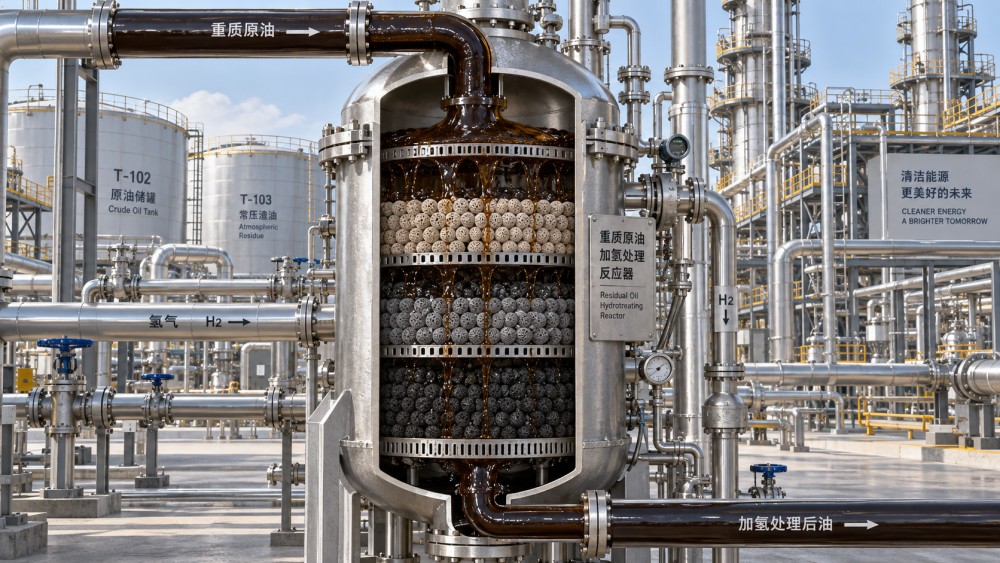
For heavy-oil hydroprocessing, larger pores and adequate pore volume generally support access for bulky molecules and provide space for metals and coke deposits. However, a very open pore structure is not automatically superior. It may reduce the concentration of active sites per unit volume or affect the balance between hydrogenation and cracking. The right question is whether the pore distribution remains functional for the expected feed throughout the planned run length.
In residue FCC, the catalyst particle includes both zeolite and matrix functions. The matrix is particularly important for pre-cracking and handling larger feed molecules before they reach the zeolite. A formulation optimized only for zeolite-based gasoline selectivity may not offer the desired conversion behavior with high-residue feeds. Refiners should review accessibility, matrix activity, rare-earth level where relevant, coke selectivity, and resistance to metals contamination as a combined system.
Separate activity from stability
Initial activity is easy to discuss and easy to overvalue. Heavy crude service is governed by how the catalyst changes with time. Metals deposition, coke, nitrogen inhibition, sulfur exposure, hydrothermal aging, and particulate fouling can alter both activity and selectivity. A selection process should therefore ask how the catalyst is expected to deactivate and what operational response will be available.
For fixed-bed hydroprocessing units
Bed grading is often as important as the main active catalyst. Heavy feeds can deposit solids and metals near the reactor inlet, causing pressure-drop growth and uneven temperature behavior. A typical catalyst system may include guard material, demetallization layers, transition layers, and deeper desulfurization or conversion catalyst. The sequence depends on feed contaminants and reactor design.
Do not evaluate the active catalyst in isolation. Check whether the proposed loading plan provides enough space for deposits, whether the grading material captures fines without plugging prematurely, and whether the reactor internals distribute liquid and gas adequately. Poor distribution can create local hot zones, leaving part of the catalyst underused while another part deactivates quickly.
For circulating FCC systems
Equilibrium catalyst properties matter more than fresh catalyst properties alone. A heavy residue feed exposes catalyst to repeated cycles of cracking, stripping, regeneration, metals accumulation, and steam. Selection should consider the expected equilibrium metals level, catalyst-to-oil ratio, regenerator conditions, delta coke, and the refinery’s ability to manage afterburn or temperature constraints.
A more metal-tolerant FCC catalyst can help control undesirable hydrogen and coke formation, but it does not eliminate the need for feed management. Where nickel and vanadium are high, a metals passivation program, antimony strategy where operationally appropriate, feed hydrotreating, or a revised crude blend may need to accompany catalyst changes. Catalyst choice and operating discipline must work together.
Check hydrogen balance before selecting a deep-conversion route
Hydrogen availability is a hard boundary for many heavy crude projects. Hydrotreating and hydrocracking catalysts can remove sulfur, reduce nitrogen, improve stability, and upgrade product quality, but their performance is tied to hydrogen partial pressure, gas purity, recycle gas rate, quench capability, and compressor capacity. Selecting a catalyst designed for deep conversion without confirming hydrogen supply can result in high temperatures, shortened cycle length, or failure to meet product targets.
Feed nitrogen deserves particular attention. Basic nitrogen compounds compete for acidic sites and can make a catalyst appear less active than expected. A feed with difficult nitrogen may require stronger pretreatment, a more suitable catalyst system, adjusted severity, or a realistic reduction in conversion expectations. The same logic applies to feeds with high aromatics and low hydrogen content: cracking them without sufficient hydrogenation support can increase coke and instability.
Use operating conditions as part of the selection criteria
Catalyst performance cannot be separated from temperature, pressure, space velocity, residence time, feed distribution, and regeneration conditions. A supplier comparison is meaningful only when competing catalysts are assessed under comparable conditions and against the same feed basis.
For hydroprocessing, review expected start-of-run and end-of-run temperature, allowable temperature rise, pressure drop, liquid hourly space velocity, hydrogen partial pressure, and planned cycle duration. A catalyst that needs aggressive temperature escalation to sustain product quality may leave little operating margin later in the run. Also consider whether temperature limits are set by metallurgy, product stability, exotherm control, or downstream separation equipment.
For FCC operations, examine riser outlet temperature, contact time, catalyst circulation rate, stripping efficiency, regenerator oxygen balance, and allowable coke burn. Heavy feeds may require a different catalyst formulation, but poor stripping or insufficient residence time in the regenerator can make the apparent catalyst problem worse. Unit constraints should be identified before changing catalyst inventory strategy.
Do not ignore contaminants introduced upstream
Heavy crude catalyst selection often fails because the feed arriving at the reactor is not the feed assumed during evaluation. Desalter carryover, corrosion products, tank-bottom solids, chemical additives, incompatible blend components, or fines from upstream equipment can change catalyst life materially.
Review desalting effectiveness, wash-water quality, crude storage practices, filtration, blending sequence, and any additives used for emulsion control or fouling mitigation. Sodium and calcium are especially disruptive in some catalytic cracking applications because they can damage catalyst acidity and promote unwanted effects in the unit. In fixed-bed service, solids and scale can become a pressure-drop issue long before the active catalyst is chemically exhausted.
When a feed shift is planned, obtain representative samples from the actual transfer point where practical. A tank sample, a laboratory blend, and a reactor-feed sample can differ because of settling, water entrainment, or blend instability.
Questions refiners often ask during catalyst selection
Should the catalyst be selected mainly by sulfur removal activity?
No. Sulfur removal is important, but heavy crude service also depends on metals capacity, pore accessibility, nitrogen tolerance, pressure-drop behavior, coke formation, and operating margin. High desulfurization activity alone may not produce the longest or most stable run.
Can a refinery process heavier crude simply by increasing catalyst quantity?
Additional catalyst inventory or higher circulation can help in some units, but it cannot correct all limitations. Large molecules may remain diffusion-limited, metals may accumulate too quickly, hydrogen may be insufficient, or regenerator and reactor temperatures may exceed practical limits. The catalyst formulation and unit configuration still need to fit the feed.
When is a guard bed necessary?
A guard bed becomes important when solids, metals, salts, or unstable heavy material could foul the main catalyst before it has completed its intended duty. It is particularly relevant in fixed-bed hydroprocessing of residue-rich feeds. The guard material should be selected for the expected contaminant type rather than treated as a generic sacrificial layer.
What information should be provided for a meaningful catalyst evaluation?
Provide the relevant fraction assay, expected range of crude properties, contaminant analysis, current unit conditions, product targets, cycle-length expectations, catalyst history, pressure-drop trend, hydrogen availability where applicable, and known operational constraints. A single average feed specification rarely captures the risk profile of heavy crude processing.
The most reliable selection decision comes from connecting the feed’s worst credible properties to the unit’s true constraint. A catalyst may be chosen for accessible pore structure, metals tolerance, controlled coke behavior, stronger sulfur removal, or longer stability, but the reason should be explicit. That makes it easier to assess whether a catalyst change, feed pretreatment step, revised loading design, or operating adjustment is the most effective response to heavier crude.
Related News
- 00
0000-00
How to verify quality systems at oil and gas industry suppliers - 00
0000-00
Which carbon capture materials grades suit high-humidity flue gas? - 00
0000-00
How commodity intelligence analytics can improve price risk decisions - 00
0000-00
Terephthalic Acid CAS 100-21-0: The Technical Checks Behind Stable Polyester Supply - 00
0000-00
What determines biofuel production capacity at commercial scale?
Weekly Insights
Stay ahead with our curated technology reports delivered every Monday.