




Which Leak Detection Technologies Suit Pipeline Transportation?




A control-room alarm during a pump change can look uncomfortably similar to the first sign of a pipeline rupture. At the other end of the spectrum, a small leak may develop quietly, without producing an obvious pressure disturbance. Choosing the right pipeline transportation leak detection technology means addressing both situations: recognizing genuine releases quickly while keeping routine operating changes from overwhelming operators with false alarms.
No single method performs equally well on crude oil, refined products, natural gas, hydrogen, and chemical transfer lines. Computational monitoring, pressure-wave analysis, acoustic sensing, and fiber-optic systems observe different physical signals. Their suitability depends on the transported fluid, pipeline configuration, operating patterns, and consequences of a missed event. For engineers and procurement teams, the useful question is not simply which technology is most sensitive, but which combination provides dependable coverage under real operating conditions.
Start with the leak scenario, not the equipment list
Before comparing suppliers, define what the system must detect. A sudden rupture, a gradually enlarging corrosion defect, and a small seal leak at a valve station create different signatures. A method optimized for rapid rupture detection may struggle with slow seepage; a sensor that identifies a local release may provide little coverage between installations.
Four site conditions should shape the shortlist:
- Fluid behavior: Compressibility, viscosity, temperature, vapor pressure, and phase changes influence hydraulic models and the signals generated by a leak.
- Operating envelope: Steady transportation is easier to monitor than frequent starts, stops, batch changes, flow reversals, or variable withdrawals.
- Route exposure: River crossings, populated areas, environmentally sensitive land, and inaccessible terrain justify different monitoring priorities.
- Available infrastructure: Existing instrumentation, communication links, power supplies, and accessible rights-of-way affect both feasibility and cost.
Detection should also be distinguished from localization. Knowing that product is escaping is not the same as knowing where a response crew should go. An effective specification sets separate requirements for detection time, location uncertainty, operating coverage, and alarm reliability.
How the main technologies compare
The following comparison describes typical strengths and limitations, not guaranteed performance. Actual results depend on sensor placement, commissioning, environmental conditions, and the pipeline’s operating state.
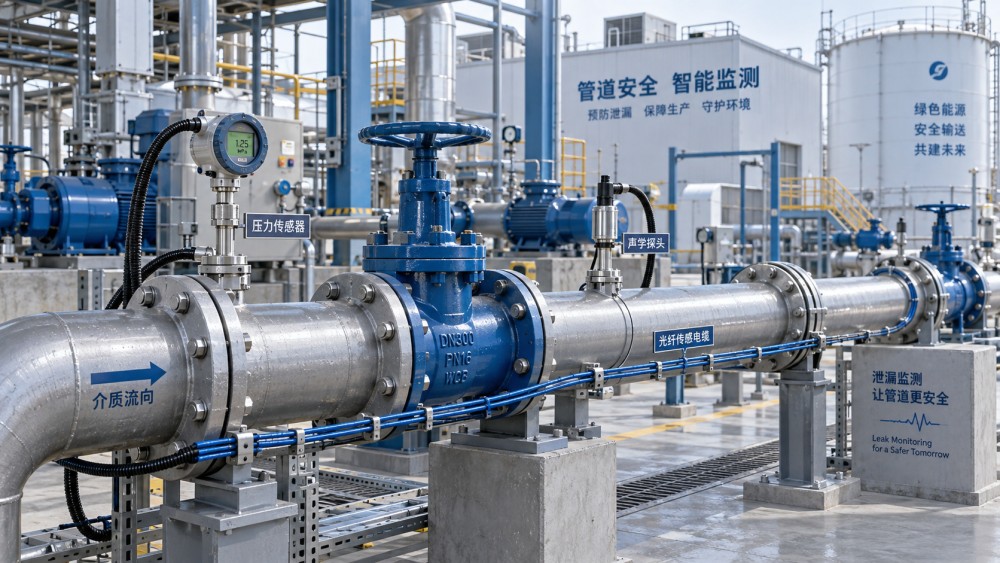
Computational pipeline monitoring: practical, but only as good as its inputs
Computational pipeline monitoring, or CPM, uses operating measurements to infer whether a pipeline is behaving normally. It is a family of methods rather than a single algorithm. Basic balance systems compare what enters and leaves; more advanced systems account for inventory changes and model pressure, temperature, flow, and fluid properties.
Simple volume balance can be useful on stable liquid lines, but uncorrected volume measurements become misleading when temperature or density changes. Gas pipelines present an additional challenge: substantial quantities of gas can accumulate or leave the line as pressure changes. This inventory effect, commonly called linepack, must be accounted for rather than interpreted automatically as leakage.
Real-time transient models offer a more detailed approach by calculating expected hydraulic behavior during changing conditions. They can support monitoring across pump operations, valve movements, and varying demand, provided the model represents those events accurately.
The attraction is clear for existing assets: much of the required information may already be available through the supervisory control and data acquisition system. Yet “already measured” does not necessarily mean “fit for leak detection.” Meter calibration, timestamp alignment, communication delays, missing data, and pressure-sensor quality can determine whether the system is dependable. CPM also needs updating as pipeline configuration and transported products change.
Negative pressure waves: valuable for sudden events
A sudden release can create a pressure disturbance that travels along the pipeline. Negative pressure wave systems identify that disturbance at separated sensors and use arrival-time differences to estimate its origin.
This approach is attractive where rapid identification of abrupt failures matters. However, the position estimate depends on wave-speed assumptions, accurate timing, sensor spacing, and the pipeline’s geometry. Fluid properties, pipe-wall behavior, branches, and reflected waves complicate interpretation.
Pump trips and rapid valve operations also generate pressure waves. Good implementations therefore incorporate operational context and signal discrimination rather than treating every disturbance as a leak. Slowly developing losses may not produce a sufficiently distinct initial wave, making this method better suited to a layered strategy than to universal coverage on its own.
Acoustic monitoring: listen where the signal can travel
Escaping fluid can produce sound and structural vibration. Fixed acoustic sensors detect these signals through the pipe wall, surrounding medium, or specialized sensing arrangements. Their usefulness depends on pressure differential, leak geometry, fluid type, sensor coupling, and background noise.
Localized acoustic monitoring can be effective around valve assemblies, stations, and sections where sensors can be installed and maintained. It is less straightforward to promise uniform coverage along a long route. Signal attenuation, joints, burial conditions, and operating machinery all influence what reaches the sensor.
Ask suppliers to explain coverage gaps and how performance changes under realistic noise conditions. A demonstration beside a quiet test pipe is not equivalent to operation near compressors, pumps, road traffic, or construction activity.
Distributed fiber optics: route-wide sensing, with installation caveats
Distributed fiber-optic systems turn an installed optical fiber into a series of sensing locations. Distributed acoustic sensing, or DAS, tracks dynamic strain signals that may reveal leakage-related vibration or nearby activity. Distributed temperature sensing, or DTS, identifies thermal changes that may occur when escaping product affects the cable’s surroundings.
These approaches are particularly attractive for new pipelines, where cable placement can be designed during construction. They may also provide additional value through third-party interference monitoring, although intrusion alerts and leak alerts require different interpretation.
The important caveat is proximity and coupling. A telecommunications fiber somewhere along the corridor is not automatically a reliable leak sensor. Cable position relative to the pipe, soil conditions, burial depth, and thermal contrast affect detectability. A temperature-based method may struggle when the release creates little measurable temperature change; an acoustic method may struggle when the leak signal is weak or poorly coupled to the fiber.
Retrofit projects must account for excavation, access permissions, fiber continuity, interrogator locations, and repair arrangements. The sensing cable is only part of the investment.
Direct external detection: useful where released product can be intercepted
Gas detectors, hydrocarbon-sensitive cables, and other chemical sensors detect the released substance rather than infer a loss from hydraulic behavior. They can add valuable coverage in pump stations, valve chambers, storage interfaces, or locations where leakage is likely to collect or pass a sensor.
Their limitation is physical transport: product must reach the detector. Wind, ventilation, soil permeability, drainage, and groundwater movement may delay detection or divert a release away from the sensing point. Material compatibility matters too. A sensor suitable for one hydrocarbon or gas should not be assumed suitable for every chemical service.
Which pipeline transportation leak detection technology fits your network?
Long liquid transmission pipelines: CPM is often a practical foundation when flow, pressure, and temperature measurements are dependable. Pressure-wave detection can add rapid-event coverage, while external sensing can reinforce protection at crossings and other high-consequence sections. Batch interfaces and product-property changes need explicit treatment in the monitoring logic.
Gas transmission networks: Choose computational methods that account for compressibility and linepack. Assess pressure-based and acoustic methods against compressor noise, demand fluctuations, and network branching. External gas detection is particularly useful at facilities, but does not replace monitoring between them.
Chemical transfer lines: Product-specific hazards often drive the decision. Toxicity, volatility, corrosiveness, and compatibility may justify direct sensing near likely release points alongside hydraulic monitoring. Multiphase flow, flashing, or strongly changing properties require specialist evaluation.
Hydrogen and carbon dioxide pipelines: Do not transfer performance claims from conventional natural gas or oil systems without validation. Hydrogen service requires attention to gas properties and detector suitability. Dense-phase carbon dioxide can exhibit complex thermal and phase behavior during release, affecting both modeling and external sensing.
Short industrial lines and frequently idle sections: Local sensors, pressure monitoring, and targeted inspections may be more proportionate than a complex network model. However, some methods lose effectiveness at low flow or during shutdown, so idle-state coverage must be specified separately.
Buy demonstrated performance, not an impressive sensitivity claim
A quoted minimum detectable leak means little without its conditions. Procurement documents should state the leak size or rate of interest, allowed detection time, pipeline operating state, and acceptable false-alarm behavior. If sensitivity is expressed as a percentage of flow, clarify how that definition applies at low throughput or when the line is idle.
Request evidence covering the conditions operators actually face:
- Steady flow, startup, shutdown, batch changes, and relevant transient events.
- Small gradual losses as well as abrupt releases.
- Sensor failures, communication outages, and degraded data quality.
- Localization uncertainty and the method used to verify it.
- Alarm persistence, confidence information, and operator response procedures.
Testing can combine approved field methods, validated simulations, and historical operating data. Each has limits: simulated leaks do not reproduce every physical signal, while field releases may be unsafe or environmentally unacceptable. Acceptance criteria should identify what each test demonstrates and what remains uncertain.
Lifecycle costs also deserve scrutiny. Include instrument calibration, model maintenance, communications, software support, cybersecurity, fiber repairs, training, and alarm investigation—not just purchase price. For liquid pipelines, API RP 1130 and API RP 1175 can inform CPM and leak detection program discussions; applicable editions, local regulations, and service-specific requirements still need confirmation.
The strongest choice is often a coordinated detection program
Layering technologies works best when their strengths are genuinely complementary. A hydraulic system may identify an unexplained inventory loss, while a route-based sensor provides local evidence. But installing several systems does not automatically improve reliability: shared dependencies, conflicting alarms, and unclear response ownership can undermine the benefit.
Define how alarms reach the control room, how operators assess them, and when isolation or emergency response procedures apply. Leak detection supports decision-making; it does not replace integrity management, inspection, corrosion control, or emergency planning.
For teams comparing solutions through GEMM’s structured pipeline technology resources, the most useful starting point is a service-specific requirement sheet. Compare sensing principles, instrumentation needs, operating limitations, supplier evidence, and maintenance obligations before comparing prices. The right solution is the one that detects the release scenarios your network cannot afford to miss—and gives operators evidence they can act on.
Related News
- 00
0000-00
Which sectors are driving demand in the chemical engineering market? - 00
0000-00
How to assess lifecycle emissions from CCUS for low-carbon cement - 00
0000-00
How do energy storage technologies compare for 8-hour discharge? - 00
0000-00
Do mill test reports prove industrial alloys meet ASTM standards? - 00
0000-00
How to verify plastic recycling system suppliers' throughput claims
Weekly Insights
Stay ahead with our curated technology reports delivered every Monday.