




Can polymer processing simulation predict injection molding warpage?




Can polymer processing simulation predict injection molding warpage?
Can polymer processing simulation predict injection molding warpage accurately enough to support engineering decisions? Yes—but its strongest use is predicting deformation mechanisms and comparing design or process alternatives, not guaranteeing final dimensions without validation. Prediction quality depends on material characterization, cooling conditions, fiber orientation, and realistic process inputs. A convincing warpage plot is only useful when the model captures what actually drives dimensional instability.
For a molded housing, connector, or industrial equipment cover, the practical question is rarely “Will it warp?” It is whether mounting points remain aligned, a sealing surface stays within tolerance, or an assembly can close without excessive force. Those requirements should define the simulation assessment before anyone interprets a colored displacement map.
What the model is actually predicting
Warpage is shape distortion caused by nonuniform contraction and the release of residual stresses. Uniform shrinkage changes size; uneven shrinkage changes shape. The two are related, but a part can have acceptable average shrinkage and still fail flatness or alignment requirements.
A typical injection molding analysis connects filling, packing, cooling, and structural deformation calculations. Flow and thermal results establish local pressure, temperature, and solidification histories. Material models then estimate shrinkage and residual stress, which feed a structural calculation of deformation after constraints are removed.
Several mechanisms can overlap. Different wall thicknesses cool and solidify at different rates. Unequal temperatures on opposing mold surfaces can promote bending. Packing pressure varies along the flow path, so regions near and far from the gate may contract differently. In semicrystalline polymers, crystallization also influences volume change and subsequent dimensional behavior.
Fiber-reinforced materials add directional behavior. Fiber orientation affects both shrinkage and stiffness, so changing gate position can change distortion even when nominal wall thickness remains unchanged. A model that treats a glass-filled polymer as isotropic may miss the reason a component twists.
Where prediction reliability is won—or lost
Material selection in the software deserves more scrutiny than it often receives. A database entry for the same polymer family is not necessarily suitable for the intended grade. Filler content, reinforcement, additives, and processing history can change the behavior that matters to warpage.
Relevant inputs include viscosity, pressure-volume-temperature behavior, thermal properties, mechanical properties, and shrinkage characterization. For reinforced polymers, fiber orientation and anisotropic properties are particularly important. Evaluators should ask which properties were measured, which were estimated, and whether the characterization covers the proposed processing window.
Recycled-content materials require similar caution. A nominal resin designation does not establish consistent feedstock composition or rheology. Where lot variation is a project concern, sensitivity studies using credible property bounds are more informative than assuming one database record represents every delivery.
Machine settings are not always cavity conditions
The process model should represent injection rate, velocity-to-pressure transfer, packing pressure and duration, melt temperature, and cooling time. A machine pressure setting should not be substituted directly for cavity pressure without checking the software’s pressure definition and losses through the delivery system. Gate freeze also matters: extending hold time after the gate has frozen does not continue packing the cavity.
Cooling inputs need equivalent care. A single prescribed mold temperature can support early screening, but it may hide local thermal imbalance. Cooling-channel geometry, coolant conditions, mold materials, inserts, and contact assumptions can change the result. For production-cycle predictions, confirm whether the thermal solution represents repeated cycling rather than only startup conditions.
Mesh quality and model formulation remain consequential. Thin-wall assumptions may be unsuitable around thick bosses, abrupt transitions, or complex three-dimensional flow. Mesh refinement should be checked at critical features, with attention to whether predicted deformation stabilizes—not merely whether the solver finishes successfully.
How to read a warpage result without overinterpreting it
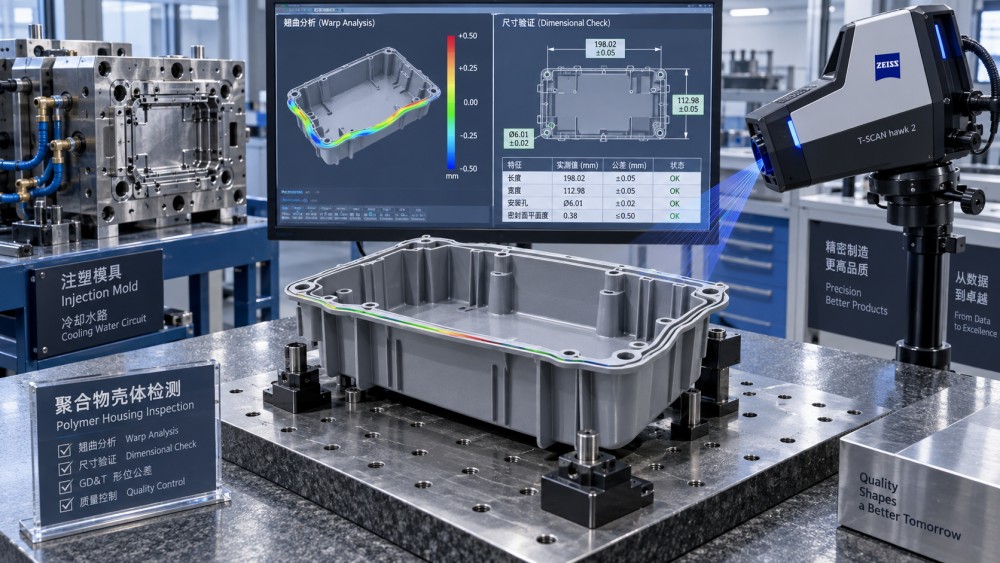
Start with the undeformed geometry, coordinate system, and displacement scale. Software often exaggerates deformation visually. A dramatic image does not establish a tolerance failure, and a mild-looking image does not establish compliance.
Compare the result against the actual drawing requirement. Total displacement, out-of-plane displacement, flatness, and positional deviation describe different things. A best-fit alignment may remove movement that remains important when the component is located against assembly datums. Free-state deformation also differs from deformation under fixtures, fasteners, or assembly loads.
- Evaluate sealing lands, mounting interfaces, and other critical features using a defined datum scheme.
- Check whether the predicted bending or twisting mechanism is consistent with thermal and orientation results.
- Compare alternatives using identical evaluation methods and material assumptions.
- Test sensitivity to uncertain inputs before treating a small predicted improvement as meaningful.
Some solvers provide separate contributions associated with cooling imbalance, differential shrinkage, or orientation. These are useful diagnostic views, but their definitions and combination methods depend on the software. They should not automatically be treated as independent, directly additive physical measurements.
Validation needs a measurement plan, not just a molded sample
A useful validation compares simulation and measurement under matched conditions. Record the material grade, drying and moisture conditions where relevant, actual process settings, and measurement timing after molding. Some polymers continue changing dimensions through post-mold crystallization, stress relaxation, or moisture uptake. Immediate measurement and conditioned inspection may answer different questions.
Use the same datums and restraint conditions for predicted and measured geometry. A thin component held firmly during scanning may appear flatter than it does in its free state. Measurement uncertainty must also be considered when assessing small deviations.
ISO 294-4 addresses determination of molding shrinkage for injection-molded thermoplastic test specimens. It can support material characterization, but it does not certify warpage prediction accuracy for a complex production part. Drawing tolerances and inspection methods require their own specification. No single universal simulation accuracy percentage establishes suitability across all polymers and geometries.
When results disagree, investigate the mechanism before adjusting coefficients. Compare filling behavior, cavity pressure where available, part weight, and temperature evidence. A model tuned to match one trial is not necessarily validated; checking another process condition helps establish whether it predicts behavior beyond that trial.
Turning the analysis into an engineering decision
Before tooling, polymer processing simulation is well suited to screening gate layouts, wall transitions, cooling concepts, and material options. After trials, it can help diagnose distortion and assess targeted changes. Tool compensation requires greater confidence because an incorrect predicted shape can become a permanent tooling error.
GEMM’s structured resources on polymer materials, injection molding equipment, processing knowledge, and supplier references can support the information-gathering stage. They help teams organize grade comparisons and identify technical questions for suppliers. Project-specific material characterization and molding validation remain necessary; industry information cannot replace them.
The decision threshold should reflect the consequence of error. A robust ranking of design alternatives may justify a gate change, while releasing a tight-tolerance sealing interface needs stronger dimensional evidence. Before accepting a prediction, confirm the material data, realistic cooling conditions, inspection reference, and sensitivity of the critical dimensions. That is what turns a warpage plot into defensible engineering evidence.
Related News
- 00
0000-00
Can polymer processing simulation predict injection molding warpage? - 00
0000-00
An export controls compliance guide to checking U.S. license requirements - 00
0000-00
How Do Metals Compare in Physical Properties and Heat Resistance? - 00
0000-00
Which Standards Apply to Tensile Strength Testing of Metal Alloys? - 00
0000-00
Petroleum refining technology trends reshaping refinery decarbonization
Weekly Insights
Stay ahead with our curated technology reports delivered every Monday.