




How Do Metals Compare in Physical Properties and Heat Resistance?




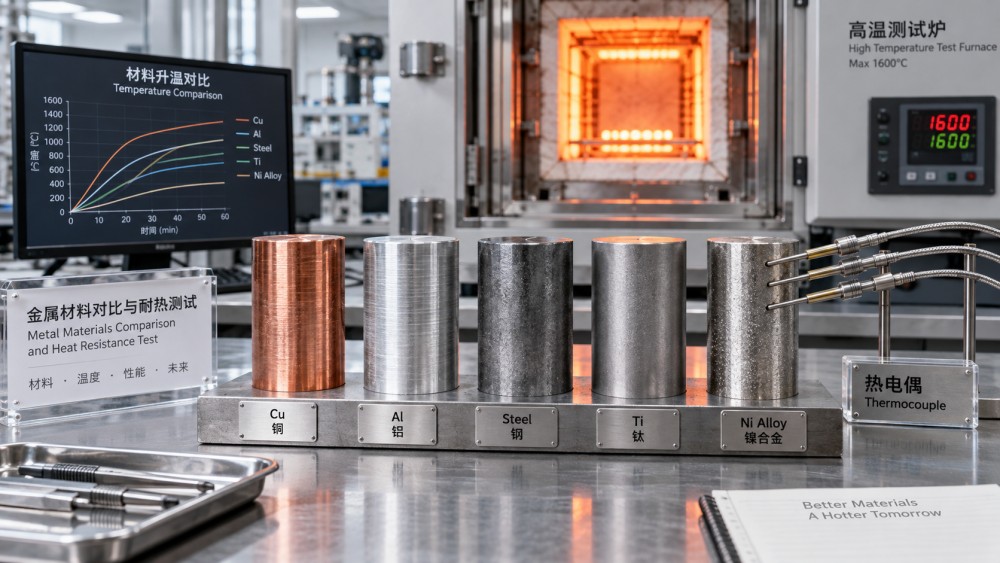
Nickel alloys generally offer the strongest options for sustained high-temperature service, while aluminum provides low weight and efficient heat transfer but loses structural capability much earlier. Copper conducts heat exceptionally well, titanium combines low density with useful strength, and steels span a wide range of behavior depending on composition and treatment. No single metal leads in strength, weight, conductivity, expansion, and heat resistance simultaneously.
The most useful comparison separates physical properties at room temperature from performance at the actual operating temperature. A component can remain far below its melting point and still fail through softening, creep, oxidation, or thermal fatigue. Load, exposure time, atmosphere, and temperature cycling determine which of those mechanisms controls material selection.
Metal Physical Properties and Temperature Resistance Chart
The values below are approximate reference values for representative materials near room temperature. They describe common property differences, not guaranteed specifications. Alloy composition, product condition, and temperature change these values; elevated-temperature suitability requires data for the exact grade.
Conductivity varies especially widely within aluminum, titanium, and nickel alloy families. High-purity copper values should not be applied to brass, bronze, or precipitation-hardened copper alloys. The stainless steel row represents austenitic grades: ferritic and martensitic stainless steels have different expansion, conductivity, and mechanical characteristics.
Heat Resistance Has Several Different Meanings
A metal that survives furnace exposure without severe scaling is not necessarily suitable for a loaded furnace fixture. Oxidation resistance describes how the surface withstands the atmosphere. Hot strength describes resistance to deformation under load. Creep resistance describes resistance to progressive deformation during prolonged exposure. These properties must be considered separately.
Melting point gives an incomplete comparison
Melting is rarely the first limit reached by a structural component. Aluminum alloys lose useful strength long before melting begins. Heat-treated steels can soften when exposure alters their hardened microstructure. Cold-worked copper loses strengthening as recovery and recrystallization occur. A melting-point chart therefore gives little guidance for a pressure boundary, bolted connection, or rotating part.
Alloys also commonly melt over a temperature interval rather than at one fixed point. Their solidus and liquidus temperatures describe the beginning and completion of melting, but neither establishes an allowable operating temperature.
Time under load changes the ranking
A brief temperature spike and years of continuous exposure place different demands on the same metal. Short-duration performance can be governed by elevated-temperature yield strength. Long-duration performance can be governed by creep deformation or rupture, even when the applied stress is below the short-term yield strength.
This distinction matters in tubes, headers, furnace supports, and hot fasteners. Small amounts of creep can change alignment or reduce bolt preload before visible fracture occurs. A published maximum temperature without an associated stress, duration, and failure criterion cannot establish suitability for these components.
Where the Main Metal Families Differ
Carbon steel and stainless steel
Carbon steel offers stiffness, strength, and straightforward fabrication for many components operating at moderate temperatures. Its relatively higher thermal conductivity compared with austenitic stainless steel helps distribute heat. However, increasing temperature reduces strength, and exposure to oxidizing atmospheres produces scale that can consume metal and detach from the surface.
Stainless steel improves oxidation resistance through a chromium-rich protective film. Austenitic grades are common in heated process equipment, but their relatively low conductivity and greater thermal expansion complicate thermal cycling. A restrained stainless assembly can develop significant thermal stresses even when its surface remains in good condition.
Stainless grades are not interchangeable. General-purpose corrosion resistance does not establish suitability for a furnace component. Heat-resistant grades, stabilization, carbon content, and product condition affect performance. Prolonged exposure within certain temperature ranges can also change microstructure and reduce corrosion resistance or toughness.
Aluminum and copper
Aluminum is attractive when weight and heat removal dominate. Heat sinks, cooling plates, and lightweight housings benefit from its low density and useful conductivity. Its high expansion requires attention at joints, particularly where aluminum attaches to steel or ceramic parts.
Heat treatment is a major boundary. The room-temperature strength of a precipitation-hardened aluminum alloy depends on its strengthening structure. Sustained heating can alter that structure and reduce strength, including after cooling. A room-temperature tensile value therefore overstates capability if the service temperature changes the alloy condition.
Copper transfers heat much faster than most structural alloys, making it valuable for heat exchangers, electrical conductors, and actively cooled components. Its high density and limited hot strength are disadvantages where weight or mechanical loading dominates. Copper alloying can improve strength, but frequently reduces conductivity. The composition must match whether heat transfer, electrical performance, or load capacity is the primary requirement.
Titanium and nickel alloys
Titanium offers useful strength at substantially lower density than steel. Its low thermal expansion helps dimensional stability, but its low conductivity allows steep temperature gradients to develop around localized heat sources. A component can therefore have a cool average temperature while a small region reaches a damaging temperature.
At elevated temperatures in air, titanium develops oxide and can absorb oxygen into the underlying metal, creating a hard, brittle surface region. Its suitability for sustained hot service depends on grade, exposure duration, atmosphere, and loading. A high melting point does not remove these limitations.
Nickel alloys cover several distinct material groups. Some prioritize corrosion resistance; others are designed for oxidation resistance or high-temperature strength. Nickel superalloys use controlled alloy chemistry and microstructure to retain load-bearing capability during demanding hot service. Their density and relatively low conductivity remain trade-offs, and processing condition strongly influences performance.
Conductivity and Expansion Can Change the Apparent Winner
High thermal conductivity is valuable when heat must leave a component quickly. Copper and aluminum are strong candidates for spreading heat into a larger cooled area. For a thermal barrier or a part separating hot and cold zones, lower conductivity reduces heat flow through the metal, although it can increase temperature differences within the component.
The heat-transfer path includes wall thickness, surface contact, coolant flow, and deposits. A highly conductive metal behind a poor thermal interface can perform worse than a less conductive metal with effective contact and cooling. Material conductivity alone does not describe the temperature reached during operation.
Expansion becomes particularly important in assemblies made from different materials. Over the same temperature rise, aluminum expands more than steel, while titanium expands less. If the parts are rigidly joined, this mismatch generates stress or changes contact pressure.
For a freely expanding straight component, the approximate length change is ΔL = α × L × ΔT, where α is the expansion coefficient, L is the original length, and ΔT is the temperature change. Wide temperature intervals require temperature-dependent expansion data. Restraints, curved geometry, and uneven heating require a more detailed assessment.
Repeated heating and cooling add another concern: thermal fatigue. Cracks can develop at weld toes, sharp corners, and transitions in thickness where thermal strain concentrates. Better oxidation resistance alone does not prevent this failure mechanism.
Translate the Comparison into an Application
A cooling plate illustrates why heat resistance cannot be ranked on one scale. Aluminum suits applications where low mass and sufficient heat spreading are priorities. Copper offers higher conductivity when local heat flux or temperature uniformity dominates. Neither choice follows directly from the highest melting point; the cooling arrangement must keep the metal within its mechanical limits.
A furnace support produces a different ranking. The support carries load while exposed to heat for extended periods, so creep and oxidation become central. Suitable heat-resistant stainless steels or nickel alloys are more credible starting points than aluminum or copper. The required temperature, atmosphere, and service life determine which grades remain viable.
A heated pipe adds pressure, wall thickness, weld properties, and thermal movement to the comparison. Carbon steel can suit moderate conditions, while higher temperatures or corrosive media shift attention toward appropriately selected alloy steels, stainless steels, or nickel alloys. External furnace temperature and internal fluid temperature alone do not establish the hottest tube-wall temperature.
The atmosphere can reverse an otherwise reasonable selection. Oxidizing air, sulfur-containing gases, carburizing conditions, and chloride-bearing deposits attack materials through different mechanisms. A protective oxide that performs well in clean air can behave poorly under another exposure. Chemical compatibility must be evaluated alongside mechanical temperature capability.
The Grade and Finished Condition Complete the Comparison
A usable material comparison identifies the alloy designation, product form, heat treatment, and relevant service-temperature properties. Sheet, casting, forging, and welded assemblies do not automatically share the same performance simply because they have similar nominal chemistry. Weld metal and heat-affected zones can become the controlling regions.
For sustained hot loading, the relevant evidence includes creep or stress-rupture data at the intended temperature and duration. For cyclic exposure, expansion behavior, fatigue response, and thermal gradients matter. For a cooled component, conductivity data should correspond to the expected temperature range and actual alloy.
The final specification should connect each property to a service condition: how hot the metal becomes, how long it stays hot, what force it carries, and what surrounds its surface. That connection turns a broad metal comparison into a defensible choice for the component.
Related News
- 00
0000-00
Can polymer processing simulation predict injection molding warpage? - 00
0000-00
An export controls compliance guide to checking U.S. license requirements - 00
0000-00
How Do Metals Compare in Physical Properties and Heat Resistance? - 00
0000-00
Which Standards Apply to Tensile Strength Testing of Metal Alloys? - 00
0000-00
Petroleum refining technology trends reshaping refinery decarbonization
Related tags
Weekly Insights
Stay ahead with our curated technology reports delivered every Monday.