




How Refinery Technology Process Control Reduces Yield Loss and Safety Risk




Start with the control problem that is actually causing loss
For a technical evaluator, refinery technology process control is rarely just an automation package review. The real question is simpler and harder at the same time: where does unstable control turn into off-spec product, unnecessary giveaway, excess energy use, or a safety margin that keeps getting thinner?
That is the right starting point, because yield loss in a refinery usually does not come from one dramatic event. It leaks out through small deviations that operators learn to live with: feed swings that push a column away from its target cut point, furnace temperature drift that changes conversion, pressure instability that affects separator performance, or analyzer lag that lets a unit run off target for too long. On the safety side, the pattern is similar. Repeated oscillation, nuisance alarms, valve hunting, and delayed response to disturbances all increase the chance that a normal upset becomes an operational incident.
When reviewing a process control strategy, do not begin with architecture diagrams. Begin with the unit conditions where value is being lost or risk is accumulating.
Check whether the control objective is tied to yield, quality, or protection
A common weakness in refinery control reviews is that loop performance is discussed without a clear business or operating objective. A loop can look stable and still be badly tuned for what the unit needs.
For each important loop or advanced control layer, pin down what it is meant to protect:
- Product yield, such as tighter cut-point control or reduced overcracking
- Product quality, such as sulfur, flash point, octane, or blend consistency
- Asset protection, including heater tubes, compressors, pumps, reactors, and exchangers
- Operating safety, especially pressure containment, thermal stability, and inventory control
If the answer is vague, the control design is usually vague too. Good refinery technology process control is explicit about which variable must stay tight, which one may float, and which constraint cannot be crossed.
Look at feed variability before judging controller performance
Many control systems get blamed for problems that begin upstream. Crude slate changes, hydrogen purity shifts, recycled stream composition, fouling, ambient conditions, and catalyst age all change the process response. If those conditions are moving and the control logic assumes a fixed process, the unit will either chase the disturbance or stay conservative.
The practical check is this: review which disturbances are measured, which are inferred, and which are ignored. Feed-forward control, inferential models, and constraint management only work when the disturbance inputs are credible and timely. If a control strategy depends on laboratory data that arrives hours later, it may support reporting, but it is not protecting yield in real time.
Verify the measurement chain, not just the control logic
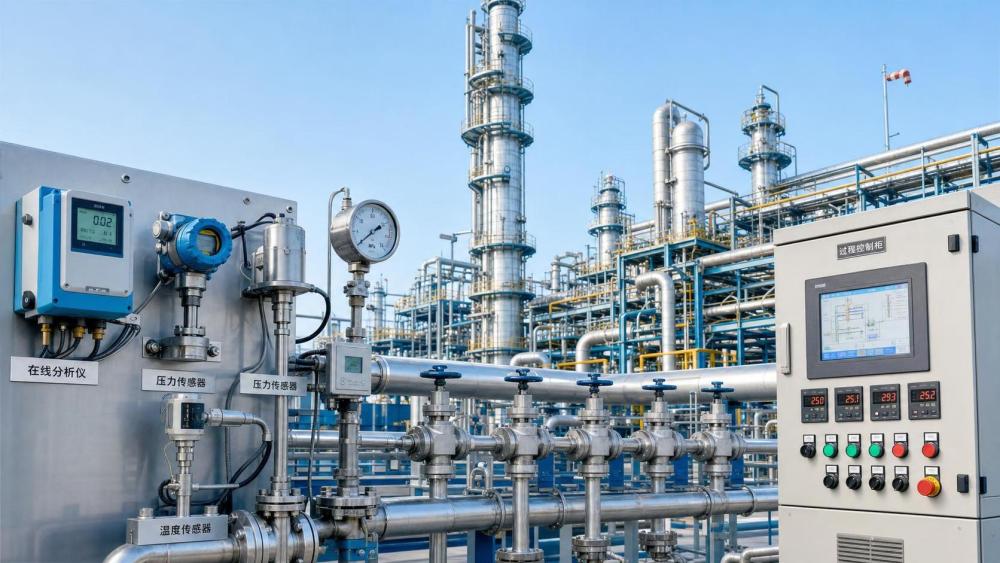
A refinery unit can only be controlled as well as it is measured. Before evaluating algorithm quality, check the field layer: transmitter range, impulse line condition, analyzer maintenance, signal filtering, sensor placement, and scan/update timing.
This is where experienced reviewers usually find the hidden cause of yield drift. Temperature may be measured at a point that lags the real process change. Pressure indication may be clean on the screen but noisy enough in the raw signal to drive valve movement. Flow compensation may be missing density or temperature correction where it matters. Online analyzers may be technically available yet routinely bypassed because operators do not trust them.
If the measurement is slow, biased, or unreliable, tighter control settings often make the problem worse.
Check whether manipulated variables have real authority
A controller cannot reduce yield loss if the final control element has no room left to move. This sounds obvious, yet it is one of the most common review misses.
Review valve sizing, stiction, deadband, split-range behavior, actuator response, and normal operating position. A valve parked near fully open or fully closed is a warning sign. So is a loop that oscillates because the valve sticks and then breaks free. In a refinery, that kind of behavior shows up quickly in furnace firing, reflux control, reactor feed, compressor recycle, and pressure control around separation equipment.
When the manipulated variable lacks authority, operators usually compensate by widening targets or running with extra cushion. That cushion is often the hidden cost in both yield and energy.
Separate basic regulatory control from constraint control
Not every refinery process problem needs advanced process control, but every serious review should distinguish between two jobs. One is keeping the process stable second by second. The other is pushing the unit as close as practical to economic or safety limits without crossing them.
If the base layer loops are poorly tuned, badly cascaded, or constantly in manual, higher-level optimization will not hold. On the other hand, if the base layer is solid and the unit still runs well away from constraints, there may be value in multivariable control, inferential quality control, or better constraint handling.
Treat alarm load and trip margin as part of process control performance
Technical evaluators sometimes separate safety systems from process control too early. That creates a blind spot. A unit that frequently surges toward interlocks, relief conditions, high-high levels, or compressor recycle limits is already telling you the process control layer is not doing enough.
You do not need to invent new safety thresholds to review this well. Check trend history around upsets. See how quickly the process returns after a disturbance. Look for repeated approach to shutdown conditions, alarm floods during rate changes, and operating procedures that rely on manual intervention to prevent escalation. Those are signs that safety risk is being managed by operator workload rather than by robust control.
Review time scales carefully
Refinery units mix very fast and very slow dynamics. Pressure can move in seconds. composition and quality may reveal themselves much later. Problems appear when the control strategy treats these as if they belong on the same clock.
Ask whether the tuning, filtering, sampling, and override logic match the process time scale. Over-filtered measurements may look smooth but respond too late. Aggressive tuning on a slow variable can create cycling that spills into product quality. Delayed inferentials may still be useful, but only when paired with fast secondary indicators that keep the process centered between updates.
Do not ignore operator interaction
A control strategy that works only when one experienced console operator is on shift is not a strong strategy. Check setpoint discipline, mode switching logic, override transparency, and the quality of control room displays. Operators should be able to tell which constraint is active, why a target moved, and which action will actually help.
One practical test is to review what happens during startup, feed change, or equipment degradation. If the unit quickly falls back to manual workarounds, the process control design may be adequate for steady state and weak everywhere else.
Use a tighter review sequence
When you are comparing refinery control approaches, review them in this order:
- Identify where yield is being lost or where the unit repeatedly approaches unsafe operating conditions.
- Confirm the controlled variable, manipulated variable, and operating constraint for each critical function.
- Validate instruments, analyzers, and final control elements before judging the software layer.
- Check whether disturbances are measured early enough to matter.
- Review trends from normal operation, transitions, and upset recovery, not just design intent.
That sequence usually gets to the truth faster. In refinery technology process control, the best design is not the one with the most features. It is the one that keeps the unit closer to its real operating target, with less giveaway, fewer surprises, and more distance from the conditions that turn instability into safety exposure.
Related News
- 00
0000-00
Virgin vs Recycled Resin: How to Switch Without Disrupting Production? - 00
0000-00
Why Bio-Based Plastics Still Have to Prove Themselves on the Molding Floor - 00
0000-00
Industrial decarbonization targets slip when baselines are weak - 00
0000-00
How to evaluate upstream energy systems suppliers for project reliability - 00
0000-00
What should companies assess before selecting sustainable energy developers?
Related tags
Weekly Insights
Stay ahead with our curated technology reports delivered every Monday.