




Which energy-saving upgrades cut injection molding power use most?




Which Energy-Saving Upgrades Cut Injection Molding Power Use Most?
For technical evaluators, injection molding energy saving is not a matter of choosing the machine with the lowest nameplate power. The meaningful question is where electricity is being consumed during an actual production hour: holding pressure, screw recovery, barrel heating, mold cooling, material drying, chilled-water circulation, compressed air, and the periods when equipment is powered but not producing good parts.
That distinction matters because the largest opportunity is not always inside the press. A modern all-electric or servo-hydraulic machine may be highly efficient, yet a poorly controlled dryer or an oversized constant-speed chiller can erase much of the benefit at plant level. Conversely, replacing an older hydraulic press can be the most compelling upgrade where long holding times, frequent mold movement, and broad production variation keep the hydraulic system working hard.
The right priority depends on machine age, resin family, part geometry, cycle time, tooling condition, and local electricity cost. Still, several upgrades consistently deserve attention because they address the highest and most controllable loads.
Start with a load profile, not an equipment shortlist
Before approving a retrofit, measure energy per kilogram of acceptable parts and energy per production cycle. The latter helps reveal whether a process is consuming power during a specific event, such as plastication or cooling; the former prevents a misleading result when shot weight, scrap rate, or uptime changes. Separate press consumption from auxiliaries wherever practical. A single main meter is useful for a first look, but it rarely tells an evaluator whether the machine, dryer, cooling loop, or downstream handling system is driving the bill.
Look at the production schedule as well. A press running one stable medical component around the clock has a different improvement path from a job-shop machine changing molds several times per week. In high-mix production, idle and warm-up energy can be material. In continuous production with a demanding engineering resin, heater control and drying may carry more weight than clamp movement.
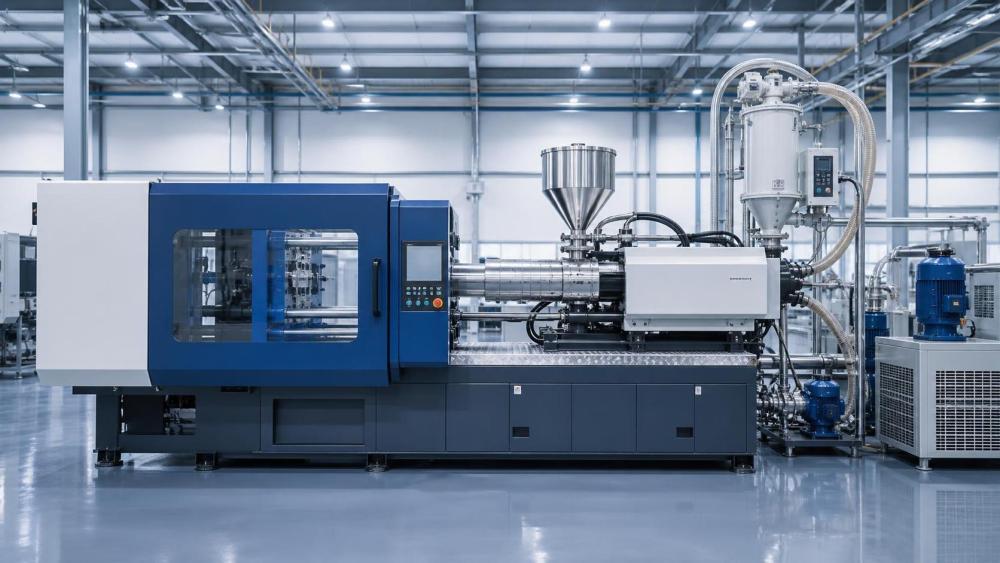
Servo hydraulics and all-electric presses usually offer the largest press-side reduction
On conventional hydraulic machines, a fixed-speed motor and pump may continue drawing substantial power even when the process needs little hydraulic flow. Replacing this arrangement with a servo motor and variable-displacement or servo-driven pump allows output to follow demand. During lower-demand parts of the cycle, the system can slow substantially rather than circulating oil at a largely constant rate.
This upgrade is particularly worth evaluating on older hydraulic presses with variable cycles, extended cooling periods, intermittent mold movement, or processes that do not require continuous high hydraulic output. It can also reduce hydraulic oil heating, which may lessen the burden on oil cooling. But it is not an automatic fit. A retrofit must be checked against response requirements, pump sizing, valve condition, controller integration, and service support. A worn hydraulic circuit can mask the expected benefit until leakage, unstable pressure, and valve performance are addressed.
For a new-machine decision, all-electric injection molding machines merit close comparison where their force range, injection performance, mold compatibility, and part-quality requirements fit the application. Their axes consume energy mainly when moving, and their repeatability can be valuable for tight-tolerance products. The trade-off is practical rather than ideological: some applications, molds, and operating environments may still favor hydraulic or hybrid configurations. Compare actual cycle requirements, not only the machine category.
Heating upgrades matter most when they improve control, not just insulation
Barrel heaters are an obvious target because they are visible and easy to specify, but the buying decision should go beyond “energy-saving bands.” Insulated barrel heaters can reduce outward heat loss and improve operator comfort around the barrel. Their value is normally greatest on machines with long heating times, high setpoints, poorly insulated existing bands, or production patterns with frequent starts and stops.
The larger process question is whether each barrel zone is accurately controlled. A drifting thermocouple, loose heater band, damaged insulation blanket, or poorly tuned temperature loop can cause heaters to cycle inefficiently while also creating melt-temperature variation. That variation can show up later as inconsistent viscosity, weight variation, sink marks, flash, or reject parts. Saving electricity while increasing scrap is not a saving.
For resin-sensitive work, verify the permitted processing window with the material supplier’s documentation and validate changes with melt temperature, cushion consistency, recovery time, and part inspection. Lower barrel settings are not automatically more efficient if they force longer recovery or compromise melt homogeneity.
Cooling-system control is often the overlooked plant-level opportunity
Cooling can represent a major electrical load, especially when a facility uses central chillers, cooling towers, pumps, and multiple mold-temperature circuits. Constant-speed pumps and fans are common candidates for variable-frequency drives because flow demand is rarely identical across all tools and shifts. A properly designed variable-speed system can reduce unnecessary pumping and fan energy while retaining the flow and pressure needed at the mold.
The caution is important: reducing flow without understanding mold cooling can lengthen cycle time or create uneven shrinkage and warpage. Review supply and return temperatures, pressure drop, circuit balance, actual flow at the mold, and cooling-time stability. If a tool has scaled passages, blocked bubblers, or poorly balanced circuits, a new VFD will not correct the underlying thermal problem.
Where chilled water is used, assess whether supply temperature is lower than the process requires. Over-chilling may consume more energy and increase condensation risk without improving the molded part. The practical target is stable mold temperature at the shortest validated cycle, not the coldest available water.
Do not ignore drying, compressed air, and idle operation
For hygroscopic materials, drying is a quality requirement, not an optional utility. Yet dryers are often selected conservatively and left operating at a fixed setting regardless of throughput. Assess drying hopper size, actual resin residence time, regeneration behavior, dew-point control where relevant, and whether the dryer is heating material that will not be processed soon. Material conveying losses and uninsulated hot-air paths should also be examined.
Compressed air deserves the same scrutiny. It is frequently used for part ejection, valve actuation, cleaning, and conveying, but leaks and excessive pressure are expensive habits. If pneumatic blow-off is used to solve a sticking-part problem, investigate ejector design, draft, venting, mold surface condition, and static control before treating additional air capacity as the answer.
Idle-energy controls can be surprisingly relevant in plants with frequent interruptions. Automated standby modes, defined barrel-temperature reductions, and disciplined shutdown procedures can help, provided restart time and resin degradation risks are understood. Some materials cannot simply remain at processing temperature while production waits for a tooling adjustment or quality hold.
A practical ranking for upgrade decisions
Build the business case around verified production conditions
A credible injection molding energy saving proposal should include baseline metering, production volume, reject rate, cycle time, maintenance status, expected downtime for installation, and the impact on spare parts and controls support. It should also distinguish peak demand from total energy use, particularly where utility tariffs make demand charges significant.
When comparing suppliers, technical teams should request the operating assumptions behind any energy claim: material, shot size, cycle, mold temperature, hydraulic demand, and which auxiliaries are included. A machine-only figure cannot be treated as a whole-cell result. Structured resources that combine injection molding equipment specifications with polymer processing guidance, supplier references, and market information—such as those organized by GEMM—can make that comparison less dependent on brochure language.
In most plants, the strongest first move is not a universal answer. Meter a representative press and its auxiliaries, identify the dominant load, then validate one upgrade against part quality and cycle stability. That discipline usually prevents the common mistake of buying a visible energy-saving device while the real loss remains elsewhere in the molding cell.
Related News
- 00
0000-00
Which sectors are driving demand in the chemical engineering market? - 00
0000-00
How to assess lifecycle emissions from CCUS for low-carbon cement - 00
0000-00
How do energy storage technologies compare for 8-hour discharge? - 00
0000-00
Do mill test reports prove industrial alloys meet ASTM standards? - 00
0000-00
How to verify plastic recycling system suppliers' throughput claims
Related tags
Weekly Insights
Stay ahead with our curated technology reports delivered every Monday.