




Repair Costs to Check Before Buying a Used Sheet Extrusion Line




A used sheet extrusion line can look inexpensive until the inspection reveals a worn screw and barrel, damaged polishing rolls, or controls that cannot be supported. The purchase price is only the starting point. Procurement should compare the cost of delivering a line that makes saleable sheet—not merely a machine that starts and turns.
The repair items to investigate are the plasticizing unit, gearbox, die, roll stack, electrical controls, and downstream equipment. Installation and commissioning need separate allowances. Before negotiating, define the intended resin, sheet width, thickness range, output requirement, and acceptance criteria. Without that specification, a seller’s demonstration may prove very little about suitability for your production.
Separate wear from a process mismatch
A repair restores an existing capability; a conversion creates a different one. This distinction matters when comparing used PP, PE, ABS, or PS sheet lines. A machine’s previous resin and product history provide useful evidence, but they do not establish that its screw configuration, cooling capacity, die, and downstream equipment suit the next application. Extrusion performance depends on the interaction between material, equipment design, and operating conditions.[1]
When evaluating an extrusor ocasión listing for a used sheet line, treat the advertised material range as a starting point for verification. Request the equipment configuration, serial numbers, available drawings, and production records. Confirm what is included: dryer where required, loader, screen changer, melt pump if fitted, temperature-control units, roll stack, haul-off, trimming equipment, and winder or cutter.
Classify every proposed expense as wear repair, application conversion, missing equipment, or installation work. Otherwise, a seemingly attractive repair quotation can conceal a much larger project. A replacement screw, for example, needs to be specified for the intended process rather than copied automatically from the existing component.
Screw, barrel, and drive: price the complete repair
Ask for documented screw and barrel measurements taken by a qualified specialist, including the measurement locations and the relevant manufacturer’s limits. A visual inspection can reveal scoring or obvious damage, but it cannot establish operating clearance. Screw and barrel wear can affect conveying, melting, and process stability; the consequences depend on the resin and operating conditions.[1]
Do not accept “the screw was rebuilt” as a complete maintenance record. Establish what work was done, when it was completed, and whether inspection reports remain available. A rebuilt screw paired with a worn barrel may leave a substantial unresolved expense.
A usable repair quotation should identify:
- Whether screw repair, replacement, barrel relining, or barrel replacement is proposed.
- Removal and refitting labor, including access and lifting requirements.
- Inspection of heaters, thermocouples, cooling arrangements, and feed-throat condition.
- Replacement-part specification, delivery time, and post-repair checks.
Evaluate the gearbox, motor, coupling, and thrust-bearing arrangement as a connected drive system. Request maintenance history and have a competent technician assess leakage, abnormal noise, vibration, and temperature during an appropriate running test. A motor operating without material does not demonstrate the drive’s condition under production load.
If a major drive component is questionable, obtain a specialist assessment before agreeing on price. The exposure includes removal, alignment, commissioning, and delay—not just the quoted replacement part. Where the condition cannot be established, record an unresolved liability rather than assigning an optimistic repair allowance.
Die and roll-stack damage can become a product-quality expense
The flat die and polishing rolls deserve close inspection because defects in these components may affect the sheet surface or thickness profile. Die condition, melt distribution, roll geometry, and cooling all influence sheet formation; a visible defect should therefore be investigated rather than attributed automatically to one component.[2]
Inspect accessible die lips for nicks, corrosion, damaged adjustment hardware, and signs of previous repair. Ask whether the die can be opened for specialist examination. Cleaning contamination, repairing a lip, and correcting damage inside the flow channel are different jobs, with different costs and delivery times.
For the roll stack, request inspection of roll surfaces, bearing condition, alignment, rotary unions, and the heating or cooling circuit. Scratches, pitting, coating damage, or geometric errors may require specialist assessment. Do not assume that refinishing is possible without checking the remaining dimensions and the manufacturer’s requirements.
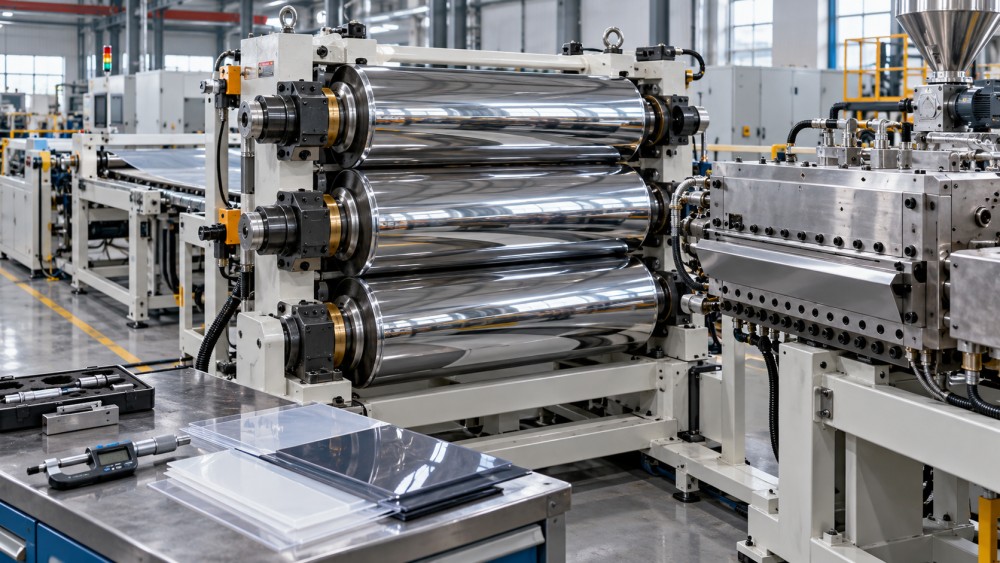
The intended product changes the purchasing decision. Sheet for demanding visual applications may justify tighter surface acceptance criteria than an opaque utility product. A demonstration using forgiving material can hide limitations relevant to the buyer’s actual work. Specify the required finish, usable width, thickness profile, and downstream processing needs before asking whether a die or roll is “good enough.”
Request itemized quotations for cleaning, repair, refinishing, replacement, transport, and reassembly. Specialist repair lead times can also determine whether the line meets the planned production date.
Controls and auxiliaries: small omissions can enlarge the project
An older electrical cabinet is not automatically a reason to reject a line. Unsupported or undocumented controls, however, create uncertainty. Record PLC, HMI, drive, and temperature-controller model numbers. Ask for electrical drawings, program backups, passwords where transferable, software requirements, and evidence that replacement hardware remains available.
A functioning screen does not prove that the buyer can recover from a controller failure. Have a controls specialist distinguish between replacing an individual device and migrating the control system. A migration quotation should address programming, wiring changes, instrumentation compatibility, documentation, and commissioning—not hardware alone.
Inspect auxiliaries against the intended process rather than the seller’s equipment list:
Check physical compatibility as well. A functioning winder may still be unsuitable for the required roll format, and a cutter may not match the planned production method. These are conversion costs, not necessarily evidence of defective equipment.
Make the running trial answer a purchasing question
A useful trial tests the proposed production duty. Agree in writing on the resin, target sheet dimensions, operating conditions, sampling method, and evidence to be retained. If the intended material cannot be tested, document the limitation and avoid treating a substitute-material run as equivalent acceptance.
Observe the line after operating conditions have stabilized, rather than accepting a short startup demonstration. Record output, motor load, available melt-pressure readings, temperature settings and readings, roll conditions, and sheet measurements. Retain labeled samples from agreed positions across the width and at agreed points during the trial.
The purpose is to connect machine condition to saleable output. Ask whether the line holds the required thickness profile, produces acceptable surfaces, and winds or cuts the sheet satisfactorily. Record interruptions, adjustments, and scrap instead of reporting only the best sample.
A successful trial does not replace dimensional inspection of wear components. Conversely, a poor trial does not establish that every major assembly needs replacement. Process setup, material condition, instrumentation, and mechanical wear may produce overlapping symptoms.[1][2] Use the results to direct further inspection and quotations.
If the line cannot be run, mark performance as unverified. Procurement can then require additional evidence, negotiate a clearly allocated repair responsibility, or decline the purchase if the unresolved exposure exceeds the available budget.
Keep safety assessment and relocation outside the repair guesswork
Do not treat a seller’s production video as evidence of safe operation. Before any intrusive inspection, qualified personnel should establish the applicable isolation procedure. In the United States, OSHA’s control-of-hazardous-energy requirements address servicing and maintenance where unexpected energization, startup, or release of stored energy could cause injury.[3] The relevant requirements elsewhere must be checked for the installation location.
Budget for a competent assessment of guarding, access to nip points, electrical condition, and safety-related control functions. OSHA’s general machine-guarding rule identifies ingoing nip points and rotating parts among the hazards requiring protection in covered US workplaces.[4] That reference is not a conformity determination for a particular line, and a working emergency-stop button is not a complete safety assessment.
Relocation also needs its own scope. Identify who drains and disconnects equipment, labels wiring and pipework, protects exposed surfaces, provides lifting arrangements, and records alignment references. Confirm the receiving site’s electrical supply, floor and foundation requirements, cooling-water arrangements, access, and available space with appropriate specialists.
Request separate prices for dismantling, packing, transport, unloading, installation, and recommissioning. Combining them into an unspecified “moving allowance” makes competing offers difficult to compare.
Turn inspection findings into a defensible offer
Build an acquisition budget with separate lines for purchase, verified repairs, application conversions, missing equipment, relocation, commissioning, and unresolved risks. Base repair entries on written quotations wherever possible. An unsupported percentage contingency is not a substitute for investigating an expensive unknown.
For each significant finding, record the evidence, proposed remedy, responsible party, quotation scope, delivery time, and acceptance check. Keep confirmed defects separate from suspected problems. This makes it easier to decide whether a seller’s discount actually covers the work being transferred to the buyer.
Commercial terms should identify included equipment, permitted inspections, agreed trial conditions, responsibility for dismantling damage, and the basis for acceptance. If the seller completes repairs, specify the records and tests required afterward. “Reconditioned” is too broad to define a measurable obligation.
The strongest candidate is not necessarily the line with the fewest visible faults. It is the line whose condition, application fit, repair scope, and commissioning requirements can be established within the buyer’s budget and schedule. When an essential assembly remains uninspectable or an obsolete control system has no credible recovery plan, that uncertainty belongs in the purchase decision—not in a future maintenance budget.
Sources
[1] Chris Rauwendaal, Polymer Extrusion, Hanser. Technical reference for extrusion equipment, screw design, wear, and process troubleshooting.
[2] Harold F. Giles Jr., John R. Wagner Jr., and Eldridge M. Mount III, Extrusion: The Definitive Processing Guide and Handbook, William Andrew. Technical reference for extrusion processing, sheet equipment, and product-quality troubleshooting.
[3] US Occupational Safety and Health Administration, 29 CFR 1910.147, The Control of Hazardous Energy (Lockout/Tagout).
[4] US Occupational Safety and Health Administration, 29 CFR 1910.212, General Requirements for All Machines.
Related News
- 00
0000-00
Are sodium-ion batteries suitable for cold-climate energy storage? - 00
0000-00
How to use an application compatibility guide before an OS upgrade - 00
0000-00
How overcapacity shapes the ferrous metallurgy market outlook - 00
0000-00
How do EU allowances differ from other carbon assets in Europe? - 00
0000-00
Can a digital supplier discovery platform verify overseas suppliers?
Related tags
Weekly Insights
Stay ahead with our curated technology reports delivered every Monday.