




Can Recycled Plastics Meet Food-Contact Safety Requirements?




Can Recycled Plastics Meet Food-Contact Safety Requirements?
Can recycled plastics meet food-contact safety requirements? Yes, but only when collection, sorting, decontamination, testing, traceability, and regulatory authorization work together as one controlled system.
For packaging buyers and manufacturers, recycled content is not automatically a food-contact risk. The decisive question is whether a specific material, process, and application meet applicable rules.
Food-contact recycled plastic must demonstrate that contaminants from previous use, collection streams, inks, adhesives, cleaners, or misuse cannot migrate into food at unsafe levels.
That requirement changes procurement decisions. Buyers must assess more than recycled-content percentage, price, color, and mechanical performance before approving material for bottles, trays, films, caps, or containers.
Can Recycled Plastics Meet Food-Contact Safety Requirements in Practice?
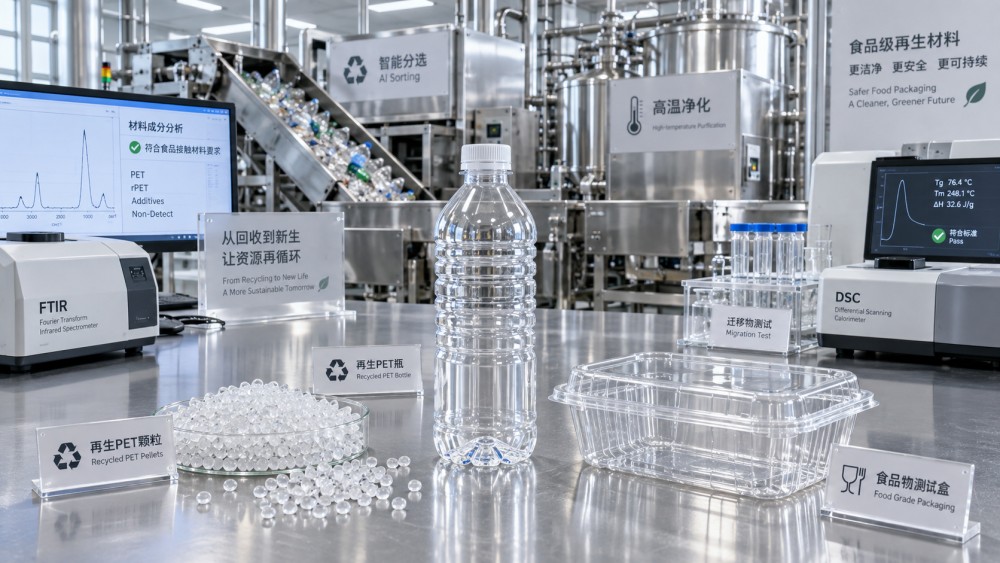
Recycled plastics can meet food-contact safety requirements when they originate from suitable feedstock and pass through validated recycling processes designed to remove possible chemical contamination effectively.
Post-consumer recycled PET is currently the most established example. It is widely used in beverage bottles because collection systems, sorting methods, and decontamination technologies are relatively mature.
Other polymers, including recycled HDPE, PP, and PS, may be appropriate for selected food-contact uses, but their approvals, exposure conditions, and supply-chain controls differ significantly.
The practical answer therefore is conditional rather than universal. A recycled resin cannot be judged safe solely by polymer identity or by a supplier's recycled-content claim.
Food-contact compliance is application-specific. A resin suitable for dry-food packaging may not be suitable for hot-fill products, fatty foods, microwave use, repeated use, or infant-food applications.
Regulators evaluate both the material and the process. They examine input quality, operational controls, contaminant removal performance, intended use, and the probability of migration into food.
For business teams, this means that a compliant recycled grade should arrive with technical documentation, regulatory support, process identification, and clearly defined limits on intended applications.
Using an unverified recycled resin can create serious consequences, including rejected packaging, customer complaints, product recalls, regulatory action, disrupted supply contracts, and long-term reputational damage.
Why Food-Contact Safety Is Harder for Recycled Resin
Virgin plastics are manufactured from controlled raw materials under defined production conditions. Recycled plastics may have encountered unknown substances before entering a recycling stream.
Potential contamination can come from non-food packaging, household chemicals, automotive fluids, pesticides, cosmetics, pharmaceuticals, labels, printing inks, or incorrectly sorted waste items.
Recycling can also introduce contaminants through grinding, washing, storage, transport, reprocessing equipment, additives, lubricants, or accidental mixing between polymer streams during material handling.
Not every detected substance creates an unacceptable safety concern. Risk depends on the chemical identity, concentration, migration behavior, food type, contact time, and temperature.
Fatty foods can absorb certain organic compounds more readily than dry foods. High temperatures and long storage periods can also increase migration from packaging into food.
Odor is another operational indicator, although it is not a complete safety test. Persistent odor may signal contamination, degradation, or insufficient removal of volatile compounds.
Color variation and black specks primarily affect appearance, but they may also indicate inconsistent feedstock control. Visual quality should support, not replace, chemical compliance assessment.
The central safety objective is to reduce potential contamination to levels that do not pose a risk under the packaging's realistic and intended conditions of use.
Feedstock Control Is the First Compliance Gate
Safe food-contact recycling begins before the recycler receives material. Collection sources strongly influence whether a recycling process can consistently produce suitable feedstock for food applications.
Closed-loop systems provide the strongest starting point. For example, used beverage bottles collected through deposit schemes usually offer more predictable input than mixed municipal waste.
Food-grade source material reduces uncertainty, but it does not eliminate the need for validated recycling. Consumers can still misuse containers or place unsuitable materials into collection systems.
Sorting technology typically combines manual inspection, near-infrared identification, density separation, metal removal, color sorting, and automated rejection systems to improve polymer purity.
Buyers should ask suppliers how they control PVC, polyolefins, multilayer materials, metals, paper, silicone, labels, dark plastics, and non-target polymers in incoming bales.
Material specifications should define allowable contamination limits. A broad statement such as “high purity” is insufficient unless the supplier identifies testing frequency, methods, and acceptance thresholds.
Traceability should connect finished pellets to collection regions, incoming bale batches, sorting records, process conditions, laboratory results, and shipment documents throughout the supply chain.
When feedstock varies sharply across regions or seasons, purchasers should expect greater variation in color, odor, processing stability, contaminant profiles, availability, and qualification effort.
How Decontamination Processes Make Recycling Possible
Mechanical recycling typically includes sorting, size reduction, washing, separation, drying, extrusion, filtration, pelletizing, and sometimes solid-state treatment or vacuum-assisted decontamination.
Each step has a distinct purpose. Washing removes residues, filtration removes physical particles, and high-temperature vacuum or gas-treatment stages can reduce absorbed volatile contaminants.
For recycled PET, super-clean processes often use high heat, vacuum, residence time, and controlled gas flow to remove surrogate contaminants from flakes or pellets.
Process validation matters more than equipment labels. Two recyclers may use similar machinery yet achieve different safety performance because operating temperatures, residence times, and controls differ.
A validated process must be run within approved parameters. Changes to feedstock composition, throughput, equipment configuration, wash chemistry, or temperature may require renewed technical assessment.
Chemical recycling can potentially provide another route. Some technologies depolymerize plastics into feedstocks that are purified before producing new polymer with virgin-like characteristics.
However, chemical recycling claims require careful review. Buyers should understand the process boundary, mass-balance method, actual recycled input, certification model, and regulatory status of output.
Neither mechanical nor chemical recycling is inherently suitable for every project. The better choice depends on polymer type, food-contact use, available supply, cost, emissions, and approval pathway.
What FDA and EU Food-Contact Rules Require
In the United States, food-contact materials are regulated under the Federal Food, Drug, and Cosmetic Act and related Food and Drug Administration requirements.
The FDA may issue letters of no objection for recycled plastic processes following voluntary submissions. These letters address a process and specified conditions, not every possible application.
An FDA no-objection letter usually identifies the input material, recycling process, intended food-contact use, temperature conditions, and any limitations relevant to the safety conclusion.
In the European Union, recycled plastic food-contact materials are governed by specific legislation alongside broader rules for plastic food-contact materials and good manufacturing practice.
EU compliance commonly involves authorization of recycling technologies or processes, depending on the regulatory framework, feedstock category, application, and date of market placement.
European Food Safety Authority opinions often assess challenge-test data, decontamination efficiency, input control, and whether residual contamination remains below a defined safety threshold.
Other markets, including the United Kingdom, Canada, Japan, China, and Gulf countries, may apply different rules. Global projects require jurisdiction-specific regulatory review before commercialization.
Compliance in one region does not automatically establish compliance elsewhere. Procurement teams should avoid assuming that a certificate, FDA letter, or EU authorization has universal applicability.
Which Tests and Documents Should Buyers Request?
A supplier questionnaire should begin with polymer type, recycled-content percentage, source classification, recycling process name, manufacturing site, annual capacity, and intended food-contact applications.
Request the regulatory basis for food-contact use, including authorization references, no-objection letters, declarations of compliance, migration data, and documented application restrictions where applicable.
Technical data sheets should cover melt flow rate, density, intrinsic viscosity for PET, moisture, ash, color, odor, volatile content, contamination limits, and mechanical properties.
Migration testing may assess overall migration and specific migration of relevant substances. Test conditions should reflect the food category, contact duration, temperature, and packaging geometry.
Challenge testing is especially important for recycling process validation. It intentionally introduces selected surrogate contaminants to measure how effectively the process removes them.
Suppliers should explain why chosen surrogates represent potential contaminants. A robust study considers compounds with varying volatility, polarity, molecular size, and affinity for the polymer.
Ask whether testing is performed by accredited laboratories and whether results represent routine production. A single historical report may not demonstrate continuing process control.
Documentation should also include change-control procedures. Buyers need notice when suppliers alter feedstock sources, production lines, additive packages, process conditions, or regulatory classifications.
How to Match Recycled Plastic Grades to Food Applications
Beverage bottles are often the clearest route for recycled PET, particularly where approved bottle-to-bottle systems and established deposit-return collection infrastructure are available.
Thermoformed trays may require careful assessment because material can face heat during forming, sealing, storage, reheating, or contact with fatty and acidic foods.
Films create additional complexity. Multilayer structures, tie layers, inks, adhesives, barriers, and recycled-content placement all influence whether the final package meets food-contact obligations.
For sensitive uses, manufacturers may place recycled material behind a functional barrier. The barrier must be demonstrated to prevent unsafe migration under actual use conditions.
Dry foods, short-contact applications, and secondary packaging may offer easier initial opportunities than high-temperature, long-storage, fatty-food, or repeated-use applications.
Caps and closures require separate review because they may use different polymers, additives, colorants, and molding conditions than the main bottle or container body.
Food-contact approval should include conversion conditions. High extrusion temperatures, residence times, drying methods, and masterbatch additions can affect odor, degradation, and migration performance.
Commercial teams should define the application before selecting the grade. Starting with a recycled-content target and searching for any available resin often creates avoidable qualification delays.
Managing Cost, Supply, and Commercial Risk
Food-contact recycled resin may cost more than general-purpose recyclate because it requires controlled feedstock, validated decontamination, testing, documentation, and stable quality management systems.
That premium should be evaluated against wider business value, including recycled-content commitments, retailer expectations, packaging taxes, customer requirements, and reduced exposure to regulatory scrutiny.
Supply availability can be constrained by collection rates, competing demand, regional recycling capacity, bottle-grade feedstock availability, and specifications requiring clear or light-colored material.
Dual sourcing can reduce disruption, but only after each supplier and grade is separately qualified. Equivalent polymer names do not guarantee identical food-contact compliance or processing behavior.
Long-term contracts should specify recycled-content methodology, compliance responsibilities, change notification, test-data access, claims substantiation, delivery tolerances, and remedies for nonconforming materials.
Procurement should distinguish physical recycled content from mass-balance claims. Both may support circularity goals, but they communicate different material attributes and require transparent customer communication.
Quality teams, regulatory specialists, converters, brand owners, and recyclers should jointly approve material changes. Food-contact decisions should not be made by purchasing alone.
A staged qualification program often works best: laboratory review, sample trials, migration assessment, pilot production, shelf-life validation, supplier audit, and controlled commercial launch.
Common Mistakes When Evaluating Food-Grade Recycled Plastics
The most common mistake is treating recycled content as a simple sustainability specification. Food-contact suitability is a regulatory and technical decision requiring documented evidence.
Another mistake is relying on generic statements such as “food safe” without checking the specific polymer, recycling process, production site, application, and geographic market.
Some buyers focus only on recycled-content percentage. Higher percentages may be desirable, but they can increase processing, color, odor, supply, and qualification challenges.
Ignoring the final package structure can also cause failure. A compliant recycled resin may become unsuitable when combined with unreviewed inks, adhesives, additives, or barrier layers.
Companies sometimes assume that certification alone removes their responsibility. Brand owners and converters still need to verify intended use, supplier reliability, and recordkeeping obligations.
Testing only the resin may overlook conversion effects. Packaging should be assessed in its finished form when processing, additives, printing, sealing, or storage conditions could alter performance.
Finally, organizations should avoid overclaiming. Environmental marketing statements about recycled content must align with actual material sourcing, certification scope, and applicable consumer-protection rules.
Strong compliance programs convert these risks into a repeatable sourcing advantage. They allow businesses to increase circular content while protecting product safety and customer confidence.
Conclusion: A Practical Decision Framework
Recycled plastics can meet food-contact safety requirements, but compliance is achieved through controlled systems rather than through recycled content alone or broad sustainability claims.
Start by defining the exact food application, market, contact conditions, recycled-content target, and performance requirements. Then evaluate suppliers against those documented technical and regulatory needs.
Prioritize validated feedstock control, proven decontamination efficiency, transparent traceability, relevant authorization, current test data, and formal change-control commitments before approving commercial supply.
For buyers, engineers, and manufacturers, the best question is not whether recycled plastic is generally safe. It is whether this grade is approved for this application.
When that question is answered with reliable evidence, recycled polymers can support circular packaging goals without compromising food safety, compliance obligations, product quality, or market credibility.
- Last One:No more articles
- Next Article:How to evaluate data quality in a recycled plastics databaseOct 06, 2026
Related News
- 00
0000-00
How to evaluate data quality in a recycled plastics database - 00
0000-00
How to assess contamination risk in plastic recycling pellets - 00
0000-00
Can biofuels for industrial boilers reduce fuel costs at high load? - 00
0000-00
How to assess the reliability of offshore drilling safety systems - 00
0000-00
How to verify quality systems at oil and gas industry suppliers
Weekly Insights
Stay ahead with our curated technology reports delivered every Monday.