








For manufacturers and procurement teams, recycled plastic can support sustainability goals, but inconsistent material performance can disrupt production, increase scrap, and compromise finished product quality.
So, is recycled plastic quality consistent across suppliers? Not necessarily: feedstock sources, sorting methods, processing controls, and testing practices can create significant differences between suppliers.
Consistency can also vary between batches from the same supplier. A successful sample therefore demonstrates potential suitability, but does not establish dependable long-term production performance.
The practical question is whether a supplier can repeatedly meet your application requirements. Answering it requires comparable specifications, representative production trials, and documented quality controls.
Why Can the Same Recycled Plastic Grade Perform Differently?
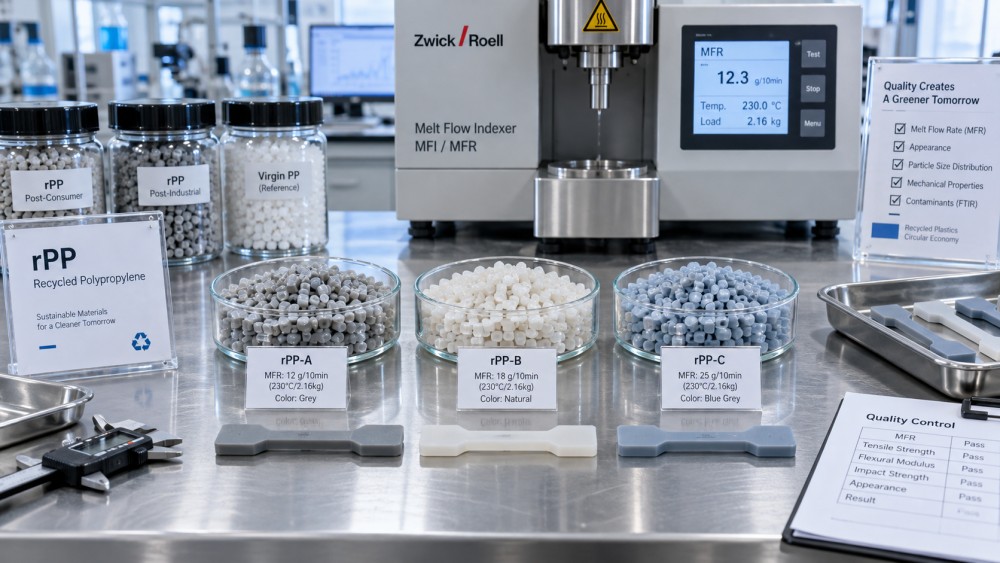
Two suppliers may both describe their material as recycled polypropylene, yet deliver pellets with different flow behavior, impact strength, odor, contamination levels, and thermal stability.
Post-consumer feedstock often combines products with different additives, colors, and service histories. Post-industrial material may be more uniform, but mixed factory scrap can still vary.
A broad source category does not establish quality. Buyers need to understand which waste streams enter the process and how the supplier controls their composition.
Sorting effectiveness determines how much unwanted polymer, metal, paper, or other material remains. Small quantities of incompatible polymers can create defects or weaken finished parts.
Washing removes certain residues, while melt filtration captures particles according to the filtration system. Neither process automatically removes dissolved contaminants, incompatible polymers, or persistent odors.
Processing history also matters. Repeated heat exposure can change molecular structure, while blending, stabilization, and controlled compounding may improve the uniformity of the resulting material.
Suppliers with comparable equipment can therefore deliver different results. Their operating discipline, input acceptance criteria, maintenance practices, and testing coverage all influence the finished resin.
What Does “Consistent Quality” Mean for Your Application?
Consistent quality means staying within an agreed performance window over time. It does not require identical numerical results, provided variation remains acceptable for your process.
The correct window depends on the product. A thick outdoor container, thin packaging film, and load-bearing component expose recycled material to different manufacturing and service demands.
Injection molding buyers may prioritize flow, impact resistance, shrinkage, and appearance. Film producers may place greater emphasis on gels, contamination, melt stability, and sealing performance.
For demanding applications, qualification must address finished product behavior, including aging or chemical exposure where relevant. Resin test results alone cannot establish every service requirement.
Define essential properties before requesting quotations. Otherwise, suppliers may offer technically different materials under similar descriptions, making apparent price comparisons unreliable and difficult to interpret.
Also distinguish consistency from suitability. A supplier can produce a highly repeatable grade that still fails your impact, appearance, regulatory, or processing requirements in practice.
Which Specifications Should Buyers Compare First?
Start with properties that affect your highest-cost failure modes. Specify the test method, conditions, units, and acceptance limits so supplier results can be compared meaningfully.
Melt flow rate is useful, but values measured at different temperatures or loads are not directly comparable. Similar flow results also do not guarantee equivalent toughness.
Mechanical properties require comparable specimen preparation and conditioning. Moisture, molding conditions, specimen geometry, and test speed can materially affect reported strength or impact test results.
Ash content needs context: intentional mineral fillers also contribute to the result. A higher ash value is not automatically evidence of poor sorting or contamination.
Use established methods, such as applicable ISO or ASTM procedures, where appropriate. Referencing a method improves comparability, but does not define an acceptable application limit.
Avoid universal acceptance ranges copied from unrelated products. Set limits using your product requirements, processing capability, baseline material performance, and results from representative qualification trials.
What Evidence Shows a Supplier Can Deliver Consistently?
A technical data sheet usually describes a grade using typical values or stated limits. It may not report the actual properties of the delivered batch.
Request a certificate of analysis linked to the shipment lot. Confirm which properties were measured, which were inferred, and which are only listed as typical.
Ask for historical results across multiple production lots, including observed ranges and rejected batches. A single excellent result provides little evidence about routine manufacturing consistency.
Useful records connect incoming feedstock, processing batches, finished pellets, and shipments. This traceability helps isolate problems and determine whether other deliveries require investigation or testing.
Quality management certification can support confidence in documented systems, but it does not certify that a particular recycled resin meets your application specifications or performance needs.
Recycled-content verification serves a different purpose. It may substantiate sourcing or content claims, while mechanical performance, contamination, and batch consistency still require separate supporting evidence.
For food-contact or other regulated uses, request evidence applicable to the specific material, recycling process, jurisdiction, and intended use. Generic certificates cannot establish universal suitability.
How Should You Qualify a New Recycled Plastic Supplier?
Use a staged qualification process that moves from documentation review to material testing and production trials. Each stage should resolve a specific sourcing or manufacturing uncertainty.
First, give shortlisted suppliers the same application brief and acceptance requirements. Include processing method, intended recycled-content level, appearance expectations, and any relevant end-use compliance requirements.
Next, obtain samples representing routine commercial production. Where feasible, evaluate multiple lots rather than relying on a specially prepared sample that may conceal normal variation.
Test critical properties under comparable conditions, using an independent laboratory when the stakes justify it. Investigate discrepancies before accepting either supplier claims or internal assumptions.
Run production trials using realistic equipment, throughput, drying practices, and blend ratios. Record defects, scrap, cycle time, pressure behavior, downtime, and finished product test results.
Assess the actual formulation you intend to use. Performance at a low recycled-content loading may not predict behavior when the recycled proportion rises substantially in production.
Keep reference samples and trial records for each qualified lot. They provide a baseline when later deliveries change appearance, processing behavior, or finished product performance.
Before scaling purchases, agree on acceptance limits, sampling procedures, rejection handling, and change notification. Qualification becomes more valuable when its findings become enforceable purchasing requirements.
How Can Buyers Control Variation After Approval?
Supplier approval is the beginning of ongoing control. Incoming checks should focus on properties most likely to affect your process, product quality, or compliance obligations.
Use lot identification throughout receiving, storage, and production. Combining unverified deliveries can make a defect harder to trace and increase the volume requiring investigation later.
Match testing frequency to risk and demonstrated supplier performance. Critical applications or recent quality problems justify closer monitoring than stable, less demanding applications do ordinarily.
Track trends as well as pass-or-fail outcomes. Results that remain within limits but drift toward a boundary may signal changing feedstock or deteriorating process control.
Require notification of material changes, including feedstock sources, formulations, production sites, and relevant processing steps. Define which changes trigger review, additional testing, or renewed qualification.
Storage also influences delivered performance. Moisture uptake, dirty handling equipment, or mixed inventory can introduce problems after shipment, even when the supplier originally met specifications.
Qualify backup suppliers independently and trial their materials before substitution. Similar grade names and matching data sheets do not establish interchangeability on your production equipment.
Is the Lowest-Priced Recycled Resin Actually Cheaper?
Compare total production cost rather than purchase price alone. A lower-priced resin may require extra drying, filtration, additives, inspection, or blending to achieve acceptable results.
Scrap and downtime can outweigh a modest purchasing discount. Include lost output, rework, customer complaints, and disposal costs when evaluating the economics of competing materials.
For example, a cheaper material that creates recurring surface defects may reduce saleable output. The relevant comparison is cost per acceptable finished unit produced consistently.
A consistent supplier may also reduce operating uncertainty by limiting adjustments between batches. That benefit matters when production schedules leave little room for troubleshooting or rework.
Compare commercial supply capability alongside technical performance. Capacity, lead times, minimum orders, and feedstock availability determine whether a qualified grade can support your purchasing plan.
Structured industry resources such as GEMM can support initial research into polymer categories, applications, supplier references, and market conditions before buyers request material-specific qualification evidence.
What Should Your Final Supplier Decision Be Based On?
Recycled plastic quality is not automatically consistent across suppliers. Dependable sourcing requires evidence that the chosen grade repeatedly meets the needs of your specific application.
Prioritize application fit, performance across multiple lots, transparent quality records, and workable supply commitments. Treat price as one part of that decision rather than its foundation.
The strongest purchasing position combines a clear specification, successful production trials, traceable deliveries, and agreed change controls. Those measures make recycled plastic sourcing more predictable.