




What Factors Affect Bioprocessing Yield in Small-Scale Plants?




Yield in a small-scale bioprocessing plant is rarely controlled by one setting or one piece of equipment. It is the combined result of how much usable substrate enters the process, how effectively the biological system converts it, how much product survives recovery, and how consistently the plant repeats those conditions from batch to batch.
For operators, the practical question is not simply whether a fermentation or bioconversion “works.” A process can produce an acceptable laboratory result and still deliver poor commercial yield when feedstock varies, oxygen transfer falls short, contamination causes a batch loss, or downstream recovery leaves too much product in the broth. Small plants are especially exposed because they often have less redundancy, more manual handling, and limited tolerance for an off-spec batch.
When evaluating what factors affect bio-processing yield in small-scale plants, it helps to separate the problem into four linked areas: feedstock and inoculum quality, control of the biological environment, equipment and operating discipline, and recovery of the final product. Improving only one area may not improve saleable output if another remains the limiting step.
Feedstock quality sets the upper limit for conversion
Raw material quality is often the first cause to investigate when yields move between batches. Whether the plant uses sugars, starch hydrolysates, agricultural residues, oils, waste streams, or another biological feedstock, the usable composition matters more than the nominal volume purchased.
A feedstock can look consistent on a purchase specification while varying in ways that affect microbial or enzymatic performance. Changes in moisture, sugar profile, particle size, nutrient content, salt loading, pH, inhibitory compounds, or residual processing chemicals can alter conversion rates. A material that is acceptable for one process may suppress the organism or enzyme used in another.
For example, a lignocellulosic hydrolysate may contain fermentable sugars but also compounds generated during pretreatment that slow microbial growth. A waste-derived feedstock may offer a cost advantage, yet its composition can shift with collection practices or upstream production schedules. In both cases, a lower-cost input can produce a higher cost per unit of recovered product if the plant must dilute, detoxify, rework, or discard batches.
Small-scale facilities should therefore define incoming controls around the variables that influence their own biology. This may include checks for solids, pH, concentration of the target substrate, microbial load, and known inhibitors. The purpose is not to create an extensive laboratory program for every delivery. It is to prevent hidden feedstock variation from being misdiagnosed later as an equipment or culture problem.
The inoculum and biological system must be stable before production begins
Yield depends on the condition of the microorganism, cell culture, or enzyme system at the moment it enters the production vessel. An underperforming inoculum can extend lag time, reduce productivity, shift metabolism toward unwanted by-products, or fail to reach the intended final concentration.
In a microbial process, important variables include strain identity, seed age, viability, inoculation rate, storage conditions, and the number of transfers between a master stock and production culture. Repeated informal propagation can gradually introduce variability even when there is no obvious contamination event. The culture may still grow, but it may no longer convert substrate in the same way.
Enzyme-driven processes have a similar issue. Enzyme activity can decline through poor storage, incompatible pH, elevated temperature, shear exposure, or contact with inhibitors in the feedstock. Using the same dosage by mass does not guarantee the same effective activity from lot to lot.
The operational control is straightforward: define a narrow release window for the inoculum or enzyme preparation, record its condition, and connect those records to batch performance. When a yield decline appears, operators can then distinguish biological variation from a failure in process control.
Temperature, pH, and oxygen transfer interact rather than operate independently
Small plants often focus on maintaining a target temperature and pH because these are visible and relatively easy to measure. They matter, but they do not fully describe the environment experienced by the biological system. The interaction among temperature, pH, nutrient availability, mixing, gas transfer, and foam control has a larger effect on final yield.
Temperature influences growth rate, enzyme activity, product formation, and contamination pressure. Running warmer may shorten a cycle, but it can also stress the organism, increase unwanted reactions, or make cooling capacity inadequate during peak metabolic activity. A process temperature that performs well at a laboratory volume may create gradients or heat-removal problems in a production vessel.
pH control has comparable tradeoffs. The setpoint must suit the organism or enzyme, but the method used to control pH also affects the process. Addition of acid or base changes volume, ionic strength, and local concentration around the dosing point. If mixing is weak, the bulk pH reading can look acceptable while cells are repeatedly exposed to short, severe excursions.
For aerobic processes, oxygen transfer is frequently the hidden constraint. Cells need dissolved oxygen, but the useful supply depends on more than the air-flow setting. Agitation speed, impeller design, liquid volume, gas dispersion, vessel geometry, broth viscosity, antifoam use, and filter condition all influence the oxygen transfer rate. As biomass rises, oxygen demand can rise faster than the system can supply it. The resulting limitation may lower productivity, change product selectivity, or create inconsistent end points.
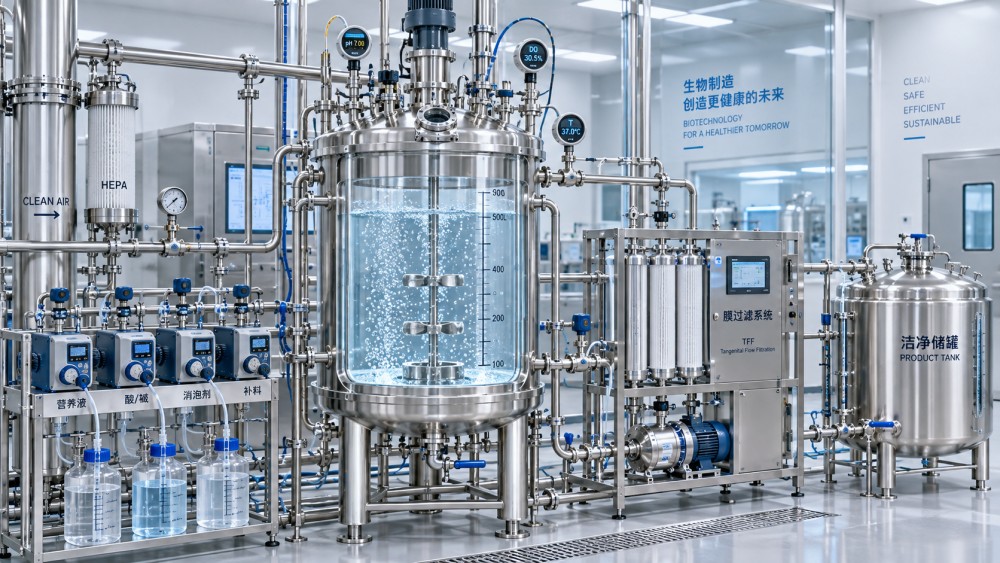
A dissolved oxygen probe is helpful, but it should not be treated as the full answer. Probe calibration, sensor placement, response time, and fouling affect the reading. Operators should look at the process pattern: agitation demand, gas flow, foam behavior, temperature load, substrate consumption, and product formation. A stable dissolved oxygen number achieved only by aggressive late-stage intervention may indicate that the process has little operating margin.
Mixing and vessel geometry can determine whether scale-up assumptions hold
“Small-scale” does not mean hydrodynamics are unimportant. At modest volumes, a vessel can still develop poor circulation zones, uneven solids distribution, gas bypassing, or localized nutrient and pH gradients. These issues become more likely with viscous broths, suspended solids, high cell densities, or materials that settle.
The vessel, agitator, baffles, sparger, and working-volume range must be considered as one system. A reactor that performs well at half volume may not provide comparable mixing near its maximum fill level. Likewise, an impeller suitable for a low-viscosity medium may not produce sufficient circulation once biomass or product concentration increases.
Manual additions are another source of variation. Adding concentrated substrate, antifoam, nutrients, acid, or base too quickly can create temporary local conditions that reduce viability or cause a metabolic shift. A small plant may rely on manual operations for flexibility, but repeatability improves when addition rates, locations, and trigger points are defined rather than left to individual judgment.
Before replacing equipment, it is useful to establish whether the apparent yield problem follows a particular fill volume, agitation limit, product concentration, or batch duration. That pattern often reveals a physical constraint. A larger motor or higher air flow may help, but only if the limitation has been correctly identified.
Contamination does not need to be obvious to reduce yield
A contaminated batch is not always visibly spoiled. Low-level microbial contamination can compete for substrate, consume nutrients, alter pH, create off-target metabolites, or weaken the production organism long before a clear visual change appears. Bacteriophage risks in some bacterial fermentations add another pathway for abrupt productivity loss.
Small plants can be more vulnerable because production, cleaning, seed preparation, sampling, and maintenance may occur in close proximity. Frequent manual connections and sampling events add exposure points. Inadequate cleaning validation, damaged seals, poorly maintained sterile filters, or dead legs in transfer lines can make the problem intermittent and difficult to trace.
A practical contamination-control program focuses on process discipline:
- Use defined cleaning and sterilization procedures for vessels, lines, sampling ports, and transfer equipment.
- Verify the condition of gaskets, valves, filters, and connections that separate sterile and non-sterile areas.
- Control sampling technique and avoid unnecessary opening of the process.
- Trend contamination findings, cleaning deviations, and unexplained changes in growth or yield across batches.
- Separate investigation of biological underperformance from investigation of confirmed contamination, since both can occur at the same time.
The objective is early detection and repeatable prevention, not reliance on a final visual inspection after most of the batch value has already been committed.
Feeding strategy affects both concentration and product quality
Many small-scale processes lose yield because substrate is supplied at the wrong rate rather than because the total amount is insufficient. A large initial dose can cause substrate inhibition, osmotic stress, excessive acid formation, unwanted biomass growth, or overflow metabolism. Underfeeding can slow production and leave expensive vessel time unused.
Fed-batch operation can improve control, but only when the feed profile reflects the actual behavior of the process. A time-based schedule may work under stable conditions and fail when feedstock concentration, inoculum strength, or oxygen transfer differs. In some processes, feeding is better tied to a measurable response such as pH demand, dissolved oxygen trend, off-gas behavior, substrate measurement, or biomass development.
There is also a tradeoff between maximum titer and total process economics. Pushing for the highest possible concentration can increase viscosity, oxygen demand, downstream difficulty, and batch duration. The best operating point is often the one that produces the most recoverable product per unit of plant time and input cost, not the one with the highest number in the reactor.
Downstream recovery can turn a good fermentation into a disappointing yield
Reactor yield and saleable yield are different measures. A process may produce the desired molecule, biomass, or intermediate efficiently, yet lose a material share during cell separation, filtration, extraction, concentration, purification, drying, or packaging.
This distinction matters particularly in small plants, where downstream systems may be selected for flexibility and modest capital cost rather than optimized recovery. Product can remain in centrifuge solids, filter cake, membranes, extraction phases, hold-up volumes, or cleaning losses. Sensitive products may degrade during heat exposure, extended residence time, pH adjustment, or repeated transfer.
Tracking these measures separately prevents a common mistake: changing fermentation conditions to solve a loss that actually occurs after harvest. Mass balance across the downstream train can show where product is leaving the process and whether a recovery improvement would deliver more value than further optimization of the bioreactor.
Measurement quality determines whether operators can identify the real constraint
Yield improvement depends on data that can be compared across batches. If substrate concentration, biomass, product concentration, pH, temperature, or volume are measured inconsistently, the plant may react to noise instead of a genuine process change.
Small facilities do not need every advanced analytical tool to build a useful operating picture. They do need a consistent batch record that captures raw-material lot, inoculum details, key setpoints, actual operating trends, additions, deviations, harvest result, recovery result, and quality disposition. Calibration and sampling procedures deserve the same attention as the process recipe; an inaccurate measurement can drive a correct process into an incorrect adjustment.
When investigating low yield, compare batches in sequence and look for what changed before asking which variable looks most important in isolation. A drop that begins with a new feedstock lot points in one direction. A decline only at high biomass points elsewhere. Losses that appear after a filtration change should not be attributed to microbial performance without checking the downstream balance.
Where a small plant should focus first
The most productive starting point is usually to define yield in commercial terms and map the batch from incoming feedstock to released product. Identify the expected material balance, then locate the largest recurring loss or source of variation. For one facility, the answer may be inconsistent hydrolysate quality; for another, it may be aeration capacity near the end of fermentation or poor recovery from a membrane step.
Changes should be made one controlled variable at a time where possible. Raising agitation, altering feed concentration, changing inoculum age, and modifying downstream filtration in the same trial can obscure the result even when final output improves. A small plant gains more from a repeatable baseline and disciplined comparison than from frequent broad adjustments.
Bioprocessing yield improves when the biological system, equipment limits, and recovery process are treated as one operating chain. The highest-value questions are therefore practical: Is the feedstock truly usable? Does the organism see stable conditions throughout the batch? Is the plant operating within its mixing and oxygen-transfer limits? And how much product remains after recovery and quality release? Clear answers to those questions provide a stronger basis for process changes, equipment investment, and scale-up decisions.
Related News
- 00
0000-00
Terephthalic Acid CAS 100-21-0: The Technical Checks Behind Stable Polyester Supply - 00
0000-00
What determines biofuel production capacity at commercial scale? - 00
0000-00
How to select industrial chemicals for pulp processing by furnish type - 00
0000-00
What Factors Affect Bioprocessing Yield in Small-Scale Plants? - 00
0000-00
Do Metal Physical Properties Change After Welding?
Weekly Insights
Stay ahead with our curated technology reports delivered every Monday.