




How to Verify Chemical Manufacturing Supplier Certifications




A certificate copy is only a starting point. Verification requires confirming that the document was issued by a legitimate certification body, remains active, covers the actual chemical site and activities, and is relevant to the material being supplied. A supplier may hold a valid management-system certificate while the specific production line, packaging operation, laboratory, or distribution activity falls outside its scope.
Begin with the certificate itself, but treat it as evidence to be tested rather than proof accepted at face value. Record the legal entity name, production address, certificate number, issue and expiry dates, certification body, accreditation mark, stated scope, and standard or scheme named on the document. These details form the basis for every later comparison.
Confirm that the certificate belongs to the operating site
The entity named on a certificate must match the party that controls the relevant manufacturing activity. A group headquarters, sales office, trading subsidiary, warehouse, or affiliated plant can have a similar name without being the source of the chemical. Differences in punctuation, local-language names, legal suffixes, and street addresses deserve review when a material is produced under multiple related entities.
Site coverage matters especially for chemicals produced through several stages. A certificate covering formulation at one location does not automatically cover synthesis at another location. Likewise, a bulk chemical plant may be certified for production while an off-site repackaging facility is excluded. If the supplied material is blended, dried, micronized, filtered, filled into drums, or relabeled elsewhere, identify which site performs each step and whether that activity is within the documented scope.
A useful comparison is between the certificate scope and the commercial description of the material. Broad wording such as “manufacture of chemical products” may be adequate for a general quality-management certificate, but it does not establish capability for a hazardous intermediate, ultra-high-purity reagent, food-contact additive, or controlled-temperature material. The supporting records should show that the relevant process, equipment controls, testing, and release procedures apply to the offered grade.
Validate the issuing and accreditation chain
Certification bodies are not interchangeable. A credible certificate identifies the organization that audited and issued it, and often displays an accreditation mark or reference. Verify the issuer through its official certificate directory or direct written confirmation using independently obtained contact details. Do not rely solely on a telephone number or web address printed on a supplied PDF.
Where an accreditation claim appears, confirm that the certification body is accredited for the relevant management-system or product-certification activity. Accreditation is a statement about the certifier’s competence and oversight within a defined scope; it does not guarantee the quality of every batch from the certified site. Even so, a missing, unverifiable, or mismatched accreditation claim changes the weight that should be assigned to the document.
Directories sometimes show a certificate as expired, withdrawn, suspended, transferred, or issued under a previous legal entity. A recently renewed document can also have a gap between the former certificate’s expiry and the new issue date. Ask for clarification and documentary continuity rather than assuming that a new-looking certificate represents uninterrupted approval.
Read scope statements as operating boundaries
The scope line is often the most misunderstood part of a certification. It identifies the activity assessed, not every product or application that appears in a catalogue. “Production and sale of industrial chemicals” is materially different from “design, manufacture, testing, and packaging of specialty chemical formulations.” The latter indicates a broader assessed process, while neither statement alone proves conformance of a particular product to a customer specification.
Scope should be examined alongside the supplied material’s risk profile:
- For a commodity solvent or base chemical, verify the plant, grade, packaging method, analytical release controls, and traceability between production lot and shipping documents.
- A fine chemical or catalyst may require evidence that impurity controls, change control, sampling, and analytical methods are appropriate for the stated purity and intended reaction conditions.
- For polymers, additives, pigments, and rubber compounds, the certificate scope should be considered with formulation control, batch consistency, contamination prevention, and the handling of recycled or reprocessed feedstock where relevant.
- Materials used in regulated, sensitive, or high-consequence applications often require scheme-specific approvals, declarations, or testing records beyond a general management certificate. A generic certificate should not be used as a substitute for those documents.
Be careful with terms that sound similar but describe different assurance levels. A quality-management system certificate concerns how a site manages defined processes. A product certificate, test report, safety document, inspection record, or regulatory declaration addresses a different question. Treating one as proof of another is a common source of approval errors.
Match validity dates to the transaction and material history
Check whether the certificate was valid when the material was manufactured, released, and shipped, not only when the document was reviewed. This distinction becomes important for stock held over long periods, material transferred between warehouses, and batches manufactured shortly before a suspension or scope change.
Expiry dates also do not always mean the system ceased operating on that day. Certification cycles can include surveillance audits, recertification audits, decisions by an independent review function, and temporary extensions under specific conditions. The relevant question is the certificate status for the exact period in question. An official directory entry or issuer confirmation is more reliable than an informal assurance that an audit is “in progress.”
For recurring supply, establish a controlled renewal review rather than retaining the original certificate indefinitely. A document-control record should link each certificate version to the legal entity, address, scope, validity period, and source used to verify it. This prevents an old file from being carried forward after a location move, ownership change, or modification to the audited activity.
Ask for evidence that connects the certificate to the product
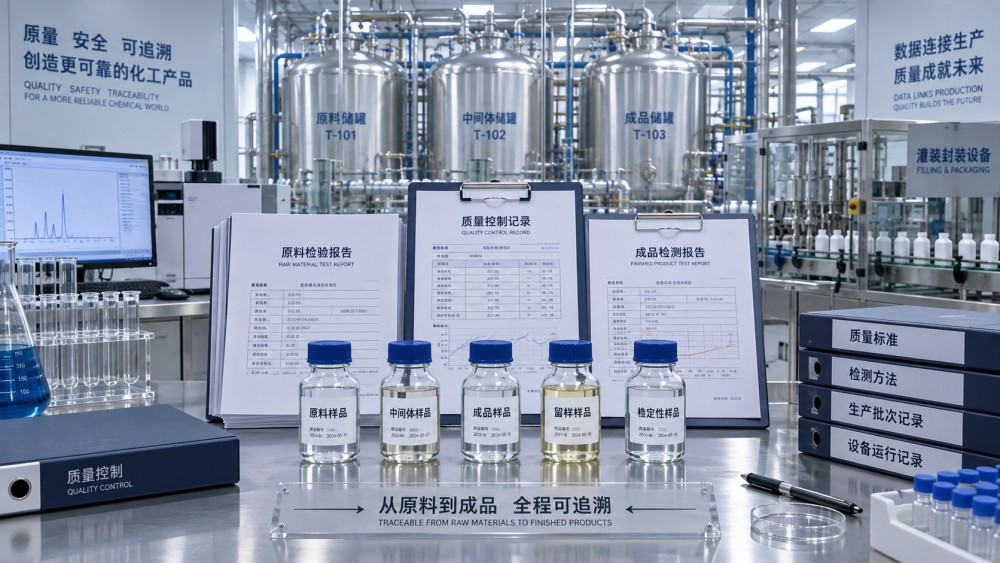
A certification demonstrates a system at a site; it does not identify every delivered batch. Product-level evidence closes that gap. The exact documents needed depend on the chemical and intended use, but records should be mutually consistent rather than individually impressive.
Compare the names, addresses, grade designations, dates, and lot references across these records. A certificate naming one entity, an analysis report naming another, and a shipping document naming a third may be legitimate in a contract-manufacturing or distribution arrangement, but the relationship should be explained and documented. Unexplained inconsistency is more informative than a polished certificate layout.
Review audit evidence without demanding confidential audit reports
Full audit reports commonly contain confidential information and may not be available. That does not prevent meaningful verification. Request an audit summary, certificate-status confirmation, corrective-action closure statement, or a controlled declaration describing the latest audit outcome. The purpose is to understand whether significant findings affected the relevant activity and whether they were closed through the certification process.
Questions should focus on relevance. If a supplier’s certificate covers quality management, ask how nonconforming batches are segregated, how out-of-specification results are investigated, and how changes to raw materials or analytical methods are approved. For a material requiring low moisture, low metal contamination, narrow particle-size distribution, or controlled inhibitor content, the records should indicate how those particular attributes are monitored. A certification audit may review the overall system, while technical suitability still rests on these specific controls.
Suspension or withdrawal is not the only concern. A recurring pattern of late analysis certificates, altered test formats, unexplained retesting, inconsistent batch numbering, or repeated changes in production address can indicate weak document control. Each signal has innocent explanations, such as a laboratory information-system migration or a packaging-site change, but the explanation should reconcile every affected record.
Distinguish certification from regulatory and transport obligations
Quality, environmental, occupational safety, product stewardship, and laboratory competence certifications serve different purposes. None automatically confirms that a substance is permitted for a particular market, classified correctly for transport, registered where required, or suitable for an end use. Those questions need their own supporting declarations and documents.
Transport information deserves separate attention for hazardous chemicals. The packaging shown on a certificate or product brochure may differ from the packaging used for export shipments. Confirm the actual pack type, closure system, labeling, segregation requirements, temperature limits, and emergency documentation against the shipment arrangement. A manufacturing-site certificate does not validate a carrier’s practices or the condition of material after prolonged storage in transit.
Similarly, environmental or safety certification can indicate that management processes have been assessed, yet it does not prove that a given product has the impurity profile, compositional disclosure, or application approval needed for a downstream process. Keep the evidence categories separate so that one document is not asked to carry a conclusion it was never designed to support.
Resolve changes before approving ongoing supply
Certificates should be reviewed again when the legal entity changes, production moves, a new subcontractor appears, a grade is reformulated, packaging changes, or a laboratory method is replaced. These events do not automatically invalidate prior qualification, but they can affect scope, traceability, comparability of test results, and responsibility for release.
Material changes deserve special care when performance depends on narrow limits. A revised raw-material source may alter trace metal content in a catalyst precursor. A different drying operation can affect moisture-sensitive powders. Changing from virgin to recycled polymer feedstock may alter odor, gel content, color stability, or contamination controls. Certification status supplies useful context, while comparative samples, updated analysis, and change-control records establish whether the supplied material remains acceptable.
The strongest verification file is concise and traceable: the current certificate, independent status confirmation, scope-to-site comparison, relevant product documents, and written resolution of any mismatch. That record supports a defensible decision without assuming that a certificate alone answers every technical, regulatory, and supply-chain question.
Related News
- 00
0000-00
How to vet suppliers in a process technology supplier directory - 00
0000-00
How to verify chemical manufacturing environmental standards compliance - 00
0000-00
How to evaluate data quality in a recycled plastics database - 00
0000-00
How to assess contamination risk in plastic recycling pellets - 00
0000-00
Can biofuels for industrial boilers reduce fuel costs at high load?
Related tags
Weekly Insights
Stay ahead with our curated technology reports delivered every Monday.