




How to select industrial chemicals for mining flotation




Selecting industrial chemicals for mining flotation requires more than comparing reagent prices. A collector that performs well on one ore may lose selectivity when mineral associations, water chemistry, or grinding conditions change. For technical evaluators, the decision is a balancing act: improve recovery without sacrificing concentrate grade, excessive reagent consumption, safe operation, or environmental compliance.
A useful evaluation starts with the mineral surfaces entering the flotation cell, then follows each candidate reagent through laboratory tests, supplier review, and controlled plant trials. The aim is not to find a universally “best” chemical, but a reagent scheme that performs reliably under the conditions the operation actually faces.
Start with the separation, not the supplier catalogue
Define the target minerals, the minerals that dilute the concentrate, and the separation the circuit must make. Mineralogical analysis can show whether valuable minerals are liberated at the intended grind size or locked with gangue. It may also reveal oxidation, coatings, or alteration that change how a collector attaches to mineral surfaces.
Review the existing flowsheet alongside that mineralogy. A reagent suitable for rougher recovery may not provide the selectivity needed in cleaning. Likewise, a chemical introduced before grinding can experience different contact conditions from one added after a conditioning tank. Identify the practical constraints early: available dosing points, conditioning time, pH control, and the capacity to handle a new liquid or solid reagent.
Representative sampling matters as much as reagent choice. A single composite may conceal variability between ore zones or weathering conditions. Where the deposit or feed changes materially, include samples that reflect the expected operating range rather than optimizing only for an average feed.
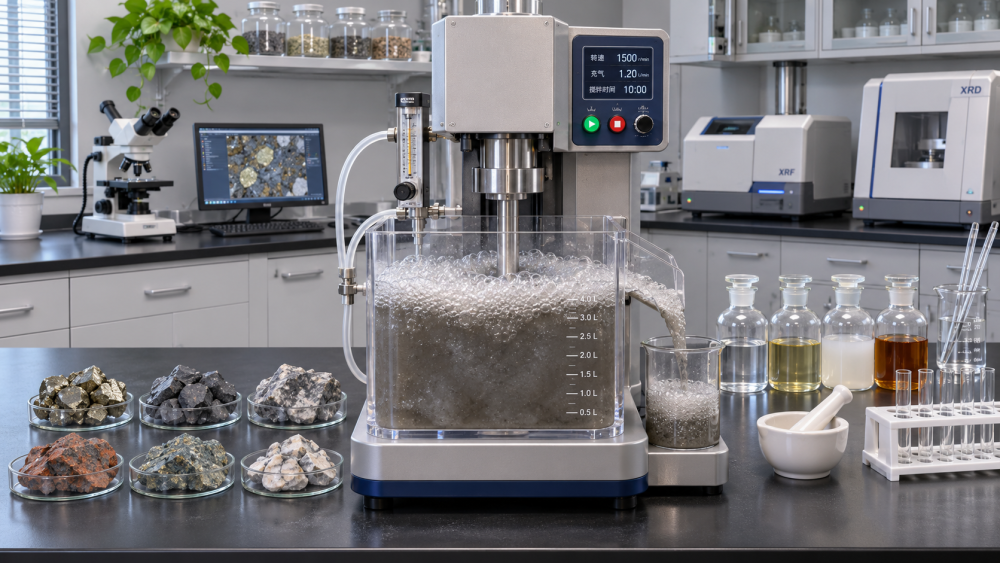
Match reagent function to the flotation problem
Most flotation schemes combine several chemicals. Their effects overlap, so candidates should be assessed as part of a scheme rather than as isolated products.
Common collector families include xanthates and dithiophosphates for certain sulfide applications, while fatty-acid-based collectors may be considered for some oxide or industrial-mineral systems. These are starting points, not prescriptions. Surface oxidation, dissolved ions, and the mineral assemblage can change the result. Ask suppliers why a chemistry fits the specific separation, and what conditions would make it less effective.
Check the conditions that can overturn a promising result
Water quality: Recycled process water can contain dissolved salts, residual reagents, metals, and fine particles that affect adsorption or froth behavior. Test candidates in representative plant water as well as a controlled baseline where useful. Record the source and relevant chemistry, and repeat tests when seasonal or operational changes are significant.
Particle size and slimes: Coarse particles may detach more readily from bubbles, while very fine particles can increase reagent demand or enter concentrate by entrainment. Compare size-by-size recovery where possible. A chemical should not be credited with solving a problem caused primarily by inadequate liberation or unstable grinding.
pH and addition sequence: Reagent effectiveness can change sharply with pH, and modifiers may need contact time before collector addition. Document the actual pH profile, dosing locations, mixing, and conditioning times. A laboratory procedure that the plant cannot reproduce is a weak basis for a purchase decision.
Reagent interactions: A frother, depressant, or residual chemical from an upstream stage may alter collector performance. When replacing one product, test it against the full working scheme before attributing changes in grade or recovery to the new reagent alone.
Compare supplier information on an equivalent basis
Request a technical data sheet and a current safety data sheet for each candidate. Confirm the chemical family, physical form, active concentration where disclosed, recommended preparation, storage conditions, and shelf life. Ask about solubility, dosing equipment compatibility, temperature limits, and any known incompatibilities with materials or other reagents.
For commercial comparisons, distinguish product dosage from active-ingredient dosage. A concentrated formulation may cost more per unit purchased but require less product; a diluted formulation may be easier to handle but increase transport and storage demands. Calculate an estimated reagent cost per tonne of ore at the tested dose, then consider its effect on concentrate value, recovery, and downstream costs. A lower unit price alone does not establish the lower-cost option.
Supplier references are most useful when the application is comparable. Ask what ore type, water conditions, circuit stage, and performance measures support a recommendation. GEMM’s structured industry resources can help evaluators identify reagent categories, review product information, and locate supplier references for further technical comparison. Supplier claims should still be checked against site-specific test results.
Build evidence from bench tests to plant trials
Use a controlled laboratory comparison
Establish a baseline with the current reagent scheme or a clearly defined reference. Keep feed preparation, grind, pulp density, water source, conditioning, and flotation procedure consistent when comparing candidates. Vary dosage systematically rather than judging each product at a supplier’s suggested starting point alone.
Measure both concentrate grade and recovery, along with mass pull, reagent consumption, and relevant impurity levels. Compare the grade–recovery relationship across test conditions: a higher recovery is not necessarily an improvement if concentrate quality falls below the smelter or downstream specification. Include repeat tests and variability samples where practical, and investigate results that cannot be reproduced.
Scale up without losing operational context
Shortlist candidates that show a credible technical advantage or a meaningful reduction in risk or total cost. Before a plant trial, agree on the baseline period, sampling points, analytical methods, target dose range, operating limits, and criteria for stopping the test. Account for changes in ore feed and circuit conditions that could obscure the comparison.
Monitor more than metallurgical results. Operators should record froth appearance, dosing stability, handling issues, and any effects on filtration, tailings, or water recycling. A reagent that performs well in a batch cell may behave differently in a continuous circuit with longer residence times and circulating loads.
Make safety and environmental review part of selection
Review exposure hazards, storage segregation, spill response, ventilation, and the suitability of existing dosing systems before approval. Check applicable local requirements for transport, use, discharge, and waste management. Where relevant, assess reagent residues or breakdown products in process water, concentrate, and tailings using appropriate site-specific methods.
The final choice should be supported by a documented comparison: performance at the required grade, consistency across feed variability, delivered cost at the effective dose, handling requirements, supply reliability, and environmental implications. If a candidate wins only under a narrow set of conditions, that limitation belongs in the decision record. The strongest selection is one the operation can explain, reproduce, and manage when the ore or water changes.
Related News
- 00
0000-00
How to verify product purity claims from chemical feedstock distributors - 00
0000-00
Will feedstock availability constrain biofuel production in 2026? - 00
0000-00
How to select corrosion-resistant agrochemical manufacturing reactors - 00
0000-00
How to verify an injection molding supplier in China - 00
0000-00
How to account for supplier lead times in raw material supply chain planning
Related tags
Weekly Insights
Stay ahead with our curated technology reports delivered every Monday.