




How to identify applicable energy equipment standards for battery storage




Identifying the right energy equipment standards for battery storage starts with a deceptively simple question: what exactly is being evaluated? A cell, a battery rack, a packaged energy storage system, and a complete installation may each face different requirements. Location, chemistry, grid connection, and intended use all change the answer.
For technical evaluators, the practical challenge is not finding a long list of standards. It is establishing which documents apply, which editions the authorities recognize, and whether the available evidence covers the equipment and installation actually proposed.
Define the project before searching for standards
Start with a project description that is specific enough to expose the interfaces. Record the installation country and local jurisdiction, indoor or outdoor location, intended use, battery chemistry, rated energy and power, voltage, and whether the system is grid-connected or operates independently. Identify the main equipment boundaries: cells, modules, racks, battery management system, power conversion system, enclosure, and site-level controls.
These details affect the standards search. A stationary lithium-ion installation may require a different assessment from a battery used in a vehicle or portable equipment. An outdoor container beside an industrial building also raises different installation questions from a battery room inside it. Do not assume that a supplier’s generic “energy storage” compliance package addresses both.
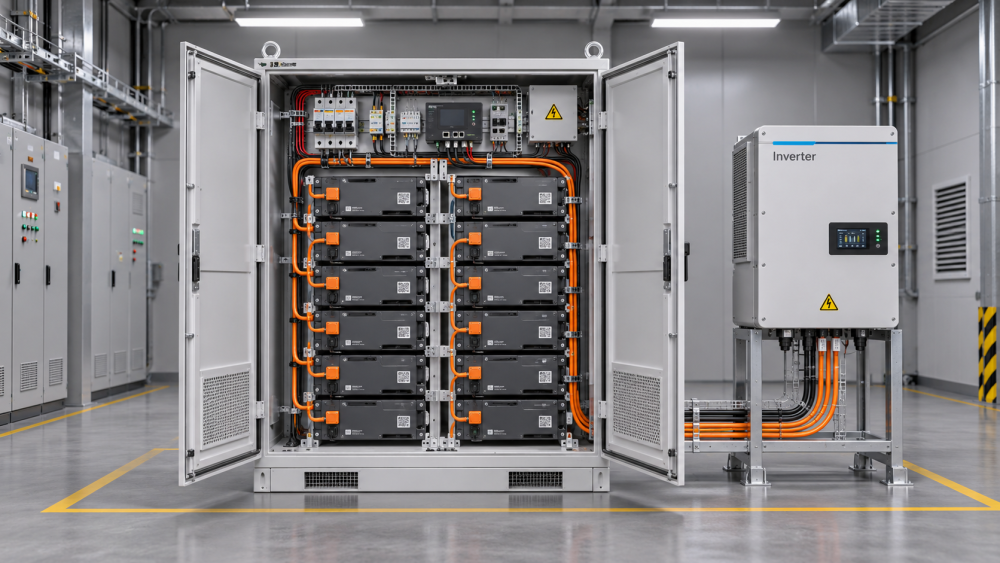
A single-line diagram and equipment layout are often more useful at this stage than a brochure. They reveal where the battery ends, where the inverter begins, and which protection functions depend on communication between separate suppliers’ equipment.
Separate legal obligations from technical standards
A standard published by an organization such as IEC, ISO, UL Standards & Engagement, or IEEE is not automatically a legal requirement everywhere. It may become mandatory through legislation, a building or fire code, a grid connection rule, or a condition imposed by an authority. It can also be required by a contract or insurer without being universally mandated by law.
Build the requirements list from the outside in: identify applicable laws and adopted codes for the site, then trace the standards they reference. Check the adopted edition and any local amendments. The newest published edition is not necessarily the edition a permitting authority applies to a particular project.
For grid-connected storage, ask the network operator about interconnection requirements early. Electrical safety documentation alone does not establish that an inverter meets the grid support, protection, or commissioning requirements for the connection point.
Map standards to the correct equipment boundary
Standards often address different layers of the same system. The following are starting points for investigation, not a universal compliance checklist:
- Battery cells and batteries: IEC 62619 addresses safety requirements for secondary lithium cells and batteries used in industrial applications. Confirm its scope and edition against the equipment being supplied.
- Stationary battery systems: IEC 63056 addresses safety requirements for secondary lithium cells and batteries used in electrical energy storage systems. Check how it relates to the battery assembly and other applicable requirements.
- Packaged storage equipment: UL 9540 covers energy storage systems and equipment. A system listing should be checked against the actual configuration, not inferred from listings held by individual components.
- Fire propagation testing: UL 9540A is a test method used to evaluate thermal runaway fire propagation in battery energy storage systems. Its results can inform a fire safety review, but a test report is not, by itself, a system certification or installation approval.
- Power conversion and interconnection: In the United States, UL 1741 and IEEE 1547 may be relevant to grid-connected equipment and its interconnection. Applicability depends on the equipment function and the requirements adopted for the project.
The distinction matters when purchasing from multiple suppliers. A battery may have evidence for its own safety evaluation, while the inverter has a separate listing. That does not automatically establish that their combined controls, communications, and protective responses have been evaluated as an integrated system.
Installation codes sit at another boundary. In the United States, NFPA 855 addresses the installation of stationary energy storage systems, while the locally adopted electrical and fire codes may also apply. Which editions and provisions govern a project must be confirmed with the authority having jurisdiction. In other markets, the route through national regulations and locally adopted standards can be different.
Read certificates and reports against the proposed configuration
A certificate headline is only the beginning. Ask for the issuing body, standard and edition, manufacturer and production location where relevant, model designation, scope, conditions of acceptance, and evidence that the certificate is current. Where possible, verify the listing through the certification body’s directory.
Compare those details with the bill of materials and drawings. A change in cell model, rack arrangement, enclosure ventilation, firmware, or inverter pairing may be material to the evaluation. That does not mean every change invalidates a certificate; it means the evaluator should ask the certifier or manufacturer whether the revised configuration remains within scope.
Also distinguish a third-party certification from a manufacturer’s declaration and from a laboratory test report. Each may be useful, but they answer different questions. A test report can describe what was tested and the results; a certification may additionally involve a formal assessment and ongoing surveillance, depending on the scheme. Neither replaces a site permit.
Turn the findings into a traceable decision
A practical compliance matrix needs more than a column of standard numbers. For each requirement, record its source, edition, equipment or installation boundary, responsible party, evidence, open issue, and the person who confirmed applicability. Mark assumptions explicitly—for example, that the enclosure remains outdoors or that the proposed inverter is unchanged.
This is particularly useful when the battery integrator, inverter supplier, engineering contractor, and site owner hold different pieces of the evidence. Assign ownership of interface tests and commissioning documentation before procurement; otherwise, gaps tend to appear when a permit or utility review is already underway.
GEMM’s structured industry information can help evaluators organize early research across equipment categories, technical specifications, supplier references, and standards-related material. Treat such resources as a starting point, then confirm the controlling requirements and current documentation with the relevant authority, network operator, standards publisher, and certification body.
Before approving a design, revisit the matrix against the final drawings and equipment schedule. If the configuration or site assumptions have changed, the standards assessment may need to change with them.
Related News
- 00
0000-00
How to verify product purity claims from chemical feedstock distributors - 00
0000-00
Will feedstock availability constrain biofuel production in 2026? - 00
0000-00
How to select corrosion-resistant agrochemical manufacturing reactors - 00
0000-00
How to verify an injection molding supplier in China - 00
0000-00
How to account for supplier lead times in raw material supply chain planning
Weekly Insights
Stay ahead with our curated technology reports delivered every Monday.