




How to size process technology equipment for fine chemical batches




Size process technology equipment for fine chemical batches around the operating conditions that limit safe, repeatable output: maximum process volume, minimum mixing level, peak heat duty, and the capacity of downstream operations. A reactor selected only from annual production demand can have sufficient nominal volume yet still miss its production target because cooling, filtration, drying, or cleaning takes longer than expected.
A defensible selection therefore starts with a batch mass balance and a realistic cycle schedule. Establish a preliminary vessel size, then check whether it can handle the most demanding stages of the recipe. For multiproduct equipment, different products may set the limits for volume, agitation, heat transfer, and separation; one “representative batch” rarely captures every constraint.
Translate production demand into an operating envelope
Begin with required saleable output, expected isolated yield, and available production time. Work backward through the recipe to calculate raw material charges, solvent additions, wash volumes, recycle streams, and expected losses. Keep reaction yield separate from isolation losses so that downstream performance does not disappear inside a single optimistic yield assumption.
Then map the entire batch sequence: charging, heating, dosing, reaction hold, cooling, sampling, transfer, cleaning, and preparation for the next batch. Include activities that occupy the equipment even when no reaction occurs. Where operations overlap, use a schedule to establish actual equipment occupancy rather than simply adding every process duration together.
For a preliminary throughput calculation:
Required batches = required saleable output ÷ saleable output per batch.
Compare the resulting batch count with the number the production schedule can accommodate. Equipment availability should reflect maintenance, cleaning, changeovers, and the intended product mix. If the schedule is already full under favorable assumptions, increasing vessel volume may be only one of several possible responses; shorter transfers or additional downstream capacity could be more effective.
Next, identify the maximum occupied process volume at every stage. The initial charge may be smaller than the volume after dosing, quenching, dilution, or phase separation. Use densities appropriate to composition and temperature, and distinguish liquid volume from the additional space required for foam or gas disengagement.
Preliminary nominal vessel volume = maximum process volume ÷ selected working-volume fraction.
For illustration, a maximum liquid inventory of 3.0 m³ at an assumed working-volume fraction of 0.70 gives a preliminary nominal capacity of approximately 4.3 m³. The fraction is a design assumption, not a universal recommendation. Foaming, boiling, gas evolution, feed behavior, and vessel geometry determine whether it is suitable.
Check the opposite end of the range as well. Minimum batch volume must provide adequate impeller immersion, temperature measurement, and useful heat-transfer area. A larger vessel may accommodate the largest campaign while performing poorly on smaller batches. Where the required operating range is too wide, separate equipment sizes may offer better control.
Check heat removal and mixing before fixing reactor size
A volume calculation establishes whether the batch fits. Thermal and mixing assessments establish whether it can be processed within the required time and quality limits.
For initial heating or cooling estimates, calculate the sensible heat duty from batch mass, heat capacity, temperature change, and available time. Include relevant vessel thermal mass and phase changes. For an exothermic reaction, assess peak heat-release rate during dosing or reaction progression; dividing total reaction heat by total batch time can conceal a much higher short-term load.
The basic heat-transfer relationship is:
Heat-transfer rate = overall heat-transfer coefficient × active heat-transfer area × temperature driving force.
Each term needs a credible basis. Active area changes with liquid level. The heat-transfer coefficient depends on agitation, viscosity, fouling, vessel construction, and utility-side conditions. The temperature driving force may narrow toward the end of cooling or when cooling water is warm. A supplier’s heating-time estimate is difficult to evaluate unless these assumptions are stated.
As geometrically similar vessels become larger, heat-transfer area per unit of contained volume decreases. Scaling batch size in direct proportion to vessel capacity can therefore produce longer cooling times or require slower reagent addition. Check the intended feed rate against demonstrated cooling capacity and the reaction’s accumulation behavior.
Normal cooling duty also does not establish safety during cooling failure or loss of agitation. Reaction calorimetry and appropriate hazard evaluation should inform allowable accumulation, temperature limits, protective measures, and emergency relief requirements. Adding nominal vessel capacity cannot substitute for that assessment.
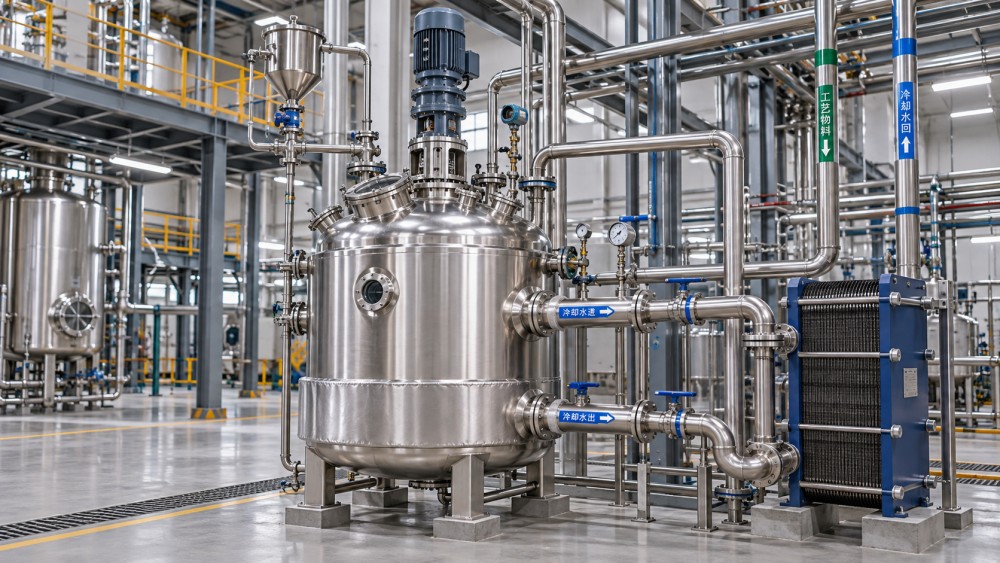
Mixing deserves its own operating envelope. Identify whether each critical stage requires bulk blending, solids suspension, liquid–liquid dispersion, gas dispersion, or rapid distribution of a reactive feed. A single agitator arrangement may face conflicting requirements across these duties.
Ask suppliers to explain the proposed impeller type, diameter, location, speed range, torque, and baffle arrangement against the process properties. Motor power alone does not demonstrate mixing performance. Viscosity changes, settling solids, increasing slurry concentration, and low liquid levels can all alter circulation and power demand.
Laboratory rpm should not be copied directly to plant equipment. Constant tip speed, power per unit volume, and mixing time are different scale-up criteria, with different consequences. Select the criterion according to the process sensitivity, particularly where local concentration affects selectivity, precipitation, or heat release. Use pilot work or a justified mixing study when available evidence cannot resolve that uncertainty.
Size separation and drying around material behavior
The production train delivers only as quickly as its limiting operation allows. A larger reactor can increase the amount waiting for filtration or drying without improving finished-product output. Evaluate downstream equipment using the batch properties it will actually receive, including variability caused by crystallization and upstream handling.
Filter area should be assessed from slurry volume, dry solids mass, cake thickness, filtration resistance, wash requirements, and allowable cycle time. Feed volume alone is insufficient. A fine or compressible cake may drain slowly despite fitting comfortably inside the filter, and increasing pressure may compact it further.
Representative filtration trials should establish how cake depth, pressure, washing, and deliquoring affect both cycle time and product recovery. Include loading, discharge, and cleaning in the capacity assessment. Where crystal size strongly affects filtration, the crystallizer’s cooling and mixing performance becomes part of the filter-sizing problem.
Dryer selection requires separate checks for occupied volume, solvent load, heat transfer, vapor removal, and final product requirements. Wet cake bulk density determines loading volume; solvent content determines how much material must be evaporated. Drying time can also depend on internal moisture movement, agglomeration, and temperature sensitivity.
Confirm that condensers, vacuum equipment, receivers, and solvent-handling systems can accommodate the expected peak vapor load. Increasing dryer volume while retaining an undersized vapor-removal system may produce little useful capacity gain.
Place these operations on one batch schedule. If a downstream unit remains occupied when the next reactor batch is ready, evaluate additional equipment, revised batch sizes, or intermediate holding capacity. Holding is practical only where stability, settling, contamination control, and temperature requirements permit it.
Turn the sizing basis into a comparable supplier specification
Issue suppliers a process duty specification that identifies the required operating range and the evidence behind it. A request for nominal capacity, construction material, and motor rating leaves too much room for incompatible assumptions.
- Batch envelope: minimum and maximum volumes, stage-by-stage inventories, densities, viscosities, solids content, foaming behavior, and operating temperatures and pressures.
- Performance duties: heating and cooling targets, peak reaction heat release, mixing objectives, transfer requirements, and downstream cycle limits.
- Site conditions: utility temperatures, pressures, available flow, vacuum capability, and any simultaneous demands that constrain performance.
- Construction and acceptance: wetted materials, seal and gasket compatibility, cleaning requirements, discharge behavior, and agreed methods for demonstrating performance.
Material compatibility should cover the full recipe, including cleaning agents, impurities, and temperature excursions. Construction choices can also affect thermal performance and mechanical operating limits, so they belong in the sizing review rather than being treated as a separate purchasing detail.
Compare quotations against the same operating cases: maximum charge, minimum fill, peak exotherm, highest viscosity, and most difficult separation. Distinguish calculated predictions from performance supported by relevant trials, and define the conditions attached to any guarantee.
The equipment size is ready to select when the mass balance, thermal assessment, mixing basis, and batch schedule support the same production target. Any remaining uncertainty should lead to a specific next step—such as calorimetry, a filtration trial, or utility verification—before nominal capacity becomes a purchase commitment.
Related News
- 00
0000-00
How to size process technology equipment for fine chemical batches - 00
0000-00
Can industrial energy storage for factories lower demand charges? - 00
0000-00
How energy costs are shaping the global heavy industry outlook - 00
0000-00
Which metal property standards apply to tensile testing of steel? - 00
0000-00
Can polymer processing simulation predict injection molding warpage?
Related tags
Weekly Insights
Stay ahead with our curated technology reports delivered every Monday.