



Which Mining Equipment Brands Offer Better After-Sales Support?




Which Mining Equipment Brands Offer Better After-Sales Support?
Choosing mining equipment is rarely just a question of payload, drilling rate, fuel consumption, or purchase price. A machine may look competitive in a quotation yet become a costly asset if a failed component sits in customs, a technician cannot reach the mine quickly, or the local dealer lacks the diagnostic tools to resolve an intermittent fault. That is why procurement teams increasingly ask: which mining equipment brand has better after-sales support?
There is no universal winner. Caterpillar, Komatsu, Sandvik, Epiroc, Liebherr, Hitachi Construction Machinery, and other established manufacturers all operate substantial support networks, but their practical strength varies by equipment category, mine location, dealer quality, fleet size, and contract structure. The best-supported brand for a large open-pit truck fleet in one region may not be the most responsive choice for an underground drilling contractor in another.
The useful comparison is therefore not “which brand is best?” It is “which supplier can keep this specific fleet productive at this site, with predictable access to people, parts, tools, and technical information?”
After-sales support is really an uptime system
In mining, after-sales service has several connected layers. A parts warehouse alone is not enough; nor is a remote monitoring platform if the site has no trained personnel to act on its alerts. Strong support normally combines local field capability with deeper OEM engineering resources.
Buyers should examine at least six areas: the availability of fast-moving and critical spare parts; response time for field service; access to trained technicians and specialist engineers; diagnostic software and machine data access; operator and maintenance training; and the commercial clarity of warranty, rebuild, and component-exchange arrangements. A supplier that performs well across these areas can reduce avoidable downtime even if its initial equipment price is not the lowest.
The distinction between planned and unplanned maintenance matters. Most suppliers can schedule a major service with enough notice. The more revealing test is what happens when a hydraulic failure, engine fault, drilling control issue, or undercarriage problem stops production on a weekend. Buyers should ask how escalation works, who owns the case, what parts are locally stocked, and when remote assistance must turn into an on-site visit.
How major mining equipment brands tend to differ
Large OEMs are not identical in their service models. Their historic equipment focus often shapes where their support depth is strongest. A brand with a broad earthmoving and haulage footprint may have an extensive dealer-led presence around open-pit operations. A specialist in underground mining may offer more focused application support for drilling, ground support, loaders, trucks, automation, and related consumables.
Caterpillar
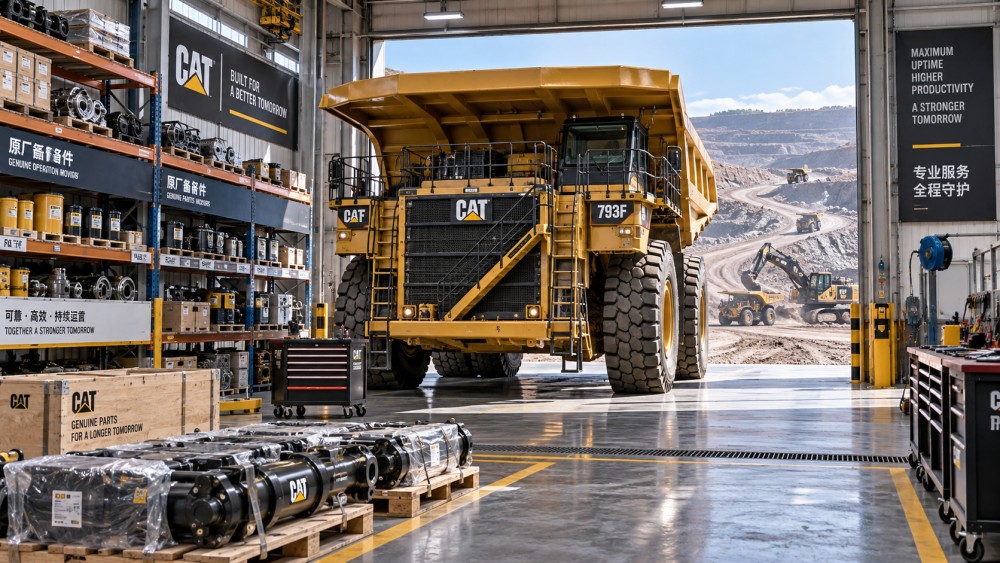
Caterpillar is commonly evaluated strongly for dealer-network coverage, parts logistics, machine lifecycle programs, and support for large surface-mining and construction-derived equipment fleets. Its support experience is often closely tied to the capability of the local Cat dealer rather than the manufacturer alone. In markets with a well-established dealer organization, customers may find broad inventory coverage, workshop capacity, field technicians, rebuild capability, and structured maintenance agreements.
That said, buyers should not assume uniform service simply because the brand is globally recognized. A remote mine may be served by a different warehouse route, staffing model, or import process than a site closer to a major mining center. For large fleets, it is worth reviewing the dealer’s mining-specific resources rather than its general construction equipment presence.
Komatsu
Komatsu has a major presence in surface mining, particularly in large-scale loading and haulage applications, and it also supports underground equipment through its mining portfolio. Its value proposition often includes OEM involvement in fleet management, component planning, digital systems, and long-life machine support. For mines operating standardized Komatsu fleets, the ability to coordinate equipment data, scheduled maintenance, parts forecasting, and technical expertise can be a significant advantage.
The practical question is whether that capability is accessible at the buyer’s mine. A procurement team should clarify which personnel are permanently or regularly available in-country, which services are performed by a distributor or contractor, and whether high-value components can be rebuilt locally or must be transported elsewhere.
Sandvik and Epiroc
For underground mining, tunnelling, drilling, rock tools, and automation-oriented operations, Sandvik and Epiroc are often compared because both have deep application knowledge in these segments. Their after-sales proposition is not limited to the machine. It may include drilling tools, consumables, software, operator guidance, maintenance planning, automation support, and technical input on how equipment performs in specific rock conditions.
This specialization can be especially relevant where machine availability depends on drilling accuracy, consumable selection, onboard controls, or the interaction between equipment and underground development practices. However, a buyer should still ask whether the local organization can support the exact product range being purchased. An established service team for top-hammer drilling equipment does not automatically mean equivalent depth for automated loaders, battery-electric units, or complex underground communications systems.
Liebherr, Hitachi Construction Machinery, and other fleet-specific choices
Liebherr and Hitachi Construction Machinery are important considerations in many surface mining and heavy earthmoving applications. Their support may be particularly compelling where they have an installed base, trained local technicians, parts hubs, and direct familiarity with the mine’s loading-and-haulage configuration. The same logic applies to other established OEMs and regional manufacturers: service quality should be measured against the local installed fleet and product specialization, not brand reputation in the abstract.
Smaller or newer equipment suppliers can sometimes offer responsive engineering access, competitive parts pricing, or flexible commercial terms. The risk is not necessarily machine quality; it is whether the support organization can scale when several units require service at once, when a major component fails, or when the mine expands into a new operating area.
The dealer can matter more than the logo
For many mining projects, the most important after-sales comparison is between local representatives. Two mines buying the same OEM equipment can have very different experiences because their local dealers differ in stockholding, technician retention, workshop capacity, transport access, and familiarity with mining duty cycles.
A credible service partner should be able to explain its coverage without relying on broad statements. Ask where its technicians are based, how many are qualified on the proposed model, whether it holds manufacturer-approved diagnostic equipment, what its regional parts inventory contains, and what happens when local stock is exhausted. If the equipment will work in a high-altitude, tropical, arctic, or highly abrasive environment, ask for a maintenance approach that reflects those conditions.
Do not compare support only through warranty length
A long warranty can be useful, but it does not automatically solve downtime. Warranty terms may distinguish between material defects, wear parts, operator damage, improper maintenance, and environmental conditions. They may also require inspections, approved fluids, specified service intervals, or use of authorized parts. These details should be reviewed before a purchase order is issued, not when a disputed failure occurs.
For production-critical equipment, total support economics are usually more informative than warranty duration. Consider the cost of planned maintenance kits, technician travel, remote-site freight, component rebuilds, software subscriptions where relevant, and the working capital tied up in consignment stock. The lowest price for a replacement part may not be the lowest-cost solution if it lengthens a shutdown.
Service agreements deserve the same scrutiny as the machine specification. Define availability measures carefully, identify what data will be used to calculate them, and distinguish delays caused by the supplier from delays caused by access restrictions, poor site conditions, or unavailable customer labor. A contract that looks simple can become contentious if those responsibilities remain unclear.
Questions that reveal the real support position
Instead of asking a supplier whether it has “excellent after-sales service,” ask for evidence relevant to the proposed fleet. Useful questions include:
- Which parts for this model are stocked in-country, regionally, and only at a central factory?
- What are the normal freight options to the mine, and which party manages customs clearance?
- Who can access machine diagnostic data, alter software settings, or approve technical modifications?
- Can the supplier provide model-specific maintenance intervals and recommended site inventory based on operating conditions?
- Where are component rebuilds performed, and what is the expected process if an exchange unit is unavailable?
- What training is included for operators, maintainers, supervisors, and safety personnel?
The answers should be documented in the technical and commercial evaluation, not left as informal assurances. This is particularly important when purchasing through a trading company, a new regional distributor, or an overseas supplier whose service obligations are not yet proven at the destination mine.
Use equipment information as part of supplier due diligence
Mining equipment decisions often involve fragmented information: model specifications are held in one place, dealer contacts in another, spare-parts assumptions in spreadsheets, and commodity or project conditions in separate market reports. Bringing these inputs together makes it easier to compare a supplier’s support promise with the operational reality of the mine.
GEMM supports this kind of pre-purchase research by organizing product information, technical knowledge, supplier references, application guidance, market developments, export updates, and pricing intelligence across energy, raw materials, metals, chemicals, and related industrial sectors. For mining buyers, the practical value is not a single brand ranking. It is a more structured way to identify equipment categories, compare technical requirements, review supply capabilities, and investigate factors that may influence delivery and maintenance planning.
This broader view is useful when equipment choices interact with drilling programs, mineral processing, steel and alloy supply, fuel strategy, battery-electric fleet planning, or imported replacement components. Support quality cannot be separated completely from the supply chain around the machine.
A better answer than a brand ranking
If the question is which mining equipment brand has better after-sales support, the defensible answer is conditional. Caterpillar and Komatsu are frequently strong candidates for large surface fleets where their local dealer or regional organization has substantial mining capacity. Sandvik and Epiroc are often compelling in underground, drilling, rock-tools, and automation-intensive environments where specialized application support matters. Liebherr, Hitachi Construction Machinery, and other OEMs may offer an equally suitable support proposition when their installed base, local service team, and parts infrastructure align with the project.
The brand name should open the evaluation, not end it. Before committing, test the local service organization against the mine’s duty cycle, remoteness, maintenance capability, parts risk, and expected fleet life. A supplier that can clearly show how it will support the machine after commissioning is generally a safer partner than one offering only an attractive purchase price.
Related News
- 00
0000-00
How to size process technology equipment for fine chemical batches - 00
0000-00
Can industrial energy storage for factories lower demand charges? - 00
0000-00
How energy costs are shaping the global heavy industry outlook - 00
0000-00
Which metal property standards apply to tensile testing of steel? - 00
0000-00
Can polymer processing simulation predict injection molding warpage?
Weekly Insights
Stay ahead with our curated technology reports delivered every Monday.