




Can industrial energy storage for factories lower demand charges?




Yes—industrial energy storage for factories can lower demand charges by discharging during periods when the site would otherwise set a high billed power demand. The strongest candidates have expensive demand charges and identifiable peaks that a battery can cover. Savings are less certain when peaks last for hours, charging creates another peak, or tariff rules prevent a lower measured demand from reducing the bill.
A factory may use roughly the same monthly electricity volume while paying more because compressors, process heating, and production equipment operate together during one costly interval. Storage can reduce that overlap at the utility meter without interrupting production. Whether the investment pays back depends on the billing rules, the full load profile, and the installed system’s operating costs—not battery capacity alone.
Start with the bill, not the battery quotation
Electricity consumption and demand are different billing quantities. Consumption measures energy used over time, usually in kilowatt-hours. Demand generally measures average power over a tariff-defined interval, in kilowatts or sometimes kilovolt-amperes. A brief equipment starting surge may have little influence on interval-average demand; sustained overlapping loads can matter much more.
Before requesting equipment prices, identify exactly which demand charges storage could affect:
- Maximum-demand charges: These may depend on the highest interval reading during the billing period, regardless of when it occurs.
- Time-window demand charges: Only peaks within specified periods may determine that component of the bill.
- Demand ratchets: A previous high reading can establish a billing floor, delaying savings even after actual demand falls.
- Contract or minimum billing demand: Reducing measured demand below this threshold may produce no additional demand-charge savings.
- Apparent-power charges: Where billing uses kVA or power-factor adjustments, a kW-only analysis may misstate the opportunity.
A tariff can contain several of these mechanisms simultaneously. Request a calculation that reproduces actual historical bills before accepting a savings forecast. If the baseline model cannot explain existing charges, its projected reduction is not a reliable purchasing basis.
Distinguish a shaveable peak from a long production plateau
A battery is well suited to covering a limited period when factory load rises above a chosen import threshold. It is less economical when the site must reduce grid purchases throughout a long, heavily loaded shift. Both situations may show the same maximum demand, yet require very different amounts of stored energy.
Obtain interval meter data at the utility’s billing resolution, preferably covering a full operating year and any relevant ratchet history. Monthly bills reveal the charged peak but not how long it lasted, whether several near-peaks occurred, or whether the battery could recharge between them. Add production schedules, planned expansions, and major shutdowns so unusual operating periods are not mistaken for normal conditions.
Plot the load against a proposed grid-import ceiling. The vertical difference above that ceiling indicates required discharge power; the accumulated area above it indicates required energy. Repeat the exercise across all intervals, not just the single highest event.
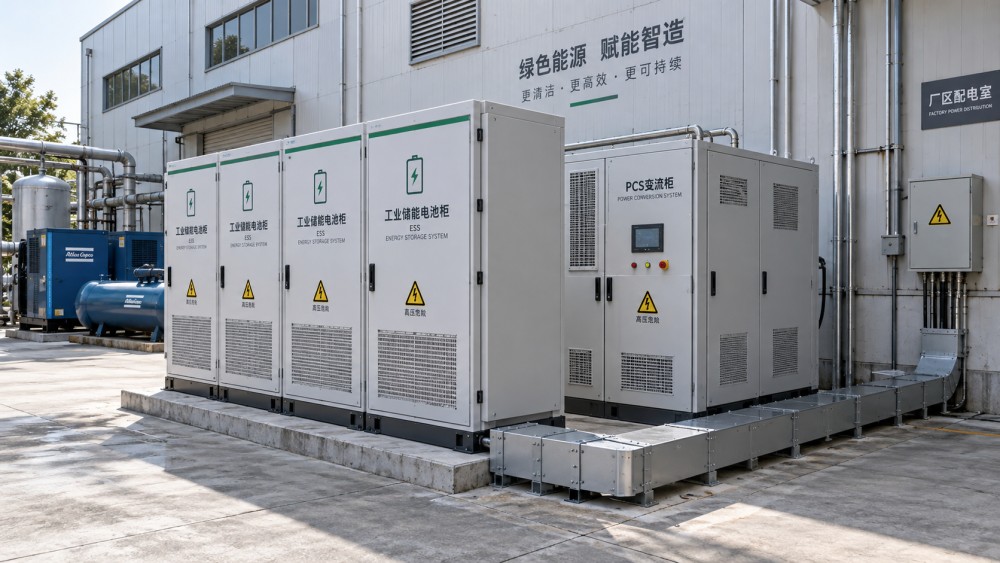
Power rating and energy capacity solve different constraints. The battery and inverter need enough usable AC power to reduce the peak, while stored energy must sustain that output for the entire event. Quoted nominal capacity is not equivalent to deliverable energy after operating reserves, conversion losses, temperature effects, and degradation are considered.
Repeated peaks can be more demanding than one isolated event. A system that covers the morning production ramp may be depleted when another line starts later. Charging between events must also stay below the relevant billing threshold; otherwise, storage can replace a production peak with a charging peak.
Require a dispatch simulation before comparing returns
A credible model should simulate battery operation interval by interval, using the applicable tariff and practical operating limits. Simply multiplying the inverter rating by a demand-charge rate assumes that every unit of rated power becomes a billable reduction every month. That assumption often overstates savings.
Controls deserve particular attention because demand savings can be unforgiving. Under a monthly maximum-demand tariff, missing one critical interval may erase much of that month’s expected reduction. Ask how the controller manages the utility’s demand-averaging interval and what happens when actual load exceeds the forecast.
Backup-power requirements introduce another trade-off. Energy reserved for an outage is unavailable for routine peak shaving unless the operating policy permits its use. A financial model should not count the same stored energy as both fully available backup reserve and fully dispatchable demand reduction.
Calculate savings after losses, service costs, and degradation
For a simple demand tariff, gross demand-charge savings equal the reduction in billed demand multiplied by the applicable demand rate. More complex tariffs require recalculating each affected billing component. Annual savings should be built from those individual billing periods rather than extrapolated from the most favorable month.
The investment assessment should then include:
- Complete installed cost: Battery equipment, power conversion, switchgear, protection, controls, civil works, engineering, interconnection, commissioning, and any necessary electrical upgrades.
- Operating expenditure: Service agreements, monitoring, insurance, inspections, auxiliary electricity, and charging losses.
- Lifecycle provisions: Capacity degradation, warranty constraints, potential augmentation or replacement, and end-of-life responsibilities.
- Commercial assumptions: Financing, discount rate, verified incentives, ownership structure, and tariff changes.
Charging losses increase electricity consumption, but total energy cost also depends on when charging occurs. Where time-based energy prices apply, shifting purchases may add savings or create extra cost. Keep this effect separate from demand-charge savings so each revenue source remains auditable.
Review discounted cash flow alongside simple payback. Test a downside case with smaller peak reductions, lower availability, and less favorable tariffs. If the project works only when every projected saving is achieved, the procurement decision carries substantial performance risk.
Compare storage with changes to factory operation
Battery storage should be compared with the least disruptive operational alternatives. Staggering equipment starts, sequencing compressor operation, or moving a flexible batch process may reduce the same billed peak with less capital expenditure. Those changes are not free if they constrain output, add labor, or affect quality; include those consequences in the comparison.
Solar generation can reduce daytime imports, but its contribution to demand savings depends on whether output coincides with the billing peak. A late-shift peak or a cloudy interval can remain exposed. Assess combined solar and storage against the net meter profile rather than adding two independently estimated savings figures.
Turn the analysis into a purchase requirement
Request proposals against a common load dataset, tariff, operating reserve, and financial evaluation period. Require suppliers to distinguish modeled savings from contractual guarantees and to state exclusions for production changes, utility tariff revisions, outages, and customer operating decisions.
Acceptance criteria should cover usable AC capacity, metering accuracy, dispatch response, monitoring access, and warranty-compatible operation. Qualified electrical and fire-safety reviewers should confirm site integration requirements before the installed budget is finalized; these costs can change the purchasing decision.
Proceed when historical dispatch modeling shows repeatable billable reductions, the battery can recharge without creating replacement peaks, and the downside financial case remains acceptable. Where long production plateaus or billing floors dominate, test operational changes or a smaller targeted system before committing to a larger battery.
Related News
- 00
0000-00
Can industrial energy storage for factories lower demand charges? - 00
0000-00
How energy costs are shaping the global heavy industry outlook - 00
0000-00
Which metal property standards apply to tensile testing of steel? - 00
0000-00
Can polymer processing simulation predict injection molding warpage? - 00
0000-00
An export controls compliance guide to checking U.S. license requirements
Weekly Insights
Stay ahead with our curated technology reports delivered every Monday.