




What Compliance Standards Apply to Industrial Chemical Imports?




A shipment can be commercially ready and still be stopped before it reaches the customer. A purchasing team may have agreed on grade, quantity, packaging, and delivery terms, yet discover that the product name on the invoice does not match the safety data sheet, the transport classification is incomplete, or the importing country requires a chemical inventory check that was never performed.
The short answer to what compliance standards apply to industrial chemicals import is that there is no single universal certificate or document set. Importers must usually satisfy several overlapping layers: chemical identification and hazard communication, market-access rules, restricted-substance controls, dangerous-goods transport requirements, customs declarations, and workplace or downstream-use obligations. The applicable rules depend on the chemical’s composition, hazard profile, intended use, annual volume, destination country, and transport mode.
Start by separating import compliance into distinct rule sets
A frequent source of confusion is treating “chemical compliance” as one task. In practice, a product may be acceptable under one framework and non-compliant under another. For example, a chemical can be legally sold for industrial use but require hazardous-goods marks during ocean freight. It can also have a valid safety data sheet while needing a national registration, notification, or inventory confirmation before import.
The following comparison helps clarify what each layer controls and what evidence is normally reviewed.
These categories interact, but they should be checked independently. A customs broker can help prepare entry documentation, yet may not assess a substance’s regulatory inventory status. A freight forwarder may validate dangerous-goods paperwork, yet is not necessarily responsible for confirming that a mixture may be placed on the market after arrival.
Hazard communication: classification, labels, and safety data sheets
Most industrial chemical imports require hazard communication that follows the destination market’s implementation of the Globally Harmonized System of Classification and Labelling of Chemicals, commonly called GHS. GHS provides the underlying approach to classifying physical, health, and environmental hazards. However, national and regional systems may adopt different editions, label requirements, language rules, concentration thresholds, and formatting details.
That distinction matters when a supplier says a product is “GHS compliant.” The useful question is not whether the supplier has a GHS-formatted document; it is whether the classification and communication meet the requirements where the chemical will be imported, stored, sold, or used.
A pre-import review should compare the safety data sheet against the actual product specification. Focus on:
- the product identifier, chemical name, CAS number, and mixture components;
- hazard classification and label elements, including signal word and pictograms;
- composition ranges, especially where hazardous ingredients are confidential or variable;
- recommended uses and identified restrictions;
- physical properties relevant to transport, such as flash point, pH, boiling point, and viscosity;
- toxicological and ecological information where local classification depends on it; and
- local emergency contact details, language, revision date, and importer information where required.
An SDS is not merely a technical attachment for the warehouse. It links purchasing, transport, customs, storage, worker protection, spill planning, and customer communication. A discrepancy between the invoice description and Section 1 of the SDS can trigger questions at the border or create an internal receiving problem. Likewise, an SDS prepared for one jurisdiction may omit wording, contact information, or legal references needed in another.
Market-access rules are often the deciding factor
Before ordering an industrial chemical, determine whether the individual substance is listed on the destination country’s chemical inventory or whether a registration, notification, pre-manufacture review, or exemption is needed. These obligations are normally linked to the substance itself, not only to the commercial product name.
Different jurisdictions use different systems. Some regulate substances through broad chemical inventory frameworks. Others use registration-based systems that may consider tonnage bands, hazard data, intended use, supply-chain role, or whether the importer has a local legal entity or representative. Certain categories, including polymers, intermediates, research materials, low-volume imports, or chemicals used only in controlled industrial processes, may have special provisions. Those provisions should never be assumed to apply without confirming the specific conditions.
For mixtures, each intentionally added component may need to be screened. Impurities, stabilizers, solvents, and additives can matter as well, particularly when they are hazardous, restricted, or present above relevant thresholds. A buyer who approves a product based solely on its main active ingredient may overlook a preservative, corrosion inhibitor, or residual monomer that changes the compliance outcome.
Who is responsible for the market-access decision?
The answer can differ from the contractual buyer-seller arrangement. A foreign manufacturer may supply technical data, but the legal importer of record may carry the obligation to ensure that the substance is eligible for import. In some systems, an authorized local representative can perform defined regulatory functions. In others, the importer remains responsible for records, notifications, or communication with authorities.
Clarify this before the purchase order is issued. Ask who will be named as importer, who owns the registration or notification status, whether the supplier’s status covers the intended use, and what evidence can be shared without disclosing protected formulation details. A statement such as “compliant for export” is not a substitute for destination-market confirmation.
Restrictions depend on both the chemical and its use
Restricted-substance screening is broader than checking whether a chemical is “banned.” A substance may be allowed for one industrial function but restricted in consumer products, coatings, electronics, food-contact applications, agricultural use, water treatment, or products with direct human exposure. Some substances require permits, prior informed consent procedures, import licenses, or special reporting. Others face restrictions because of persistence, bioaccumulation, reproductive toxicity, ozone effects, or potential misuse.
This is why the intended use needs to be stated accurately. “Industrial use” is too broad to answer many compliance questions. A solvent used in a closed manufacturing system can be treated differently from the same solvent supplied to small workshops, incorporated into an article, or used in a formulation that will later be exported.
Procurement specifications should therefore capture more than concentration and purity. They should identify the planned application, whether the material will be reformulated, whether it will be sold onward, and whether it may enter regulated end-use categories. A change in use after import can create obligations that were not visible during the original border transaction.
Transport rules apply even when the material can legally enter the country
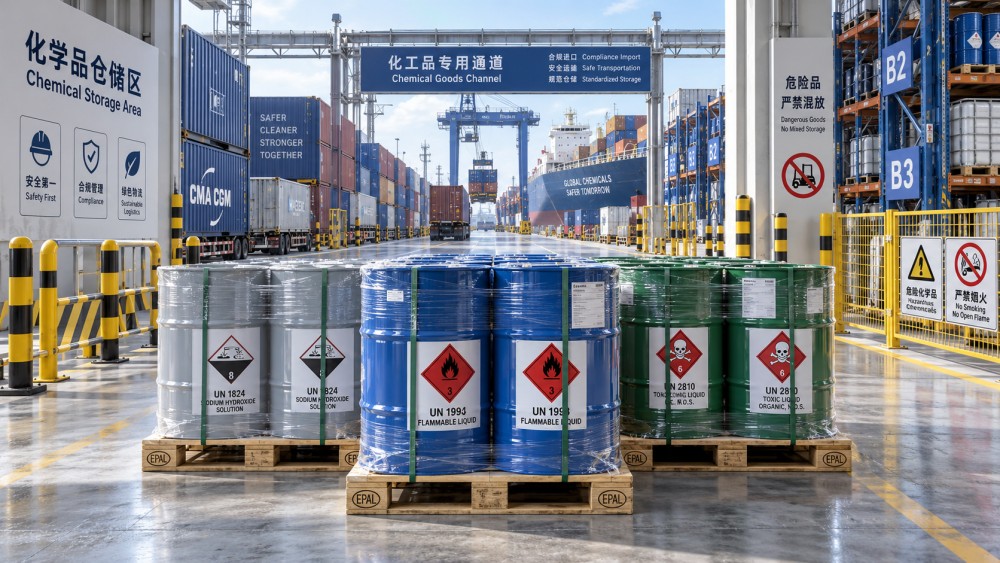
Dangerous-goods compliance governs the movement of hazardous chemicals, not their market approval. The United Nations model recommendations provide a foundation for transport classification, while modal rules govern actual carriage. Road, rail, maritime, and air shipments may follow different operational requirements. Common frameworks include ADR for certain road transport routes, the IMDG Code for sea freight, and IATA Dangerous Goods Regulations for air carriage.
Transport classification normally considers characteristics such as flammability, corrosivity, acute toxicity, oxidizing properties, reactivity, infectious risk, radioactive properties, and environmental hazards. The shipped product may require a proper shipping name, UN number, hazard class, subsidiary risk, packing group, marine pollutant notation, limited-quantity marking, or temperature-control instructions.
For a buyer comparing suppliers, transport data often reveals whether they are quoting equivalent products. Two cleaners or additives with similar sales descriptions may have different flash points, packing groups, or environmental classifications. Those differences can affect packaging selection, freight acceptance, route availability, insurance, warehouse segregation, and delivery lead time.
Do not rely on a freight agent to classify an unfamiliar product from a marketing description. Request the supplier’s current transport classification and supporting physical-property data. Where the product is a mixture, ensure that the classification reflects the final shipped formulation rather than a raw ingredient’s classification.
Customs documents must tell the same story as technical documents
Customs authorities primarily need an accurate declaration of the goods being imported, their value, origin, and tariff classification. Chemical shipments may also attract permit checks or agency reviews based on the product category. The commercial invoice, packing list, bill of lading or air waybill, certificate of origin where relevant, import license, and customs entry should be internally consistent.
A generic invoice line such as “chemical additive” may be insufficient for customs or downstream compliance. The description should be commercially understandable while aligning with the chemical identity and product documentation. At the same time, confidential composition does not need to be exposed unnecessarily on every document. The goal is controlled consistency: customs receives a truthful, supportable product description, while detailed formula information is managed through appropriate technical and confidentiality channels.
Tariff classification should not be selected simply because a similar product used that code previously. Product function, composition, concentration, and physical form can alter classification. This can affect duty treatment and statistical reporting, but it may also influence whether another authority reviews the shipment.
A practical comparison process before selecting a supplier
When several suppliers offer a chemically similar product, the lowest unit price may not represent the lowest import risk. Compare the offers using the same evidence requirements. Start with a technical identity review, then move through market access, transport, and shipment documentation.
- Define the imported item precisely. Record trade name, chemical identity, CAS numbers, mixture composition ranges, grade, impurities, stabilizers, and physical form.
- Confirm the destination and supply-chain roles. Identify the importer of record, consignee, local distributor, end user, and any representative handling regulatory duties.
- Screen each relevant substance. Check inventory status, registration or notification requirements, use restrictions, permit needs, and applicable exemptions.
- Review the current SDS and proposed label. Confirm that they match the formula and satisfy destination-language and local hazard communication requirements.
- Verify transport classification for the actual route. Compare road, sea, and air options; a shipment acceptable by vessel may not be practical by air.
- Align customs descriptions and commodity data. Ensure invoice wording, tariff classification, origin information, package count, net weight, and dangerous-goods data do not conflict.
- Set a change-control requirement. Require notice before any change to formulation, supplier site, impurity profile, packaging, classification, or SDS revision.
The final point is easy to overlook. A compliant first shipment does not automatically validate later shipments. Changes in raw materials, manufacturing process, concentration, or hazard classification can affect transport status, SDS content, restricted-substance screening, and market-access obligations.
Situations that deserve a deeper review
Some shipments carry a higher probability of compliance gaps. Examples include newly developed specialty chemicals, blends with confidential ingredients, materials purchased through traders rather than directly from producers, products with variable natural extracts, chemicals intended for resale in multiple countries, and goods moved through a free-trade zone before final import.
Extra care is also justified where a product has no CAS number, contains nanomaterials, is sold as a polymer or intermediate, is intended for laboratory use but may move into production, or is described as “non-hazardous” despite having incomplete physical-property data. “Non-hazardous for transport” does not necessarily mean unrestricted for market access, and “not classified” does not establish that a substance has been properly evaluated under local chemical-control rules.
A sound import decision is based on a documented chain from chemical identity to intended use, local market status, hazard communication, transport classification, and customs declaration. When those records agree, the shipment is far less likely to encounter avoidable delays or leave the importer carrying an unrecognized regulatory obligation.
- Last One:No more articles
- Next Article:How Do Metals Compare in Physical Properties and Heat Resistance?Oct 14, 2026
Related News
- 00
0000-00
Can polymer processing simulation predict injection molding warpage? - 00
0000-00
An export controls compliance guide to checking U.S. license requirements - 00
0000-00
How Do Metals Compare in Physical Properties and Heat Resistance? - 00
0000-00
Which Standards Apply to Tensile Strength Testing of Metal Alloys? - 00
0000-00
Petroleum refining technology trends reshaping refinery decarbonization
Weekly Insights
Stay ahead with our curated technology reports delivered every Monday.