




Are Laboratory Chemicals from Different Regions Equally Pure?




Laboratory chemicals from different regions are not automatically equal in purity, even when their labels show the same grade, assay, or chemical name. A reagent marked as 99% pure in two markets may meet the same broad numerical claim while behaving differently in a sensitive method. The difference may lie in the remaining fraction: trace metals, water, residual solvents, isomers, chloride, sulfate, particles, stabilizers, or organic background. For routine cleaning, teaching, or general synthesis, those differences may have little practical effect. For trace analysis, cell work, semiconductor processing, chromatography, or calibration, they can change results.
Purity is therefore not a single universal property. It is a measurement made against a defined method, at a particular time, on a particular batch. Region of manufacture can influence the controls around that measurement, but it does not by itself determine whether a chemical is good or poor. A well-controlled producer in any region can supply highly reliable material; a weakly controlled source can produce inconsistent material anywhere. The useful comparison is between documented batch quality, relevant impurity limits, packaging integrity, and reproducibility rather than country labels alone.
Same assay, different chemical quality
An assay value usually describes the amount of the named compound present in the sample. It does not necessarily identify every impurity that remains. Consider two bottles of acetone, each stated as 99.5% assay. One may contain more water, while the other contains a low-level nonvolatile organic residue. Either bottle can meet the assay claim, yet the first may interfere with moisture-sensitive reactions and the second may create a rising baseline in chromatographic work.
The same issue appears with inorganic salts and acids. A high assay for hydrochloric acid does not establish whether iron, sodium, calcium, arsenic, or other elemental contaminants are controlled at concentrations suitable for trace-metal preparation. A sodium chloride reagent may have a satisfactory main-component assay while still carrying bromide, iodide, phosphate, or insoluble particles that matter in a specific analytical procedure.
Purity grade names can also create false equivalence. Terms such as analytical grade, reagent grade, laboratory grade, technical grade, molecular biology grade, HPLC grade, and electronic grade describe different intended uses, but naming conventions are not always applied identically across suppliers or markets. Two products with similar grade wording should not be treated as interchangeable until the written specification is compared. The critical question is whether the specification controls the contaminants that affect the intended procedure.
Where regional differences can enter
Raw-material origin is one source of variation. Feedstocks made through different routes can contain distinct impurity patterns. For example, an acid recovered from one industrial stream may need more extensive treatment to remove metal ions than material derived from another route. Solvents can differ in residual alcohols, ketones, hydrocarbons, or stabilizer content according to the purification sequence and the condition of upstream equipment.
Manufacturing discipline determines whether those potential contaminants are consistently controlled. Important details include segregation of product lines, cleaning validation between campaigns, water-system quality, filtration, equipment materials, sample handling, and the frequency of analytical verification. A facility producing technical chemicals and laboratory reagents on shared equipment can still achieve suitable quality, but the controls must be visible in specifications, batch records, and release testing.
Testing capability also affects comparability. A result reported as “trace metals: passes” has limited value without knowing which elements were examined, how low the method can reliably measure, and whether the listed limit applies to each element or to a total. A certificate may show a single chromatographic purity result while omitting nonvolatile residue, peroxide content, UV absorbance, particulate matter, or microbial burden. None of those omitted tests is universally necessary; their relevance depends on the chemical and its intended use.
Regulatory oversight and local quality infrastructure can influence consistency, especially where chemical classification, labeling, transport, and record retention practices vary. However, regulation should be treated as context rather than proof of purity. A compliant label cannot replace a batch-specific certificate of analysis, and a certificate alone cannot prove that storage and transport preserved the released quality.
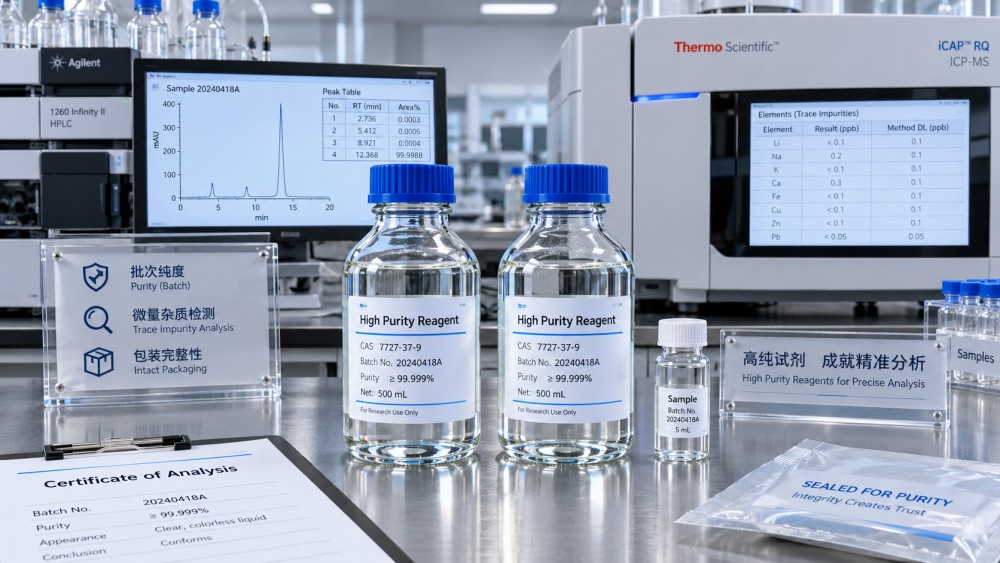
The certificate of analysis needs to match the application
A certificate of analysis is often the best starting point, but it should be read as a technical document rather than a pass/fail badge. First confirm the exact product identity: chemical name, concentration, grade, catalog reference where applicable, batch number, manufacturing or retest date, and package size. A certificate issued for a bulk production lot may not establish that a small package has remained protected after filling, warehousing, and distribution.
Next, compare the test panel with the actual failure modes of the method. A mobile phase solvent used for UV detection needs meaningful control of absorbance and residue, not merely a high assay. An acid used to prepare blanks for elemental determination needs individual elemental impurity limits. A buffer component used in sensitive biological work may require controls for nucleases, endotoxins, bioburden, or other biological contaminants, whereas such tests add little value to an acid-base titration.
Reported units deserve close attention. Limits expressed in parts per million, milligrams per kilogram, micrograms per liter, percent, or milliequivalents are not interchangeable without considering density, concentration, and sample preparation. A result below a detection limit is also different from a measured value near that limit. If one certificate lists “<0.1” and another lists “not detected,” the statements are not equivalent unless the analytical method and reporting threshold are known.
For hydrated salts, solutions, and volatile chemicals, the basis of reporting is especially important. Assay on an anhydrous basis, assay as received, and concentration by mass can all describe the same material differently. A comparison that ignores basis and test method can make equivalent batches appear different or conceal a material difference.
Impurities that matter are often application-specific
Trace metals receive much attention because they are easy to recognize as contaminants, but they are only one part of the picture. Organic impurities can suppress or produce chromatographic peaks. Peroxides in ethers can affect reactions and create handling concerns. Dissolved gases influence pH-sensitive measurements and oxidation-sensitive systems. Chloride and sulfate may interfere with precipitation reactions or electrochemical tests. Insoluble matter can block fine filters, damage instrument components, or produce erratic blank readings.
Stabilizers are a frequent source of confusion. Some solvents are deliberately stabilized to reduce degradation during storage. That is beneficial for shelf stability, yet the stabilizer may interfere with a particular reaction, detector, or purification step. Conversely, an unstabilized solvent is not automatically superior. Without an appropriate storage environment, it can degrade faster and no longer match its original certificate. The correct choice is tied to the procedure and the planned storage period.
Container interaction can change the result after release. Strong alkalis may extract material from glass under certain conditions. Trace-metal work can be compromised by unsuitable caps, liners, tubing, or transfer tools. Hygroscopic solids can gain water after repeated opening, while volatile solvents can shift in composition through evaporation if closures are damaged. These changes are not evidence that the original manufacturing region produced lower-purity material; they show why received quality and in-use quality must be separated.
Transport and storage can erase an initial quality advantage
A highly specified reagent is only as reliable as its condition when opened. Long transport routes, temperature excursions, humid storage, damaged seals, and delayed inventory rotation can alter susceptible chemicals. Light-sensitive compounds may discolor or form degradation products. Some solutions can crystallize, stratify, or lose concentration if exposed to unsuitable temperatures. Oxidizable materials can develop impurities when repeatedly exposed to air.
Comparison should therefore include packaging format and handling instructions. Amber glass, fluorinated containers, metal cans, moisture barriers, septum caps, inert-gas headspace, and tamper-evident seals are functional controls, not decorative packaging differences. A package designed for repeated sampling may reduce contamination risk relative to a large container opened many times, even where the liquid inside began with the same release specification.
Receipt inspection can identify problems before a chemical enters a method. Package damage, leakage, unusual color, visible solids, broken seals, unreadable batch details, or mismatched documentation deserve investigation. For critical reagents, a small incoming verification test may be more informative than relying on a nominal regional origin. The verification should target the characteristic that can invalidate the procedure, such as water content, blank response, conductivity, pH, assay, or a selected impurity.
A practical way to compare equivalent-looking products
Start with the method requirement rather than the product name. Define the chemical form, concentration, acceptable contaminants, physical condition, and storage constraints. A specification written only as “high purity” leaves too much room for incompatible substitutes. A more useful requirement might identify maximum water content, a defined metal panel, residue after evaporation, low UV absorbance at relevant wavelengths, or a limit for a known interfering ion.
- Compare the full specification sheet, including test methods where available, instead of comparing the headline assay alone.
- Look for individual impurity limits that relate directly to the procedure. A total impurity figure offers little protection when one particular ion or organic compound causes the failure.
- Review several batch certificates when consistency matters. A single favorable batch shows release quality for that lot, not necessarily the spread between production lots.
- Separate unopened shelf-life expectations from the controls needed after opening. A reagent used over months may need smaller pack sizes or a transfer method that limits exposure.
- When changing source, qualify the material against the established method with appropriate blanks, controls, and system-suitability criteria before replacing existing stock.
Supplier documentation should also be internally consistent. The product label, safety documentation, technical specification, and certificate should agree on concentration, grade, batch identification, and storage conditions. Contradictions do not prove poor quality, but they weaken traceability and make investigation harder when a method begins to drift.
When regional origin is useful information
Origin can be relevant when it signals a known manufacturing route, a particular pharmacopeial or industry specification, a practical transport condition, or the availability of documentation. It can also affect lead times and the likelihood that a product spends extended periods in a challenging climate before use. These are legitimate comparison points, but they should be converted into verifiable technical questions.
For example, instead of assuming that a reagent from one region has superior trace-metal quality, compare the declared elemental limits, the method used to obtain them, the lot documentation, the package design, and the consistency of incoming verification. Instead of assuming that a locally stocked solvent is fresher, compare manufacture date, retest date, storage history where available, seal condition, and baseline performance in the intended instrument.
Laboratory chemicals from different regions can be equally pure when they are produced under comparable controls, tested against equivalent and relevant specifications, and preserved through distribution. They are not equivalent merely because the bottle shows the same assay or grade. The most defensible comparison follows the contaminants that matter to the work, the evidence behind the stated limits, and the condition of the material at the point of use.
- Last One:No more articles
- Next Article:No more articles
Related News
- 00
0000-00
Which metal property standards apply to tensile testing of steel? - 00
0000-00
Can polymer processing simulation predict injection molding warpage? - 00
0000-00
An export controls compliance guide to checking U.S. license requirements - 00
0000-00
How Do Metals Compare in Physical Properties and Heat Resistance? - 00
0000-00
Which Standards Apply to Tensile Strength Testing of Metal Alloys?
Related tags
Weekly Insights
Stay ahead with our curated technology reports delivered every Monday.