




How Should Laboratory Chemicals Be Stored to Prevent Degradation?




Chemicals degrade when their storage conditions allow them to react with moisture, oxygen, light, heat, contaminants, or their own containers. The practical answer is to store each reagent according to its safety data sheet and label, then control the environmental factors that matter for that specific material. A clean cabinet at room temperature is sufficient for many stable salts and buffers, but it is not a universal solution for volatile solvents, hygroscopic powders, peroxide-forming liquids, light-sensitive compounds, oxidizers, or temperature-controlled biological reagents.
For laboratories, degradation is more than an inventory problem. A reagent that has lost concentration, absorbed water, formed decomposition products, or become contaminated can alter analytical results without producing an obvious warning. The consequence may be failed quality-control checks, unreliable calibration, repeat testing, invalid batches, or a safety incident caused by pressure buildup or incompatible storage. Good storage therefore starts with chemical identity and intended use, not with a one-size-fits-all cabinet layout.
Start with the label, SDS, and intended analytical use
The manufacturer label and current safety data sheet should define the starting conditions: recommended temperature range, protection from light, container requirements, incompatibilities, shelf life, and any special handling after opening. These instructions are more useful than generic advice because stability can differ significantly among chemicals that appear similar.
For example, a high-purity solvent used in trace analysis may need tighter protection from water and airborne contamination than the same solvent used for routine cleaning. An acid sold for general laboratory work may remain usable after minor exposure to air, while an ultrapure grade intended for instrumental analysis may no longer meet its specification. Storage decisions should therefore consider both chemical hazard and the performance requirement of the method.
Before placing a new chemical into stock, record:
- The original receipt date, opening date, and supplier expiry or retest date.
- The storage condition stated on the label and SDS.
- Whether the material is sensitive to moisture, air, light, heat, freezing, or repeated temperature cycling.
- The container material and closure type supplied by the manufacturer.
- Its segregation group, especially whether it is flammable, oxidizing, corrosive, toxic, water-reactive, or peroxide-forming.
- Any method-specific limit for concentration, purity, water content, or blank contamination.
This record does not need to become a complicated administrative exercise. Its purpose is to prevent a common failure: treating every unopened bottle as equally stable and every opened bottle as suitable until its printed expiry date.
Control the conditions that cause degradation
Most storage failures can be traced to a small set of environmental exposures. The right control depends on which exposure creates the greatest risk for the chemical in question.
Temperature: avoid both heat and unnecessary cycling
Elevated temperature generally accelerates chemical reactions, evaporation, and pressure buildup. Volatile solvents can lose composition through repeated opening in a warm room; reactive materials can decompose more quickly; and standard solutions may drift from their certified concentration. Refrigerated materials should stay within their specified range, but refrigeration is not automatically beneficial. Some liquids crystallize, separate, or become unsuitable after freezing. Others can be damaged by recurring movement between cold storage and bench conditions.
A refrigerator or freezer used for laboratory chemicals should be suitable for that duty and should not be treated as ordinary food-storage equipment. Materials that can release flammable vapors require storage equipment appropriate for flammable chemicals. Keeping incompatible substances together simply because they share a temperature requirement creates a different risk.
Temperature monitoring is particularly useful for expensive, sensitive, or regulated reagents. A recorded temperature excursion does not always mean a reagent must be discarded, but it gives the laboratory the information needed to assess whether the material remains fit for use. Without that information, a deviation may only emerge later as unexplained analytical variability.
Moisture: protect hygroscopic and water-reactive materials at the point of use
Many powders, salts, catalysts, desiccants, and reactive intermediates absorb water from humid air. The visible signs can include clumping, color changes, loss of free-flowing behavior, or caking, but degradation often begins before those signs appear. Water uptake can change mass-based preparation, reduce assay value, initiate hydrolysis, or produce variable reaction outcomes.
For hygroscopic materials, storage quality depends heavily on how the container is opened and resealed. Leaving a bottle uncapped while weighing material, using a wet spatula, or returning excess material to the original container can introduce more risk than the cabinet environment itself. Use clean, dry tools; remove only the required amount; close the container promptly; and keep the original closure clean enough to seal correctly.
Where the supplier specifies dry storage, use the stated approach, such as tightly closed packaging, a desiccated enclosure, or an inert atmosphere. The method should be proportionate to the material. A routine reagent that tolerates short air exposure may not need elaborate handling, while a highly moisture-sensitive reagent may require a controlled dry box or glovebox throughout dispensing.
Light: use the packaging as part of the stability control
Light can initiate or accelerate decomposition in photosensitive acids, metal salts, dyes, indicators, vitamins, some organic compounds, and many reference materials. Amber glass helps reduce exposure, but it is not a substitute for proper placement. Bottles stored under direct sunlight, intense bench lighting, or near a window can still experience substantial exposure over time.
Keep light-sensitive materials in their original amber container where possible, inside a closed cabinet or secondary opaque container if the label calls for light protection. Avoid transferring such chemicals into clear bottles for convenience unless the replacement packaging is demonstrably compatible and provides the same level of protection. Labels should remain visible and legible; a fully wrapped bottle that cannot be identified safely creates operational problems.
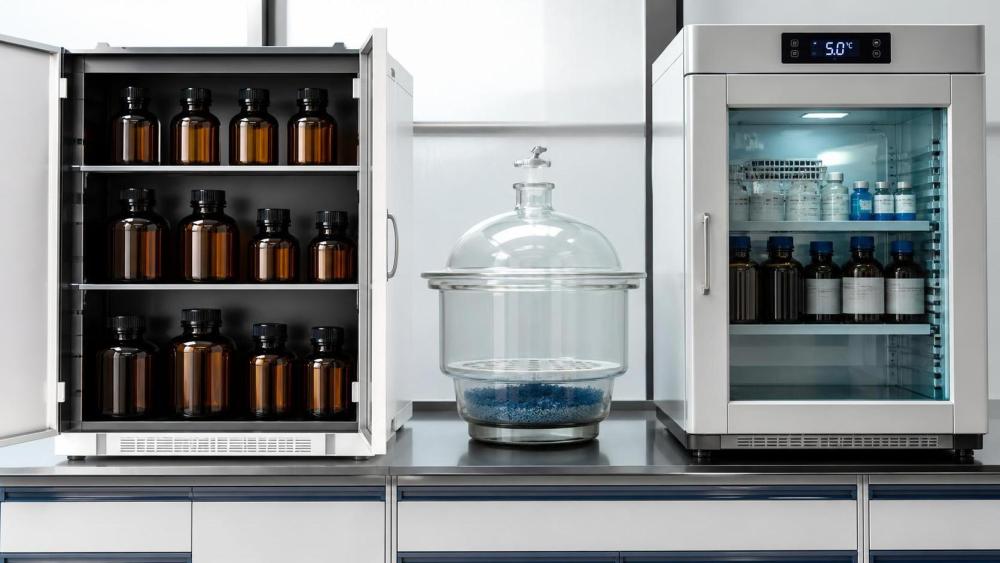
Air and headspace: reduce oxidation, carbonation, and solvent loss
Oxygen and carbon dioxide can change the composition of air-sensitive reagents. Strong bases may absorb carbon dioxide and water, changing concentration and introducing carbonate contamination. Oxidizable chemicals may form impurities over time. Volatile liquids may evaporate, especially when a cap liner is damaged or the bottle is repeatedly opened.
The simplest controls are often the most effective: use the smallest practical package size, keep containers tightly closed, inspect caps and liners, and avoid prolonged dispensing. A large container that is opened frequently creates a growing headspace exposure problem. Dividing a compatible bulk material into properly labeled, clean secondary containers can reduce repeated access to the main stock, but only when transfer procedures prevent contamination and preserve traceability.
Packaging compatibility is a chemical-control decision
A container is not merely a transport item. Glass, polyethylene, polypropylene, fluoropolymers, metal closures, elastomer liners, and adhesives each have limits. A chemical may leach substances from its packaging, permeate through a plastic wall, corrode a cap, react with a liner, or adsorb onto the container surface. These interactions can reduce purity even if temperature and cabinet segregation are otherwise correct.
Keep chemicals in their original manufacturer packaging unless there is a clear operational reason to transfer them. Original containers are selected to match the product specification and provide important identification. When secondary containers are necessary, verify compatibility using supplier guidance and laboratory procedures. The secondary label should identify the contents, concentration where applicable, relevant hazards, preparation or transfer date, and any shortened use-by date.
Do not assume that an intact-looking bottle remains acceptable. Cracked caps, hardened liners, discolored plastics, corrosion around closures, swollen containers, crystallized residues, and missing labels all warrant investigation. For highly reactive or high-purity chemicals, even a minor closure defect can matter before visible bulk changes occur.
Segregate for safety without losing sight of stability
Chemical segregation is usually discussed as a fire and reaction-prevention measure, but it also helps preserve material quality. Acids stored near bases, oxidizers near organic solvents, or corrosives under poorly protected metal shelving can create leaks, contamination, and damage that compromise neighboring reagents. Storage arrangements should follow compatibility groups rather than alphabetical order alone.
Secondary containment is useful for spill control, but it should not become a mixed storage bin. Containers placed together in the same tray should remain compatible in the event of leakage. Avoid stacking large bottles or placing corrosives where a leak can damage labels, shelving, or incompatible stock below.
Opening a bottle changes its storage life
The printed expiry date often applies to an unopened product stored as specified. Once opened, the relevant question becomes whether the chemical has been exposed to conditions that could alter its quality. Some products state an in-use period after opening; others require the laboratory to establish an internal control based on use frequency, storage conditions, and method criticality.
High-use reagents deserve particular attention because each opening introduces air, moisture, and potential cross-contamination. This is especially important for volumetric solutions, chromatography solvents, reference standards, and reagents used in low-level analysis. A bottle can remain within its labelled date while no longer being suitable for a sensitive method.
A workable approach is to apply first-expire, first-out inventory control, then add condition-based checks for critical reagents. These checks may include visual inspection, confirmation of solution clarity, review of temperature records, standardization, blank response, calibration performance, or method-specific verification. The appropriate test depends on the material and the consequence of an incorrect result.
Common practices that shorten reagent life
Several familiar habits undermine otherwise sound storage programs. Refrigerating every chemical can cause precipitation, freezing, or condensation damage. Decanting into unlabelled convenience bottles breaks traceability. Storing all liquids together may place oxidizers next to flammables. Leaving reagents on a bench for daily access exposes them to heat and light for no analytical benefit. Returning unused material to the original bottle can contaminate an entire lot.
Another weak practice is relying only on appearance. Some degraded chemicals turn yellow, form precipitates, or generate crystals, but many quality changes are invisible. A clear solution can still have reduced concentration, elevated impurity levels, altered pH, or unsuitable trace-metal background. When a reagent supports a release decision, calibration, or validated analytical method, storage suitability should be linked to the method’s acceptance criteria rather than visual appearance alone.
Build a storage routine that can be maintained
The most reliable system is one laboratory staff can follow consistently. Assign storage locations by hazard and temperature requirement, maintain a clear chemical inventory, inspect higher-risk materials on a defined schedule, and remove expired or compromised stock promptly. Separate long-term stock from daily-use bottles where practical, and make sure labels remain readable after cleaning or secondary containment.
For purchasing teams and laboratory managers, package size should be part of the quality decision. Buying the largest container may reduce unit price while increasing waste, repeated exposure, and the chance that a partially used reagent ages beyond the needs of the method. The better choice is often the package size that can be consumed within a controlled in-use period while preserving the required grade and traceability.
Knowing how to store laboratory chemicals to avoid degradation ultimately comes down to matching storage controls to the chemical’s failure mode. Read the supplied instructions, protect against the relevant environmental trigger, use compatible packaging, segregate hazards correctly, and treat opened containers as a separate stability decision. Those steps preserve both the chemical and the confidence that laboratory results still mean what they appear to mean.
Related News
- 00
0000-00
Which sectors are driving demand in the chemical engineering market? - 00
0000-00
How to assess lifecycle emissions from CCUS for low-carbon cement - 00
0000-00
How do energy storage technologies compare for 8-hour discharge? - 00
0000-00
Do mill test reports prove industrial alloys meet ASTM standards? - 00
0000-00
How to verify plastic recycling system suppliers' throughput claims
Weekly Insights
Stay ahead with our curated technology reports delivered every Monday.