




How to reduce equipment downtime in mining operations




When a haul truck fails on a production route or a conveyor stops feeding the plant, the lost time can spread well beyond the equipment under repair. Crews may wait for access, spare parts, or a revised operating plan while production targets come under pressure.
Reducing downtime starts with identifying the failures that cause the greatest production loss, then addressing their causes through targeted maintenance, condition monitoring, parts readiness, and coordinated scheduling. For effective mining operations optimization, measure both how often critical equipment fails and how long it takes to restore service; each points to a different set of actions.
Find the interruptions that matter most
Start with a consistent downtime record for major mobile and fixed assets. Capture the asset, start and end times, failure symptom, affected component, work performed, and reason for any delay. Separate planned maintenance from unplanned failure, and distinguish repair time from waiting for isolation, technicians, parts, or equipment access.
Rank recurring events by their effect on the operating plan, not simply by the number of work orders. A short stop on a bottleneck crusher may have a greater production impact than a longer repair on a machine with a standby unit. Include knock-on effects where they can be established, but avoid counting the same lost production twice across linked assets.
Useful measures include equipment availability, mean time between failures, and mean time to repair. Define the operating hours and failure events used in each calculation before comparing assets or periods. Availability can conceal repeated brief stoppages, while an average repair time can hide a small number of exceptionally long parts delays. Review the underlying events alongside the headline measures.
Trace recurring failures beyond the failed part
Replacing a bearing, hose, or motor restores an asset, but it does not necessarily address the condition that caused the failure. Examine repeat incidents alongside operating conditions, recent maintenance, inspection findings, and any changes in material or duty cycle.
- Conveyors: Repeated belt damage may warrant checks for misalignment, material buildup, damaged idlers, loading-point wear, or inadequate cleaning. Confirm the actual failure mechanism before changing components.
- Crushers and screens: Abnormal vibration, overheating, or frequent wear-part replacement can point to loading, lubrication, alignment, or material-feed issues. Assess patterns against the equipment manufacturer’s limits and site conditions.
- Mobile equipment: Tire damage, cooling problems, and hydraulic faults may be influenced by haul-road condition, contamination, loading practices, or inspection quality as well as component condition.
- Pumps: Seal failures and vibration should prompt a review of alignment, suction conditions, operating duty, and fluid characteristics rather than an automatic seal replacement alone.
Use a structured root-cause review for high-impact or repeated failures. Record the evidence, distinguish confirmed causes from assumptions, assign corrective actions, and set a date to check whether the failure pattern has changed. Where evidence is incomplete, preserve relevant parts and operating records before they are discarded or overwritten.
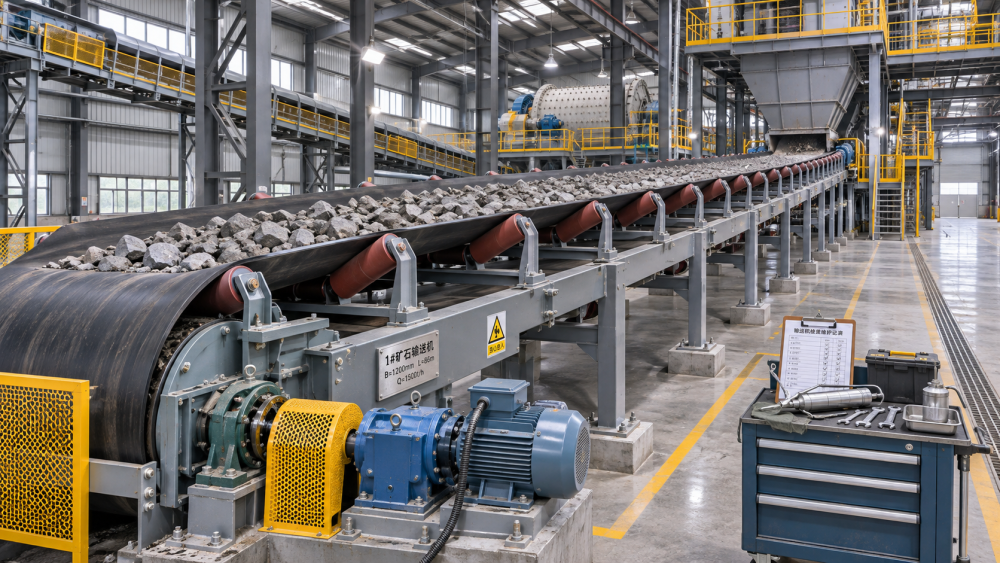
Match the maintenance method to the failure
Preventive maintenance is useful when a component has a known service interval or when inspection can detect deterioration before failure. Use manufacturer guidance as a starting point, then review intervals against site duty, observed wear, and failure history. Tasks should specify the inspection point, acceptance criteria, tools, and action required when a defect is found. A schedule filled with vague “check condition” tasks can consume maintenance time without producing a usable decision.
Condition monitoring is most useful where deterioration can be detected early enough to plan an intervention. Vibration analysis may help track rotating equipment; lubricant sampling can reveal wear or contamination; temperature and pressure trends can indicate changes in cooling, lubrication, or process performance. Select the measurement around a plausible failure mode rather than collecting data because a sensor is available.
Establish a baseline under comparable operating conditions, assign someone to review alerts, and define when a reading triggers inspection, increased monitoring, or a controlled shutdown. A threshold without an owner or response plan is unlikely to prevent a failure. Some failure modes give little warning; protective devices, operating controls, or planned replacement may be more appropriate than monitoring alone.
Not every asset needs the same level of attention. Low-consequence equipment with readily available replacements may be suitable for a simpler repair-on-failure approach, provided failure does not create an unacceptable safety, environmental, or production risk.
Make planned work easier than emergency work
Maintenance windows compete with production, so work packages need to be ready before equipment is released. Identify the required labor, parts, lifting equipment, permits, isolation points, and expected duration. Group compatible tasks during the same shutdown, but leave enough time for inspection findings and avoid adding work that exceeds the available resources.
For mobile fleets, coordinate releases with dispatch and the production schedule. For fixed plant, check upstream and downstream dependencies: stopping a conveyor may affect access to a crusher, stockpile, or processing circuit. A shared look-ahead schedule helps maintenance and operations resolve these conflicts before the shift starts.
Repeat delays deserve their own work order review. If repairs routinely wait for isolation, improve the preparation and handover process. If diagnosis takes longer than the repair, review fault information, troubleshooting procedures, and technician access to equipment history. These are different problems from a shortage of spare parts and should not be treated as one.
Protect recovery time with a spare-parts plan
Prioritize parts according to equipment criticality, likelihood of failure, replenishment lead time, and the consequences of not having a replacement. A low-cost consumable can stop a major asset if it is difficult to obtain; an expensive assembly may justify a repairable spare or an agreed supply arrangement when its absence would extend a critical outage.
Check that stored parts are identifiable, compatible with the installed equipment, and kept in conditions appropriate to the item. Review shelf life where applicable, preserve storage requirements for seals and lubricants, and keep repairable components traceable through the rebuild process. Reconcile inventory records with physical stock: an item shown as available but missing or unsuitable is not an effective spare.
When sourcing alternatives, verify dimensions, materials, operating ratings, interfaces, and any equipment-specific requirements before substitution. A part that fits physically may still be unsuitable for the load, fluid, temperature, or duty cycle.
Turn the plan into an operating routine
Assign an owner to each high-priority action and review progress in a short recurring meeting involving operations, maintenance, and supply personnel. Track overdue critical inspections, repeat failures, work-order backlog, parts-related waiting time, and the completion of corrective actions. Compare these with production impact rather than treating completed work orders as proof that reliability has improved.
Use the findings to adjust the plan. A rising backlog may call for more realistic scheduling or additional resources; repeated failures after a component change call for a fresh examination of the cause. Before inspections or repairs, follow site isolation and energy-control procedures, and use competent personnel for work involving stored energy, confined spaces, lifting, or other significant hazards. Return equipment to service only after the required checks and operational handover are complete.
Related News
- 00
0000-00
How to verify product purity claims from chemical feedstock distributors - 00
0000-00
Will feedstock availability constrain biofuel production in 2026? - 00
0000-00
How to select corrosion-resistant agrochemical manufacturing reactors - 00
0000-00
How to verify an injection molding supplier in China - 00
0000-00
How to account for supplier lead times in raw material supply chain planning
Related tags
Weekly Insights
Stay ahead with our curated technology reports delivered every Monday.