




Are There Safer Alternatives to Traditional Steel Manufacturing?




Are there safer alternatives to traditional steel manufacturing? Yes—but “safer” needs to be defined carefully. In steelmaking, the risks are not limited to carbon emissions. Workers may be exposed to molten metal, extreme heat, dust, noise, coke-oven gases, moving heavy equipment, high-voltage systems, and the unpredictable consequences of process upsets. Communities and project owners also face concerns around air quality, water use, energy security, and the long operating life of major industrial assets.
Traditional integrated steelmaking, built around blast furnaces and basic oxygen furnaces, remains essential for many grades and volumes of steel. It is a mature route with deeply established supply chains. Yet its dependence on coke, sinter plants, iron ore reduction, and large-scale hot-metal handling creates both environmental burdens and difficult operating conditions. Newer production routes do not eliminate risk, but they can shift it into forms that are more controllable, more automated, and in some cases substantially lower in emissions.
For manufacturers, buyers, investors, and engineering teams, the practical question is not whether one technology is universally better. It is which route can produce the required steel quality with an acceptable safety profile, realistic energy inputs, dependable raw materials, and a credible path to commercial operation.
Why the conventional route is difficult to make safer
An integrated steelworks typically converts iron ore into hot metal in a blast furnace, then refines it into steel in a basic oxygen furnace. The process has been improved over decades through gas capture, dust collection, refractory design, process control, enclosed conveyors, and stronger worker-protection systems. Still, several inherent hazards remain.
- High-temperature exposure: Hot metal, slag, liquid steel, and radiant heat create severe burn and fire risks during tapping, transfer, relining, and maintenance.
- Coke and sinter operations: Preparing reducing agents and agglomerated ore can involve particulate matter, combustion gases, and complex materials handling.
- Heavy mobile equipment: Rail-mounted ladle cars, cranes, loaders, and scrap or ore handling systems raise collision and lifting risks.
- Carbon-intensive chemistry: Carbon is not merely an energy source in the blast furnace; it is part of the reduction chemistry. That makes deep emissions cuts harder than simply switching an electricity contract.
- Maintenance in harsh environments: Shutdown work around furnaces, ducts, refractories, and confined spaces is often among the highest-risk activity in a plant.
It is worth avoiding a common misconception: a blast furnace is not automatically unsafe, and an alternative facility is not automatically safe. A well-managed conventional mill may outperform a poorly designed new installation. The difference lies in the process hazards that can be designed out, isolated, monitored, or reduced before people are placed near them.
Electric arc furnaces: the most established alternative
For many steelmakers, the electric arc furnace (EAF) is the clearest available alternative to conventional blast-furnace steelmaking. Instead of producing iron from ore using coke, an EAF melts recycled ferrous scrap, direct reduced iron (DRI), hot-briquetted iron (HBI), or a blend of these metallic inputs using electrical energy.
From a safety and environmental perspective, the appeal is straightforward. An EAF avoids coke ovens, sinter plants, and blast-furnace ironmaking. That can reduce exposure to some combustion-related emissions and simplify the overall site layout. It also supports a circular material model: steel scrap is remelted rather than discarded, helping preserve the value embedded in existing metal.
However, EAF operations still involve molten steel, arc flash hazards, water-leak risks, dust, fumes, oxygen injection, and large scrap charges. Scrap can contain sealed containers, moisture, coatings, oils, or unknown alloying elements. If contaminated scrap enters the furnace, it can create safety incidents, quality problems, or difficult-to-control emissions.
When an EAF is a strong fit
EAF steelmaking is often attractive where scrap availability is reliable, electricity supply is stable, and the desired product mix can tolerate or manage residual elements such as copper, tin, chromium, or nickel. Long products, reinforcing bar, structural sections, and many engineering steels are commonly produced through electric routes. With careful charge design and high-quality DRI or HBI, EAFs can also support more demanding flat-product applications.
The climate benefit depends heavily on the power source. An EAF supplied by coal-dominated electricity may still have a considerable carbon footprint, while one powered by low-carbon generation offers a much stronger emissions case. For procurement teams, “electric steel” is not enough information; the metallic charge mix and electricity origin matter.
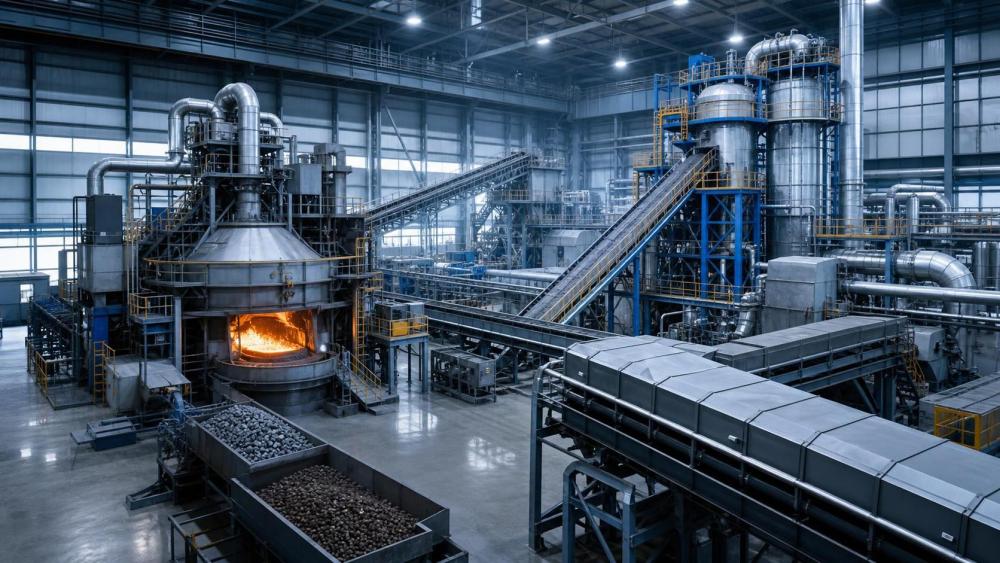
Hydrogen-based direct reduced iron: a promising route with new hazards to manage
Hydrogen-based direct reduced iron, often called hydrogen DRI or H2-DRI, is one of the most discussed pathways for lower-carbon primary steelmaking. Instead of relying primarily on carbon monoxide from coal or natural gas to remove oxygen from iron ore, the process uses hydrogen. The resulting DRI is then melted in an EAF or another electric melting unit.
When the hydrogen is produced with low-carbon electricity and the furnace electricity is also low carbon, this route can significantly reduce the emissions associated with primary steel production. It also avoids much of the coke-making infrastructure connected to the traditional blast-furnace route.
But hydrogen should not be treated as a simple safety upgrade. It is a small molecule that can leak through systems more easily than many conventional industrial gases. It has a wide flammability range, an almost invisible flame in daylight, and requires rigor in leak detection, ventilation, zoning, emergency response, and materials selection. Hydrogen can also contribute to embrittlement in certain metals and components if the system is not properly designed.
In other words, hydrogen DRI moves risk rather than making risk disappear. It reduces dependence on coke and can lower direct process emissions, but it demands mature gas-handling discipline. For a project team, the safety case must cover hydrogen production, compression, storage, transport, shaft-furnace operation, and the downstream handling of hot or cold DRI.
The raw-material constraint is real
Not every iron ore is suitable for direct reduction. DRI plants generally need high-grade iron ore pellets or lump ore with appropriate chemistry and physical properties. This can introduce sourcing pressure, especially when several new projects compete for limited premium-grade feedstock. Beneficiation and pelletizing may expand supply over time, but these stages also require capital, water, energy, and environmental controls.
For steel buyers, this matters because the sustainability profile of a finished coil, bar, plate, or billet is inseparable from the route and raw materials behind it. A supplier’s claim should be assessed alongside ore source, reductant, electricity, scrap share, process emissions, and product traceability.
Can carbon capture make conventional steelmaking safer?
Carbon capture, utilization, and storage (CCUS) is not a replacement for steelmaking equipment in the way an EAF or DRI plant may be. It is an add-on strategy that captures carbon dioxide from blast-furnace gas, reformer gas, or other process streams before it reaches the atmosphere. For regions with existing integrated assets, limited scrap, or constrained renewable power, CCUS may be one of the few near-term options for reducing emissions without closing major plants.
Its contribution to worker safety is indirect. Carbon capture can support improved gas management and more enclosed process systems, but it introduces additional equipment: solvent units, compressors, pipelines, dehydration systems, and storage or transport connections. These systems need their own hazard studies and operating procedures. Capturing carbon does not remove the high-temperature, coke-related, or molten-metal risks of the base steelmaking route.
CCUS is therefore best understood as a transition tool or a site-specific decarbonization option, not as a complete answer to safer manufacturing. It may be appropriate where existing blast furnaces have substantial remaining life and suitable carbon transport and storage infrastructure is available.
Safety improvements that matter regardless of the furnace route
Some of the strongest safety gains do not come from a single “green steel” technology. They come from changing how people interact with hazardous processes. A modernized steel plant can reduce direct human exposure through automation, remote operation, predictive maintenance, and better material tracking.
Automation deserves a balanced view. It can remove workers from dangerous zones, but it also creates new needs in cybersecurity, functional safety, sensor reliability, and technician training. A remote crane system is only safer if operators can trust its visibility, interlocks, communications, and fail-safe behavior.
A practical way to compare steelmaking alternatives
Companies evaluating steel supply or planning a new facility should avoid comparing technologies through a single metric such as “CO2 per tonne” or “percentage recycled content.” A more useful assessment starts with the end requirement: the steel grade, mechanical properties, coating needs, volume, delivery location, and required certifications.
Then examine the production route in five layers.
- Material suitability: Can scrap, DRI, HBI, pig iron, or iron ore consistently achieve the chemistry and cleanliness the product requires?
- Energy reality: Is there enough affordable electricity? What is its grid mix? Is hydrogen available at the required purity, pressure, and reliability?
- Process safety: Which hazards are eliminated, which remain, and which new ones are introduced? Look beyond the furnace itself to storage, charging, transport, and maintenance.
- Infrastructure readiness: Consider grid connections, water systems, pellet supply, hydrogen pipelines or trucking, carbon storage networks, ports, and rail capacity.
- Commercial traceability: Can the producer document the route, recycled content, emissions methodology, standards compliance, and supply continuity?
This approach prevents an all-too-common procurement mistake: choosing a material label before confirming whether the supplier’s actual production route fits the project’s technical and risk requirements.
What “safer steel” may look like in practice
The safest future steel plant may not look like one dramatic breakthrough. It may be an EAF using carefully sorted scrap and DRI, powered increasingly by low-carbon electricity, with operators working from protected control rooms. In another region, it may be a hydrogen DRI plant connected to renewable generation and supported by stringent gas-safety systems. Elsewhere, a modernized integrated mill with carbon capture, enclosed material handling, and advanced automation may be the most realistic near-term improvement.
Each pathway has trade-offs. Scrap-based production depends on quality scrap collection and sorting. Hydrogen DRI depends on renewable power, electrolyzers, suitable ore, and safe hydrogen infrastructure. Carbon capture depends on storage or transport networks and does not change the core reduction chemistry. Decisions should be grounded in local resources rather than in broad claims about a universally superior route.
Finding reliable information before making a sourcing decision
Steelmaking technology is developing quickly, and terminology can be confusing. “Low-carbon steel,” “green steel,” “electric steel,” and “near-zero-emissions steel” are often used differently across markets. Buyers and project managers should ask for process-specific information rather than relying on a label alone.
Useful reference points include the steel grade and standard, furnace route, metallic input composition, power source, reductant type, emissions accounting boundary, recycling content, and available environmental product documentation. Technical resources that bring together steel products, alloys, smelting equipment, raw materials, supplier capabilities, export information, and market developments can make comparison more practical. Platforms such as GEMM help users organize these fragmented details before engaging suppliers or committing capital to a process choice.
So, are there safer alternatives to traditional steel manufacturing? There are credible alternatives, and several are already operating at commercial scale. The best option is not simply the newest furnace or the lowest-emissions headline. It is the route that matches the required material performance while reducing avoidable worker exposure, managing new process hazards responsibly, and fitting the energy and raw-material realities of the region.
Related News
- 00
0000-00
Which sectors are driving demand in the chemical engineering market? - 00
0000-00
How to assess lifecycle emissions from CCUS for low-carbon cement - 00
0000-00
How do energy storage technologies compare for 8-hour discharge? - 00
0000-00
Do mill test reports prove industrial alloys meet ASTM standards? - 00
0000-00
How to verify plastic recycling system suppliers' throughput claims
Weekly Insights
Stay ahead with our curated technology reports delivered every Monday.