




What Maintenance Does a Drilling Rig Need Every 500 Hours?




A drilling rig rarely fails at a convenient moment. The warning signs often appear earlier: a hydraulic function that feels slower than usual, a rotary head that runs warmer, a loose connection near the mast, or a filter indicator that has been ignored for one shift too many. Knowing what maintenance does a drilling rig need every 500 hours gives crews a practical opportunity to find these issues before they become a stalled borehole, a damaged component, or a safety incident.
The 500-hour service is not identical for every rig. A compact geotechnical rig, water-well unit, mining drill, and oilfield workover rig all have different duty cycles, fluid capacities, and manufacturer requirements. Still, the interval is commonly used as a more thorough preventive-maintenance checkpoint than the daily walk-around or weekly grease routine. It is the point where operators should look beyond obvious leaks and ask whether the machine is still operating within its intended condition.
A good service plan starts with the rig manufacturer’s operation and maintenance manual. That document takes priority for lubricant grades, oil-analysis limits, torque values, filter replacement intervals, and inspection procedures. The checklist below provides a working framework for maintenance teams, fleet managers, and project supervisors who need to prepare a reliable 500-hour drilling rig service.
Start with the maintenance record, not the wrench
Before opening a panel or draining a fluid reservoir, review what the rig has experienced during its last 500 operating hours. Hours alone do not tell the full story. A unit drilling in abrasive sand, corrosive groundwater, extreme heat, or remote winter conditions may need more attention than a similar rig working on stable ground with clean fuel and trained operators.
Check operator logs, fault codes, repair notes, oil-analysis reports, and records of consumables used. Ask the crew a few direct questions: Has the engine been hard to start? Has the feed system drifted? Has a pump become noisy? Are there repeated alarms, unusual vibration, or inconsistent drilling pressure? These observations help the maintenance team focus on developing problems rather than treating the service as a box-ticking exercise.
Also confirm that the hour meter, service stickers, and digital maintenance system agree. Missed intervals are common when rigs move between sites or operate under multiple contractors. A clear record is particularly valuable when comparing suppliers, assessing used drilling equipment, or planning spare-parts inventory across a fleet.
Control contamination: filters, fluids, and breathers
Contamination is one of the most persistent threats to drilling equipment. Dust, water, metal particles, poor fuel quality, and degraded oil can shorten the life of pumps, injectors, bearings, valves, and gear sets. At 500 hours, fluid-condition checks deserve more than a quick glance through a sight glass.
Engine oil and engine filtration
Change engine oil and the oil filter if the manufacturer’s prescribed interval falls at 500 hours. Even when an oil change is not yet due, inspect the oil level, color, odor, and visible contamination. A milky appearance may indicate water ingress; a fuel smell can point to dilution; metallic debris in drained oil or a cut-open filter requires immediate investigation.
Inspect the air intake system carefully. Service or replace the engine air filter only according to the restriction indicator and manufacturer guidance. Replacing filters too early can sometimes disturb the sealing surface and introduce contamination, while waiting too long raises fuel consumption and increases engine wear. Examine intake hoses, clamps, dust ejector valves, and housing seals for cracks or loose fittings.
Fuel filters and water separators should be drained or replaced as specified. In dusty drilling locations, mobile fuel tanks and refueling practices deserve scrutiny as well. A clean new filter cannot compensate for contaminated fuel entering the system every day.
Hydraulic oil, filters, and reservoir condition
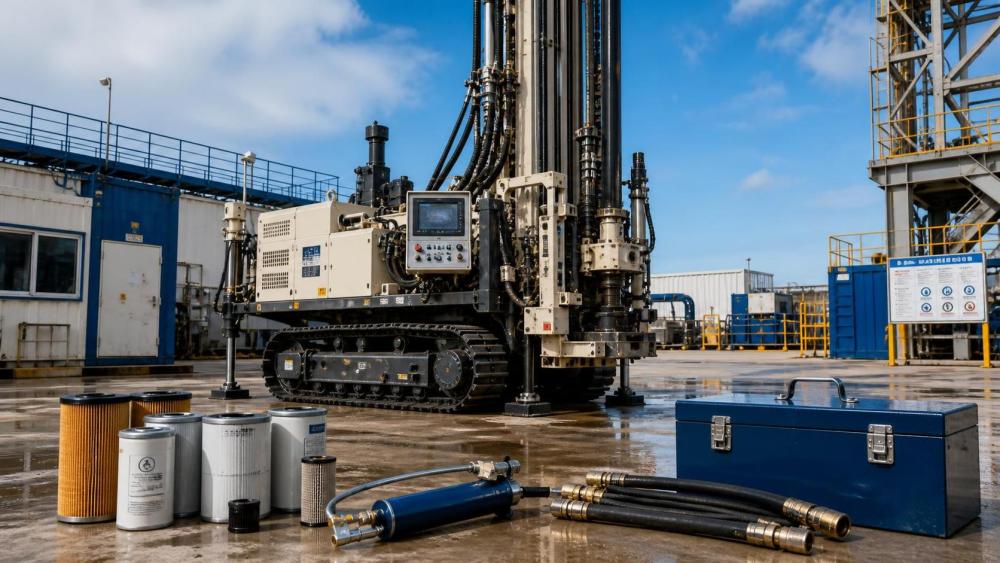
The hydraulic circuit drives many of the rig’s highest-load functions: feed, rotation, jacking, mast movement, breakout systems, and auxiliary tools. Check hydraulic oil level with the rig parked as instructed, then inspect the fluid for foaming, discoloration, burnt odor, or suspended particles. Take an oil sample when the fleet maintenance program uses laboratory analysis, preferably from a live sampling point rather than from the bottom of the tank.
Replace return, pressure, pilot, or case-drain filters where the scheduled service interval requires it. Record the condition of removed elements. A small amount of normal residue may be expected, but shiny metal, rubber fragments, or heavy sludge can reveal a pump, motor, hose, or seal problem before it causes a major failure.
Do not overlook reservoir breathers and filler caps. A blocked or damaged breather can pull unfiltered air into the tank as fluid levels change. Wipe filler areas clean before opening them, and use dedicated, clean transfer equipment for hydraulic oil. Many hydraulic failures begin during routine servicing, not while drilling.
Lubricate moving points—but verify that grease is reaching them
At 500 hours, the lubrication system should be inspected as a system rather than treated as a list of grease nipples. Grease mast pivots, cylinder pins, rotary-head supports, breakout clamps, rod-handler joints, winch components, sliding surfaces, and other points listed by the manufacturer. Use the correct grease type; mixing incompatible products can reduce performance and make lubrication intervals unreliable.
Automatic lubrication systems need special attention. Check the reservoir level, pump operation, timer settings, distribution blocks, injector lines, and fittings. A full grease reservoir does not prove that grease is reaching every point. Look for dry pins, hardened grease, damaged tubing, or excess grease escaping at one point while another remains starved.
Inspect wire ropes, sheaves, pulleys, and winch drums if the rig uses them. Look for broken wires, flattened sections, corrosion, poor spooling, or damaged rope guides. Follow the manufacturer’s discard criteria rather than relying on visual judgment alone. Rope failures can develop quietly and carry serious consequences around suspended loads and mast operations.
Inspect the drilling system where load and vibration concentrate
The mast, feed frame, rotary head, gearbox, drill string handling equipment, and structural weldments endure repeated shock loads. A 500-hour inspection should focus on both wear and alignment.
Check the mast and substructure for cracked welds, bent members, corrosion, missing retainers, loose fasteners, and damaged safety decals. Pay close attention to high-stress areas around pivot points, cylinder mounts, guide rails, and brackets. Clean dirt and drill cuttings from suspected areas before inspection; cracks are easy to miss under accumulated mud.
Inspect feed chains, cables, rollers, slides, and wear pads. Measure chain tension or cable condition according to the manual, and confirm that the rotary head travels smoothly without binding or excessive side play. Uneven wear in guide pads or rails may indicate misalignment, worn bearings, or a bent component. Ignoring this can affect hole straightness, drilling efficiency, and the life of the feed system.
For rotary gearboxes and drive systems, check lubricant level, external leakage, breather condition, mounting bolts, and abnormal noise. If the service schedule calls for gearbox oil replacement or sampling at 500 hours, follow the specified procedure and use the correct fluid. Gear oil that appears unusually dark, smells burnt, or contains visible metal should not be dismissed as ordinary aging.
Examine drill rod threads, thread protectors, breakout jaws, clamps, and handling systems. Replace worn gripping surfaces before they begin to slip or damage tooling. Thread compound should be clean and suitable for the rod type and drilling application. Damaged threads can turn a routine rod change into downtime, lost tools, or a difficult recovery operation.
Check hoses, cylinders, and hydraulic function under pressure
A visual hydraulic inspection is important, but it should be paired with a controlled functional test. Look along every accessible hose for abrasion, blistering, cracking, leakage, improper routing, and missing clamps. Hoses rubbing against the mast, frame, or moving feed assembly can fail without much warning. Check fittings for seepage and cylinders for rod scoring, damaged wipers, loose mounting pins, and oil leaks.
Never use hands to search for a pressurized hydraulic leak. A fine fluid jet can penetrate skin and requires urgent medical treatment. Use safe inspection methods, appropriate personal protective equipment, and follow site isolation procedures.
With the work area clear, operate the mast, feed, rotation, jacks, clamps, and auxiliary functions through their normal range. Listen for pump whine, chatter, knocking, or cavitation. Watch for jerky travel, weak movement, unexpected drift, or overheating. These symptoms do not always mean a major component has failed, but they should lead to diagnosis before the rig returns to demanding work.
Engine, cooling, and electrical checks prevent avoidable stoppages
Drilling crews often feel the impact of engine and electrical problems long before a scheduled overhaul. At the 500-hour mark, inspect belts, pulleys, engine mounts, exhaust connections, battery terminals, starter cables, and wiring harnesses. Tighten connections only to specified torque and repair damaged insulation before moisture and vibration make the problem worse.
Clean the radiator, oil cooler, charge-air cooler, and protective screens using a method that does not bend fins or drive debris deeper into the core. Cooling packages working in dusty areas can lose heat-transfer capacity quickly. Check coolant level and concentration where appropriate, inspect hoses and clamps, and look for seepage around the water pump, radiator, and heater lines.
Test work lights, emergency stops, alarms, gauges, cameras, interlocks, and communication systems. A machine may still drill with a failed warning lamp or faulty backup alarm, but it should not be accepted as ready for safe operation. Electrical defects are especially important on rigs with electronic engine controls, automated rod handling, remote monitoring, or hybrid power components.
Safety devices and structural fasteners should never be “assumed okay”
A 500-hour service is an appropriate time to inspect safety-critical items in a deliberate sequence. Verify emergency-stop function, guarding, fire extinguishers, access steps, handrails, anti-slip surfaces, lockout points, lifting eyes, and mast-locking devices. Check that required labels remain readable, particularly around crush zones, high-pressure circuits, rotating equipment, and electrical hazards.
Fasteners on the mast, rotary head, engine mounts, subframe, stabilizers, and hydraulic components should be examined and torqued only where the manufacturer specifies a value and sequence. Randomly tightening every bolt can cause damage or hide a deeper issue. If bolts repeatedly loosen, investigate vibration, joint condition, alignment, or improper installation rather than simply applying more torque.
For rigs used in regulated mining, construction, water-well, or energy operations, site-specific inspection requirements may add items beyond the standard maintenance manual. Document those checks clearly. A signed checklist has value only when it records real findings, corrective action, and the person responsible for follow-up.
What should be replaced at 500 hours?
There is no universal parts list. Depending on the rig model and operating environment, the 500-hour service may include engine oil and filter changes, fuel-filter replacement, hydraulic-filter replacement, lubrication-system consumables, gearbox oil service, and replacement of worn seals, clamps, hoses, or wear pads identified during inspection.
The important distinction is between scheduled replacement and condition-based replacement. Filters and fluids may have fixed intervals. Hoses, pins, chains, bearings, drill string components, and structural parts should be replaced when inspection measurements, visible condition, diagnostic evidence, or manufacturer limits require it. Replacing everything prematurely increases cost; delaying known wear increases risk.
A practical closeout before the rig returns to the hole
Once maintenance is complete, clean the machine, remove tools and rags, reinstall guards, and check fluid levels after the rig has been run and cycled. Record hours, parts used, lubricant types, inspection findings, faults corrected, and items deferred for repair. A short post-service test under controlled conditions can reveal leaks, low fluid levels, loose fittings, or alarms that were not apparent during shutdown.
For organizations managing several equipment types, structured technical information is useful when comparing maintenance requirements, component specifications, and available replacement options. Industry platforms such as GEMM can help users locate drilling equipment references, understand application-specific systems, review supplier information, and connect maintenance decisions with broader sourcing and operating considerations.
Ultimately, the answer to what maintenance does a drilling rig need every 500 hours is not simply “change fluids and grease fittings.” It is a disciplined inspection of the systems that carry load, transmit power, manage heat, and protect people around the rig. When that work is documented and performed with attention to the machine’s actual operating conditions, the 500-hour interval becomes a valuable safeguard against the far more expensive interruption nobody planned for.
Related News
- 00
0000-00
Which sectors are driving demand in the chemical engineering market? - 00
0000-00
How to assess lifecycle emissions from CCUS for low-carbon cement - 00
0000-00
How do energy storage technologies compare for 8-hour discharge? - 00
0000-00
Do mill test reports prove industrial alloys meet ASTM standards? - 00
0000-00
How to verify plastic recycling system suppliers' throughput claims
Weekly Insights
Stay ahead with our curated technology reports delivered every Monday.