




Which Metal Alloy Best Resists Sulfuric Acid Corrosion?




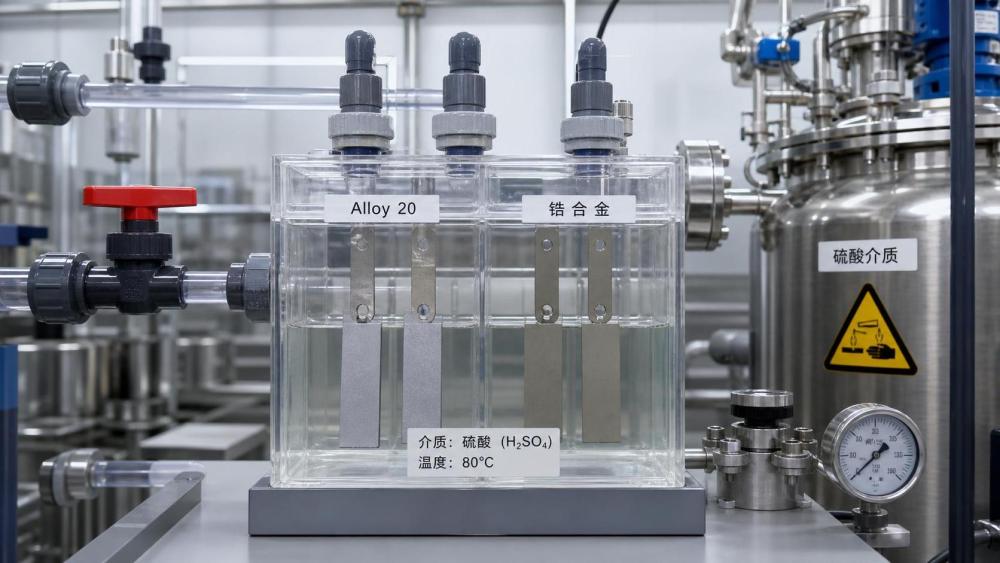
No single metal alloy is best for every sulfuric acid service. For many industrial duties, Alloy 20 is the most practical general-purpose choice because it was developed specifically for sulfuric acid resistance. Where corrosion resistance takes priority over cost and fabrication simplicity, zirconium alloys often provide superior performance across a broader range of sulfuric acid concentrations and temperatures. Stainless steel, nickel alloys, titanium, and high-silicon iron each have narrower but valuable operating windows.
The correct answer depends on the actual acid chemistry at the metal surface, not merely the concentration written on a process sheet. Temperature, flow, dissolved oxygen, ferric ions, chlorides, reducing contaminants, vapor condensation, and periods of shutdown can all change the corrosion mechanism. A material that performs well in a storage tank can fail rapidly in a heated pump, valve trim, agitator zone, or acid-transfer line.
Start with the service condition, not the alloy name
Sulfuric acid behaves differently as concentration changes. Dilute acid is strongly acidic and often reducing, which can destabilize the passive oxide films that protect stainless steels and titanium. At higher concentrations, the acid may become less corrosive to certain materials because a protective surface film forms. Raising the temperature can remove that advantage, increase corrosion rate, or create localized attack at crevices and deposits.
A material-selection review should separate at least four questions:
- What is the normal acid concentration? Include dilution points, wash-water carryover, startup mixtures, and any concentration changes during cleaning or batch processing.
- What is the highest metal temperature? Bulk liquid temperature is not always enough. Heat-traced pipework, pump seal faces, exchanger inlets, and steam-heated equipment can run hotter than the measured process stream.
- Is the acid clean? Chlorides, hydrofluoric acid, metal salts, oxidizing contaminants, and suspended solids can alter the expected corrosion behavior substantially.
- Where can liquid become trapped? Gaskets, lap joints, threaded connections, dead legs, flange faces, and deposits create local chemistry that differs from the main flowing stream.
These details explain why corrosion tables are useful screening tools but should not be treated as final design approval. Published data usually describe a defined concentration, temperature, exposure method, and material condition. They may not represent welded fabrication, fluctuating concentration, erosion, or stagnant acid.
Alloy 20: often the practical answer for sulfuric acid
Alloy 20 is an austenitic nickel-chromium-molybdenum alloy with copper additions. Its composition was developed to improve resistance to sulfuric acid while retaining the fabrication characteristics associated with stainless-based alloys. It is frequently selected for tanks, pipe, pumps, valves, fittings, pickling equipment, chemical-process vessels, and acid handling systems where 316 stainless steel is no longer reliable.
Its major advantage is balance. Alloy 20 offers useful resistance across many dilute and intermediate sulfuric acid conditions, has better general corrosion resistance than common austenitic stainless steels, and is generally more accessible and easier to fabricate than highly specialized reactive-metal equipment. It also has a long history in sulfuric acid service, so compatible welding consumables, cast equivalents, and component forms are commonly available.
That balance does not make Alloy 20 universal. Hot concentrated acid, strongly reducing acid with unfavorable impurities, severe crevice conditions, or rapidly changing concentration may require a more resistant material. A supplier quotation that identifies only “Alloy 20” also needs review: wrought plate, pipe, forged fittings, cast pump casings, weld metal, and fasteners may have different product forms and corrosion behavior.
When a system uses Alloy 20, weld procedure control matters. Heat tint and oxide scale left after welding may undermine local corrosion resistance. Weld geometry should avoid sharp crevices and incomplete penetration. Where post-weld cleaning is appropriate, the cleaning method must itself be compatible with the alloy and must not leave chloride-bearing residues on the surface.
When zirconium becomes the leading choice
Zirconium alloys are among the most resistant metallic materials for sulfuric acid. They are especially attractive where acid is hot, where concentration varies through a difficult range, or where long service life outweighs the cost of a conventional nickel alloy. The protective zirconium oxide film remains stable in many sulfuric acid environments that challenge stainless steels and standard nickel alloys.
The strongest case for zirconium is not simply “high acid concentration.” It is demanding sulfuric acid duty with elevated temperature, aggressive concentration changes, or repeated exposure that would make corrosion allowance impractical. Zirconium can be supplied as solid components or as cladding and lining over a structural substrate, depending on pressure, geometry, and heat-transfer requirements.
Its limitations need equal attention. Zirconium is not a universal acid metal. Fluoride contamination is particularly important because fluoride species can attack the protective oxide film. Even trace contamination from upstream chemistry, cleaning agents, or contaminated rinse water deserves investigation. Design also needs to account for fabrication method, weld quality, material traceability, and the possibility of galvanic coupling to less noble connected metals.
Where zirconium is used as a clad construction, the corrosion-resistant layer must be protected during fabrication and maintenance. Grinding through the clad layer, attaching temporary fixtures without control, or allowing a damaged lining to expose the backing steel can create a localized failure point. The backing material provides strength; it is not intended to tolerate sulfuric acid exposure.
Why titanium is frequently misapplied
Titanium has an excellent reputation in many corrosive services, especially oxidizing media and chloride-containing water. That reputation can lead to an incorrect assumption that it is automatically suitable for sulfuric acid. In reducing sulfuric acid conditions, titanium's protective oxide film may not remain stable. The result can be high general corrosion or hydrogen absorption under unsuitable conditions.
Titanium may perform acceptably where oxidizing species support passivation, but that is a condition-specific outcome rather than a default material rule. A process containing ferric ions, dissolved oxygen, or another oxidizing influence can behave differently from clean, deaerated acid. Changing the feed source or introducing a reducing cleaning step can therefore change the material ranking.
For this reason, titanium should not be selected solely because it resists seawater, chlorides, or nitric acid. Sulfuric acid requires its own compatibility review, including upset conditions and the possibility that oxygen levels decline in a closed or stagnant system.
Stainless steels: useful only in defined windows
Type 316L stainless steel is widely available and often appears in early estimates, but it is vulnerable in many sulfuric acid services. Dilute, warm, or contaminated acid can cause unacceptable general corrosion, while crevices beneath gaskets and deposits can concentrate the attack. Higher-alloy stainless grades can extend the operating range, particularly where chromium, molybdenum, nickel, and nitrogen improve resistance to localized corrosion.
However, stainless steel performance in sulfuric acid should not be inferred from chloride-pitting resistance alone. An alloy optimized for seawater does not necessarily solve reducing-acid corrosion. The role of sulfuric acid concentration is also non-linear: a grade that resists one concentration range may perform poorly at a lower or higher concentration.
Stainless steel remains a sensible choice where verified service data supports it and where the process is controlled. It is less suitable as a conservative default for heated or variable sulfuric acid service. Extra wall thickness is not a substitute for compatibility when corrosion is localized, when weld zones are attacked, or when loss of a passive film can accelerate quickly.
Nickel alloys and high-silicon iron have specialized roles
Nickel-based alloys are often considered when Alloy 20 approaches its limits. Some nickel-chromium-molybdenum grades offer broad resistance to mixed acids and aggressive impurities, but their sulfuric acid performance must still be checked against the exact reducing or oxidizing condition. A grade that excels in chloride-bearing oxidizing process liquor may not be the most economical or durable answer for hot reducing sulfuric acid.
Alloy 825 is another commonly considered nickel-iron-chromium material. It can offer useful resistance in selected sulfuric acid duties and is often evaluated where equipment also encounters chloride contamination or mixed chemical exposure. Its suitability should be based on the full environment rather than assumed from its nickel content.
High-silicon iron can provide excellent resistance to certain concentrated sulfuric acid applications, particularly in static or low-velocity equipment. Its weakness is mechanical: it is brittle compared with steel and nickel alloys, making it poorly suited to impact, vibration, thermal shock, complex welded fabrication, and some pressure-containing designs. It can be a strong material choice for a defined component, yet an unsuitable choice for a complete piping system.
Component location can change the answer
A sulfuric acid system may need more than one material. Tank shell, internal coils, nozzles, pump casing, impeller, mechanical seal parts, bolts, valve seats, and instrumentation connections see different temperatures, velocities, stresses, and crevice geometries. Selecting one alloy for every item can either create unnecessary cost or leave a small but critical weak point.
For example, a lined carbon steel tank may be compatible with the stored acid while its metallic nozzle, drain valve, or sampling connection becomes the first corrosion site. A pump may have an alloy casing but fail at a seal spring, sleeve, fastener, or flush connection. Sulfuric acid dilution stations deserve special care because the heat of dilution can create a short, severe temperature spike at the point where water and acid meet.
Flow velocity also needs interpretation. Higher velocity can reduce stagnant deposits and keep surfaces more uniform, but it can worsen erosion-corrosion where solids are present or where protective films are fragile. The same acid composition may therefore require different materials for a quiet storage vessel and a slurry-bearing transfer pump.
A defensible selection sequence
- Define the acid concentration range, including off-specification batches, dilution, startup, cleaning, and shutdown conditions.
- Map maximum wall temperatures rather than relying only on nominal process temperature.
- Identify contaminants from upstream feedstocks, recycled acid, rinse streams, and cleaning chemicals. Fluoride, chlorides, dissolved metals, and oxidizing or reducing species deserve explicit attention.
- Separate wetted components by duty: static containment, flowing pipework, valve internals, pumping, heat transfer, vapor space, and condensate exposure.
- Review corrosion data for the actual material form and welded condition. Where the duty is close to a known limit, use testing or experienced corrosion-engineering review before finalizing the specification.
- Specify fabrication and inspection requirements that preserve the selected material's corrosion resistance, including weld filler compatibility, surface cleaning, lining integrity, and positive material identification where mixed alloys are present.
The most useful short answer is therefore two-part: Alloy 20 is often the best practical all-round alloy for sulfuric acid equipment, while zirconium is frequently the best high-performance metallic choice for the most demanding sulfuric acid conditions. The final selection should follow the actual concentration, temperature, impurity profile, component duty, and fabrication details, because any one of those factors can reverse the apparent ranking.
Related News
- 00
0000-00
Which drilling systems are suited to long-lateral shale wells? - 00
0000-00
Which sectors are driving demand in the chemical engineering market? - 00
0000-00
How to assess lifecycle emissions from CCUS for low-carbon cement - 00
0000-00
How do energy storage technologies compare for 8-hour discharge? - 00
0000-00
Do mill test reports prove industrial alloys meet ASTM standards?
Related tags
Weekly Insights
Stay ahead with our curated technology reports delivered every Monday.