




Matching Tyre Cutter Capacity to Reclaimed Rubber Powder Production Lines




A reclaimed rubber powder line can be limited long before the mill, granulator, or screening deck reaches its nominal rating. In many projects, the restriction begins at the tyre cutting stage: whole tyres arrive irregularly, bead content varies, and the first size-reduction machine must prepare feed that downstream equipment can accept consistently. Selecting a cutter by its brochure throughput alone can create an expensive mismatch between the receiving area and the rest of the process.
For project managers, the practical question is not simply “How many tyres can the cutter process per hour?” It is whether the cutter can deliver suitably sized, repeatable feedstock at a rate that keeps the next process stage supplied without creating excessive stockpiles, unplanned stops, or avoidable wear. Capacity matching requires a view of the full material flow, including tyre intake, cutting pattern, conveyor transfer, steel separation, milling, classification, dust control, and maintenance access.
Start with the real bottleneck, not the nameplate rating
A tyre cutter is normally installed near the front of a reclaimed rubber powder production line, where it reduces whole passenger, truck, agricultural, or mixed end-of-life tyres into sections suitable for later shredding or grinding. Its nominal output may be presented as mass per hour, tyres per hour, or a maximum tyre size. None of these figures alone describes the output available to the line in normal operation.
Actual capacity depends on the incoming tyre mix. A steady supply of similar passenger tyres behaves very differently from a mixed stream containing truck casings, tyres with substantial remaining tread, mud-contaminated tyres, or units with varying sidewall thickness. Larger tyres require more handling time and may need different positioning. Bead wires can change cutting resistance and affect blade wear. If the cutter output is calculated from an ideal sample but the procurement plan assumes a variable local feedstock stream, the upstream machine can become the line’s first operational constraint.
Project teams should distinguish between three capacity measures:
- Peak mechanical capacity: output under favourable conditions, often with uniform feed and limited interruptions.
- Planned operating capacity: output expected during normal scheduled production, including routine loading, discharge, and operator handling.
- Effective line capacity: the sustained rate after allowing for changeovers, blade inspection, downstream pauses, material variation, and planned maintenance.
The third measure is the one that should guide project economics. A cutter that occasionally exceeds the downstream rate offers little benefit if its output shape or feed consistency causes the shredder, cracker mill, or granulator to stop repeatedly.
Translate downstream demand into cutter requirements
Capacity matching starts at the point where powder is specified. The desired powder grade, its permitted metal and textile content, and the required production rate determine the duty imposed on upstream equipment. Fine powder production often involves more than one reduction and separation stage. Each stage has a practical feed-size range, and forcing oversized tyre sections into a machine designed for smaller fragments can reduce throughput, increase power demand, and accelerate wear on cutting elements or screens.
Rather than treating the cutter as an isolated purchase, map the line backward from the first machine that receives cut tyre pieces. The engineering team should define:
- the largest feed dimension accepted by the next reduction stage;
- the preferred piece geometry, such as strips, blocks, or sections;
- the downstream machine’s continuous feed demand;
- the mass of material that can be buffered between stages;
- the anticipated percentage of heavy-duty or oversized tyres;
- the operating schedule, including whether the cutter runs continuously or in batches.
A cutter may be sized slightly above the average downstream demand when a buffer conveyor, bin, or controlled stock area is available. This arrangement allows the cutter to operate in batches while the next machine receives a more stable supply. The buffer, however, must be designed around the real bulk behaviour of cut rubber. Large irregular sections can bridge in narrow hoppers, catch on conveyor transitions, and resist smooth discharge. A storage volume calculated only from mass may be inadequate if the material is bulky and poorly flowing.
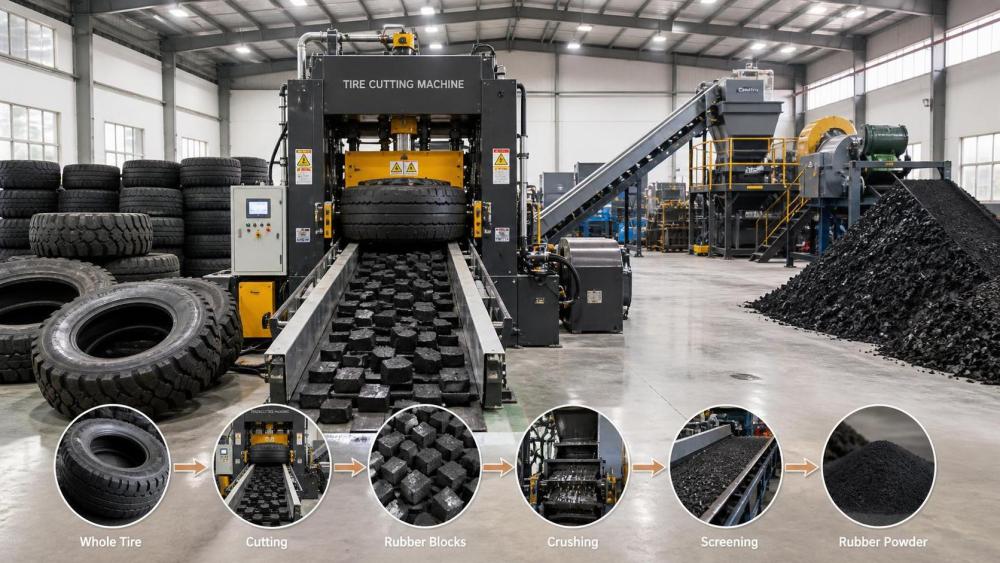
Conversely, oversized front-end capacity can be wasteful where there is no safe buffering space. If a high-output cutter discharges material faster than operators or conveyors can clear it, pile-up near the discharge point becomes both a productivity and safety issue. The best arrangement is often one that has enough reserve capacity to recover from routine interruptions, not one that maximizes instantaneous cutting rate.
Feed size consistency matters as much as tonnes per hour
Downstream shredders and mills respond to dimensional variation differently. A robust primary shredder may tolerate a broad range of tyre sections, while a smaller secondary machine may need relatively uniform pieces to avoid uneven rotor loading. Wide variation in cut size can cause surging: large pieces momentarily reduce feed rate, then smaller pieces pass quickly, leaving the next stage alternately starved and overloaded.
For reclaimed rubber powder production, the cutter should be assessed for the repeatability of its cut rather than merely its ability to sever a tyre. The cutting arrangement, clamping method, tyre positioning, and operator procedure all affect the outcome. A machine that creates manageable pieces with a predictable maximum dimension can simplify conveyor selection and reduce the risk of oversized feed entering later equipment.
When reviewing a cutter described as a шинорез, the project specification should state the intended incoming tyre categories and the required discharge condition. It should not rely on a broad statement such as “suitable for waste tyres.” The supplier’s scope, inspection records, and proposed operating procedure should be checked against the actual line layout and material route.
Use a material-flow balance during design
A simple mass-flow balance can expose mismatches early. If the powder line is expected to consume a certain average mass of prepared tyre material during each operating shift, the cutter must provide at least that quantity after allowing for expected downtime and non-cutting activities. The balance should also account for material removed or diverted before powder production, including bead wire, textile fractions, rejected contaminated tyres, and off-spec pieces that require reprocessing.
It is useful to plan for a realistic availability factor rather than assuming every machine runs for every scheduled hour. Cutting blades require inspection and replacement. Hydraulic systems, electrical controls, guards, conveyors, and clamping mechanisms also need attention. The exact allowance varies by machine condition, feedstock, maintenance discipline, and spare-parts access, but omitting it can make a line look balanced on paper when it is not.
Used cutting equipment needs a different verification process
Used machinery can be a practical option for projects that need to control capital expenditure or integrate equipment into an existing rubber-processing facility. Its value depends less on age alone than on condition, configuration, serviceability, and fit with the intended process. A used cutter that was designed for a different tyre category or discharge size may require modifications that offset its initial purchase advantage.
Safety verification should be treated as part of output verification. A cutter cannot sustain planned production if guarding, interlocks, emergency-stop functions, hydraulic controls, or electrical protection are unreliable. During inspection, project teams should establish whether the machine can be operated and maintained without routine exposure to pinch points, moving blades, falling tyre sections, or unexpected energy release. Local legal requirements and site safety procedures will determine the detailed compliance review.
Key inspection points commonly include:
- condition and alignment of blades, knife holders, guides, and clamping surfaces;
- evidence of cracks, deformation, corrosion, or prior repairs in the frame and cutting area;
- hydraulic hose condition, leakage, pressure stability, and cylinder movement where hydraulic actuation is used;
- operation of guards, interlocks, emergency stops, control panels, and isolation points;
- availability of drawings, wiring information, manuals, and suitable replacement parts;
- compatibility of motors and controls with site power supply;
- clearance for loading, discharge, blade servicing, and safe removal of trapped material.
An acceptance plan should define what can be observed before shipment and what must be confirmed after installation. If practical, a trial should use tyre types representative of the intended feedstock rather than only easy-to-cut samples. The objective is not to demand a universal performance figure; it is to see whether cut size, cycle consistency, control response, and operator handling align with the line design.
Line layout can quietly reduce cutter output
Even a well-selected machine can lose practical capacity through poor integration. Tyres need enough space for staging and safe loading. The cutter discharge must align with downstream conveying equipment without forcing operators to reposition material manually. Sharp conveyor angles, undersized transfer openings, and insufficient containment can cause recurring blockages. These issues often appear after commissioning, when the cutting machine is blamed for delays that originate in the surrounding arrangement.
Access is equally important. Blade changes, cleaning, inspection, and removal of occasional trapped material should be possible without dismantling unrelated equipment. Projects that place the cutter tightly against walls or other machines may save floor area initially but make routine maintenance longer and less safe. In a multi-shift operation, a short maintenance task can become a major loss of feed availability if access is restricted.
Dust and debris management should also be considered at the cutting stage. Although cutting whole tyres generally produces different emissions from fine grinding, loose dirt, rubber fragments, and metal-containing pieces may still require containment and housekeeping measures. The appropriate approach depends on the material condition and site rules, but the layout should leave room for cleaning and avoid creating areas where combustible debris can accumulate.
Build procurement documents around operating conditions
A useful request for quotation or internal equipment specification describes the process duty, not just the equipment category. It should identify tyre diameters and widths, expected proportion of truck or specialty tyres, incoming contamination, target cut dimensions, expected operating hours, desired interface with conveyors, and available electrical supply. Where used equipment is considered, the document should also request condition photographs, equipment history if available, details of repairs or replaced components, and a clear list of included and excluded accessories.
Commercial comparison should include more than equipment price. Installation work, electrical adaptation, conveyor changes, replacement blades, guarding upgrades, testing, and transport can materially affect the delivered cost of a used or refurbished machine. A lower-priced cutter may be appropriate if the project has in-house engineering capacity and predictable tyre input. A more complete package may reduce integration uncertainty where the schedule is tight or the line has little spare capacity.
Commission around stable feed, then optimize
During commissioning, it is sensible to establish a stable baseline with a narrow, representative tyre mix before introducing the full range of available material. Operators can then record actual cycle times, inspect cut pieces, observe conveyor behaviour, and identify whether downstream equipment receives material evenly. Once the base condition is stable, more demanding tyres can be introduced in controlled batches.
The cutter’s operating procedure should define how tyres are inspected before loading, how oversized units are handled, when blades are checked, and what conditions require a stop. Recording the cause of interruptions is more useful than recording only total output. A recurring delay caused by tyre positioning calls for a different remedy than one caused by blade wear, a blocked discharge chute, or a downstream conveyor fault.
Capacity matching is ultimately an integration exercise. The cutter should prepare tyres at a rate and size range that the reclaimed rubber powder line can absorb reliably, while leaving enough operational margin for changing feedstock and planned maintenance. Projects that specify this relationship early are better placed to avoid a front-end machine that is either undersized for the duty or oversized for the process it is meant to support.
Related News
- 00
0000-00
Can a digital supplier discovery platform verify overseas suppliers? - 00
0000-00
Which drilling systems are suited to long-lateral shale wells? - 00
0000-00
Which sectors are driving demand in the chemical engineering market? - 00
0000-00
How to assess lifecycle emissions from CCUS for low-carbon cement - 00
0000-00
How do energy storage technologies compare for 8-hour discharge?
Related tags
Weekly Insights
Stay ahead with our curated technology reports delivered every Monday.