




What Maintenance Schedule Suits Underground Mining Equipment?




Build the Schedule Around Exposure and Duty Cycle
The maintenance schedule that suits underground mining equipment is usually a layered, condition-based program rather than a single calendar. A loader, drill jumbo, bolter, truck, or scaler operating through wet headings, abrasive dust, steep ramps, and frequent stop-start cycles should not be maintained on the same interval as an equivalent machine used in cleaner, lower-duty conditions.
For most underground fleets, the practical starting point is a shift-based inspection, a weekly service routine, planned maintenance at manufacturer hour intervals, and condition monitoring for components whose failure would create a safety event or major production delay. The schedule then needs adjustment using the mine's own operating evidence: contamination levels, repair history, component temperatures, fluid analysis, fault-code trends, and the actual hours spent under load.
A calendar-only plan often misses the point. A machine may run relatively few engine hours while accumulating severe stress from short tramming distances, repeated hydraulic movements, idling, high ambient heat, water ingress, or poor ventilation. Conversely, replacing major parts strictly because a date has passed can increase cost without reducing risk. The right program gives maintenance teams defined intervention points while leaving room to shorten or extend specific tasks when conditions justify it.
Start Every Shift With Safety-Critical Checks
Pre-start and end-of-shift inspections are the foundation of underground equipment maintenance. They are not detailed workshop services. Their purpose is to identify defects that could affect braking, steering, visibility, fire protection, personnel safety, or the machine's ability to return safely from the working area.
Operators are usually best positioned to spot changes that a workshop inspection may miss: a new vibration in the drivetrain, a hydraulic function moving more slowly than usual, an unusual smell, a drop in tramming power, repeated warning lights, or a leaking hose near a heat source. For this reason, inspection records should capture observations in usable language rather than forcing every issue into a generic “pass” or “fail” field.
- Check fluid levels and visible leaks from fuel, engine oil, coolant, hydraulic circuits, transmission systems, and brake circuits.
- Inspect tires, wheel fasteners, tracks, articulation joints, pins, boom structures, buckets, feed rails, and ground-engaging tools for damage or excessive wear.
- Test brakes, steering, emergency stops, lights, alarms, cameras, fire-suppression equipment, seat restraints, and communication systems where fitted.
- Confirm that filters, radiator packs, cooling-air passages, electrical cabinets, and fire-protection zones are free of excessive dust or debris.
- Record machine hours, active alarms, fault codes, and any loss of performance before the machine enters service.
Daily checks should lead to clear decisions. A minor issue can be logged for planned attention; a defect involving brakes, steering, fire protection, structural damage, exposed electrical conductors, or uncontrolled fluid leakage should trigger removal from service according to site procedures. Treating all defects as equal is one reason inspection systems become ineffective.
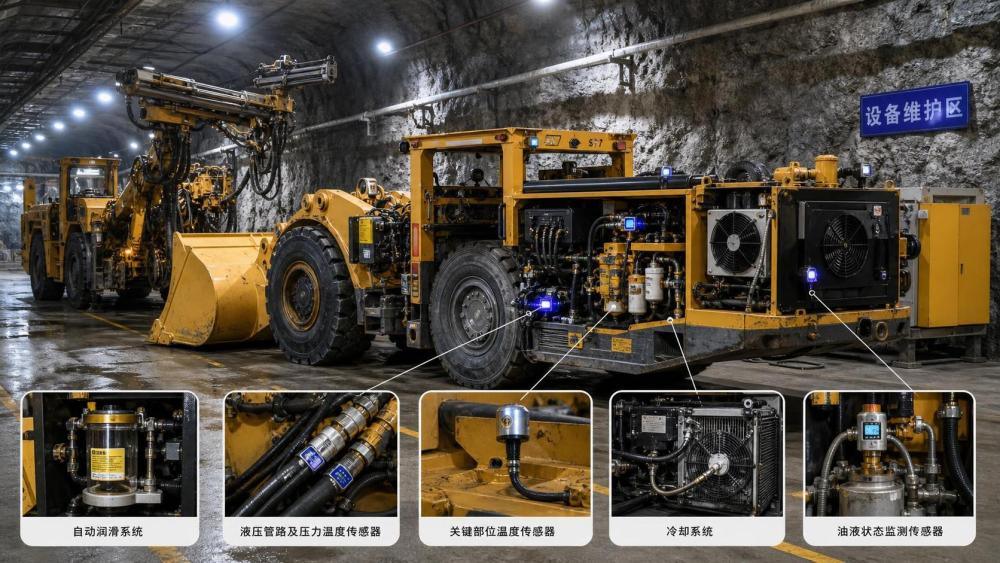
Use Weekly Service Time to Control Contamination and Wear
Underground mines impose a contamination problem on nearly every mobile asset. Fine dust reaches joints, filters, electrical enclosures, cooling surfaces, and hydraulic systems. Water, mud, saline groundwater, and process residues can accelerate corrosion and degrade lubricants. The weekly service interval is therefore where many fleets win or lose reliability.
Weekly work commonly includes lubrication of pivots and articulation points; cleaning or inspecting cooling packs; checking air filtration restriction indicators; examining hoses and clamps; torque checks at defined high-load locations; and reviewing battery condition, electrical connections, and cable routing. The exact list should reflect equipment design, but the principle remains consistent: remove contamination before it becomes a heat, wear, or failure problem.
Lubrication deserves particular attention. A nominal grease interval is only useful when the correct lubricant reaches the intended bearing surface. Blocked lines, damaged fittings, empty automatic-lubrication reservoirs, or grease displaced by water can leave high-load pins unprotected even when records show the task as completed. Where machines work in wet ground, wash-down areas, or highly abrasive muck, lubrication frequency may need to increase beyond the standard manual.
Filter decisions should also be based on operating condition, not habit. Changing filters prematurely creates avoidable cost and can introduce contamination during servicing. Extending them too far can damage pumps, injectors, turbochargers, or cooling performance. Restriction indicators, fluid cleanliness results, differential pressure readings, and inspection of the intake path provide a better basis than changing every filter at the same fixed interval.
Plan Major Services by Operating Hours, but Do Not Treat Hours as the Only Measure
Manufacturer service intervals remain the core structure for oil changes, drivetrain inspections, valve adjustments, hydraulic maintenance, and component overhaul planning. They provide a defensible baseline because they reflect the equipment's design, lubricant specification, and expected duty cycle. Yet underground operations often require a separate severity classification.
A useful approach is to place each machine or machine group into a normal, severe, or extreme duty category. Normal duty may apply where ventilation is adequate, haul roads are maintained, water exposure is limited, and machines complete predictable work cycles. Severe duty may include high dust levels, sustained gradients, long loaded hauls, frequent high-temperature operation, or heavy use of hydraulic attachments. Extreme duty can include corrosive water, persistent mud, very short and repetitive cycles, unusual ambient temperatures, or access constraints that delay repairs.
Once a category is assigned, maintenance planners can reduce selected intervals rather than shortening everything. For example, a wet mine may require more frequent inspection of electrical connections, seals, brake components, and articulation bearings, while a hot, dusty mine may demand closer attention to cooling systems, air intake protection, and fluid condition. A machine working on steep ramps may need more frequent brake, transmission, axle, and tire reviews than a drilling unit that stays largely in one development heading.
Service intervals should be tied to engine hours, but planners should also track idle time, loaded operating time, distance traveled, tonnes handled where relevant, drilling metres, and the number of work cycles. These measures reveal whether two machines with the same hour reading have experienced comparable stress. A load-haul-dump machine repeatedly filling and tramming under heavy payload may consume components very differently from one used for lighter clean-up work.
Do Not Make Overhaul Dates Automatic
Major components such as engines, transmissions, hydraulic pumps, wheel motors, axles, rock drills, and compressor systems may have recommended overhaul ranges. Those ranges are valuable for budgeting and parts planning, but they should not automatically become replacement dates. Early removal may be justified where inspection, oil analysis, vibration monitoring, temperature trends, or repeated faults show deterioration. At the same time, a well-performing component with stable condition indicators may be able to remain in service under a managed extension program.
The extension decision should never rely on a single clean oil sample or one month of good performance. It should consider trend data, the consequence of in-service failure, availability of replacement units, access to the machine, and whether the component can be changed in a planned maintenance window. The cost of a failure at the face or on a main haul route is often much larger than the price of the failed part.
Condition Monitoring Is Most Valuable for High-Consequence Components
Predictive maintenance does not require every machine to carry an extensive sensor package. The better question is where early detection changes a decision. Components that are expensive, difficult to access, safety-critical, or likely to cause long downtime are the strongest candidates for condition monitoring.
Oil analysis can identify contamination, abnormal wear metals, viscosity changes, water ingress, and oxidation in engine, transmission, axle, and hydraulic systems. It becomes useful when samples are taken consistently and interpreted as trends. One abnormal result may reflect sampling error or a recent repair. A repeated change in particle count, water content, or wear-metal pattern is more meaningful and should lead to targeted inspection.
Temperature monitoring can expose restricted cooling flow, bearing distress, brake drag, electrical resistance, or hydraulic inefficiency. Vibration analysis may be suitable for certain rotating equipment, pumps, fans, motors, and drivetrain components. Telematics and onboard diagnostic data can reveal recurring derates, overspeed events, regeneration issues, excessive idle time, pressure deviations, or operator-triggered alarms.
These tools should support the maintenance schedule rather than create a second, disconnected reporting system. If a condition alert cannot be assigned, assessed, and closed through the maintenance workflow, the mine collects data without improving availability. Maintenance teams need defined response rules: which alerts require immediate inspection, which can wait for the next scheduled service, and which trends justify bringing forward a component change.
Match the Schedule to Equipment Type
Underground mining fleets share many maintenance needs, but their failure patterns differ. A schedule should reflect the working system, not merely the machine brand or purchase year.
- Load-haul-dump machines and underground trucks: Focus heavily on brakes, steering, articulation, tires, rims, driveline components, cooling systems, payload-related stress, and transmission or axle condition. Haul gradients and road quality should influence inspection frequency.
- Drill jumbos and bolters: Give added attention to feed beams, booms, rotation units, rock drills, hoses, water systems, dust suppression, electrical cables, and structural pins. Poor drilling accuracy or declining penetration can be an early maintenance signal, not only an operating issue.
- Scalers and breaker-equipped machines: Inspect attachment structures, hydraulic circuits, pin wear, bushings, couplers, and boom cracks closely. High-impact work can accelerate fatigue even when engine hours are modest.
- Utility vehicles and personnel carriers: Maintain them to the same safety discipline as production equipment. Their lower apparent duty cycle can lead to missed brake, steering, lighting, restraint, and fire-system checks.
- Fixed underground systems: Pumps, fans, crushers, conveyors, chargers, and substations need a separate reliability plan based on criticality, redundancy, vibration, temperature, electrical inspection, and spare-part lead times.
Design the Schedule Around Access, Spares, and Production Windows
A technically correct schedule still fails if the mine cannot perform the work when required. Underground access may be restricted by blasting, ventilation changes, ground-support activity, shift handovers, or the location of the machine. Maintenance planning should account for travel time, isolation requirements, lifting access, tool availability, and whether a repair can be completed safely in the assigned window.
For critical assets, planned maintenance should be connected to parts strategy. A mine does not need to stock every component, but it should know which failures would stop production and which parts have long replenishment times. Filters, hoses, seal kits, wear items, sensors, brake components, and frequently damaged electrical parts may justify local availability. Rotable components such as pumps, transmissions, or rock drills may require repairable spares or supplier support arrangements, depending on fleet size and rebuild capability.
Maintenance records should distinguish between planned replacement, condition-based intervention, damage repair, and recurring defect. Without that distinction, a fleet can appear to have high maintenance spend while the underlying cause remains hidden. Repeated hose failures may point to routing or heat exposure. Repeated filter blockage may indicate contamination control problems. Repeated structural repairs may reflect application mismatch, operator practice, or a change in ground conditions.
A Practical Starting Framework
For a mine establishing or revising its maintenance program, the most workable sequence is straightforward. Use the original equipment manufacturer schedule as the base. Identify safety-critical systems and make their inspections shift-based. Classify each machine by operating severity. Add weekly contamination control and lubrication tasks. Use condition monitoring for high-cost or high-consequence components. Then review failures, downtime, and fluid or diagnostic trends often enough to adjust the intervals.
The schedule should become more specific as operating evidence accumulates. Mines that repeatedly revise intervals without recording why can create inconsistency; mines that never revise them may continue servicing the wrong items at the wrong time. A controlled change process, with clear ownership between operations, maintenance, and reliability personnel, keeps the program practical.
The suitable maintenance schedule for underground mining equipment is therefore one that preserves safety every shift, controls dirt and water before they cause damage, uses operating hours as a baseline, and responds to the mine's actual duty cycle. That combination gives planners a better chance of avoiding disruptive failures without turning maintenance into indiscriminate parts replacement.
Related News
- 00
0000-00
Which sectors are driving demand in the chemical engineering market? - 00
0000-00
How to assess lifecycle emissions from CCUS for low-carbon cement - 00
0000-00
How do energy storage technologies compare for 8-hour discharge? - 00
0000-00
Do mill test reports prove industrial alloys meet ASTM standards? - 00
0000-00
How to verify plastic recycling system suppliers' throughput claims
Related tags
Weekly Insights
Stay ahead with our curated technology reports delivered every Monday.