




Buyer Checks for C25 Ductile Iron Pipe Specifications and Traceability




Buyer Checks for C25 Ductile Iron Pipe Specifications and Traceability
A pipe quotation that states “C25 ductile iron” is not yet a complete purchasing specification. The designation may be meaningful within a particular standard system, but it does not by itself confirm the pipe’s nominal diameter range, wall thickness, joint type, coating system, pressure capability at the intended diameter, or suitability for the installation environment. For procurement teams, the central task is to turn a short class designation into a controlled, verifiable supply requirement.
This matters because ductile iron pipe is commonly procured for water transmission, distribution networks, pumping stations, irrigation schemes, industrial utility lines, and buried infrastructure where replacement after installation can be disruptive and expensive. A mismatch discovered at the factory gate may delay a project; the same mismatch discovered after backfilling may create a far larger commercial and operational issue.
For a C25 ductile iron pipe purchase, buyer checks should begin with the governing standard and end with traceable evidence tied to the actual delivered lots. Documentation alone is not enough, but undocumented material leaves the buyer with little basis for acceptance, claims management, or future maintenance planning.
Why “C25” Needs Context Before It Becomes a Purchase Requirement
In ductile iron pipe standards, class designations are linked to defined dimensional and pressure-related requirements. Yet the designation must always be read alongside the referenced standard. In European and international water-pipeline practice, EN 545 and ISO 2531 contain requirements for ductile iron pipes, fittings, accessories, joints, linings, and external coatings used in water applications. Their technical tables and test provisions determine how class, diameter, wall thickness, and allowable pressure conditions are interpreted.
A buyer should avoid treating C25 as a universal statement of identical performance across all diameters or product ranges. Pressure capability can depend on nominal diameter, pipe geometry, joint arrangement, temperature, surge conditions, installation constraints, and the manufacturer’s declared system limits. A line exposed to pump starts, rapid valve closure, or frequent pressure fluctuations needs a different review from a gravity line or a relatively stable distribution main.
The request for quotation should therefore state the intended service rather than only the desired class. Useful project inputs include:
- fluid conveyed, expected operating temperature, and whether the line carries potable water, raw water, process water, or another medium;
- nominal diameters, total quantities, pipe lengths, and allowable tolerances;
- normal operating pressure, maximum pressure, and any calculated transient or surge pressure;
- burial depth, soil condition, traffic loading, trench method, and whether the pipe will be restrained or thrust-blocked;
- joint type, gasket requirements, fittings interface, flange requirements, and compatibility with existing assets;
- internal lining and external coating requirements for the actual water chemistry and soil environment; and
- the governing standard, edition, acceptance tests, and document package required at delivery.
Without those details, a supplier may price a technically plausible pipe that is nevertheless unsuitable for the project’s pressure envelope or corrosion exposure. The lowest quotation can then conceal later changes in coating, joint accessories, testing, packing, or inspection scope.
Separate the Pipe Class from the Full Technical Schedule
Procurement specifications often become weak when the class name replaces the complete product description. A more reliable schedule separates each technical element so that suppliers quote to the same basis. This also makes bid comparison more meaningful.
Where the project uses a named standard, buyers should obtain and review the applicable text rather than relying on catalogue summaries. EN 545:2010 addresses ductile iron pipes, fittings, accessories, and joints for water pipelines, while ISO 2531:2009 covers ductile iron pipes, fittings, accessories, and joints for water applications. Project owners may also impose additional requirements through utility standards, public works specifications, or contract documents. Sources: EN 545:2010, Ductile iron pipes, fittings, accessories and their joints for water pipelines—Requirements and test methods; ISO 2531:2009, Ductile iron pipes, fittings, accessories and their joints for water applications.
Pressure Review: Check the Whole System, Not Only the Straight Pipe
A common purchasing error is to confirm the class of straight pipe while leaving fittings, valves, couplings, flanges, restrained joints, and transition pieces outside the same pressure review. The pipeline will only be as robust as its lowest-rated component under the relevant operating and transient conditions.
Pressure assessment should distinguish among normal operating pressure, maximum operating pressure, and short-duration surge or water-hammer events. A pump trip, valve closure sequence, or sudden flow reversal can create transient pressures materially above normal duty. Hydraulic designers should establish those conditions; procurement personnel should make sure the resulting requirements are transferred without ambiguity into the bill of quantities and purchase order.
For a project calling for a C25 ductile iron pipe, the buyer should ask the supplier to identify the standard-based pressure information applicable to each quoted diameter and confirm the relationship between the proposed pipe, its joints, associated fittings, and the specified test regime. This is more useful than accepting a generic statement that the product is “high pressure” or “suitable for water supply.”
Where a contractor proposes substitutions, the review should cover more than nominal pressure. A thinner-wall alternative, another material, or a different joint configuration may alter handling procedures, thrust restraint design, trench bedding assumptions, corrosion protection, or the allowable construction tolerances. Such changes may be acceptable, but they should be assessed as system changes rather than treated as equivalent solely because the nominal diameter matches.
Traceability Should Survive Receiving, Storage, and Installation
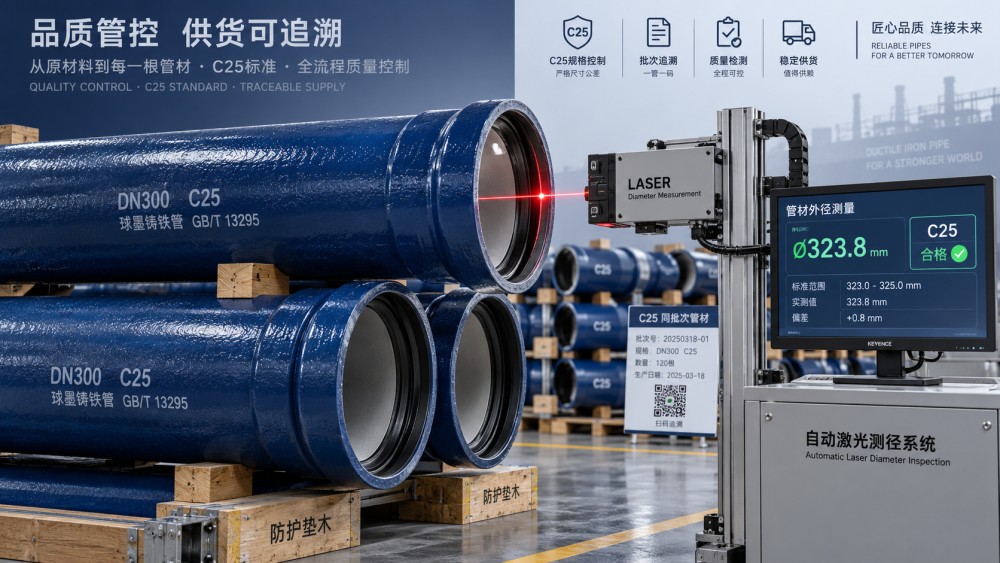
Traceability is sometimes reduced to a certificate attached to a shipping file. In practice, it is a chain connecting the installed pipe to its production lot, inspection records, and declared specification. If the chain breaks when pipes are unloaded and mixed in a laydown area, the value of the factory documents is sharply reduced.
The purchase order should define what identification must appear on the pipe or remain linked to it through durable tags or bundle controls. Depending on the governing standard and agreed inspection plan, this may include manufacturer identification, production date or code, nominal diameter, class, standard reference, coating information, and a production or batch reference. Buyers should specify legibility expectations because coating application, transport abrasion, and field handling can obscure markings.
A workable traceability process normally has three levels:
- Factory traceability: melt or production records, dimensions, pressure testing, coating or lining controls, and release records are linked to a defined lot or production batch.
- Shipment traceability: packing lists identify the lot references, diameters, quantities, and shipping units loaded for the project.
- Site traceability: receiving personnel record which lots were accepted, where they were stored, and, for critical lines, where they were installed.
The required depth of site records depends on project risk. A small non-critical extension may use lot-level receiving records. A trunk main, treatment plant connection, or line beneath major infrastructure may justify recording lot references by chainage, valve section, or installation zone. This can simplify later investigation if there is a coating concern, joint issue, or dispute over supplied material.
Documents That Support Acceptance Rather Than Merely Filling a File
Buyers should request documents early enough to review them before dispatch, especially where third-party inspection, client witness points, or export documentation is involved. A certificate package should be contract-specific and tied to the supplied items, not a collection of generic brochures or sample reports.
Typical evidence may include a certificate of conformity, dimensional inspection records, hydrostatic test records where required by the applicable standard or contract, lining and coating inspection results, material-related production records, and packing lists that reconcile to the shipment. The exact document set should follow the contract and relevant standard. It should not be copied blindly from another project, because requirements for potable-water contact materials, external corrosion protection, or public utility approval can differ by jurisdiction.
For water intended for human consumption, local regulatory acceptance can apply to linings, coatings, joint materials, and other wetted components. Procurement teams should confirm the project’s required approval route with the owner or local authority instead of assuming that compliance in one market automatically transfers to another. The World Health Organization notes that materials in contact with drinking-water systems should not adversely affect water quality; national rules and approval schemes determine how that principle is implemented. Source: World Health Organization, Guidelines for Drinking-water Quality, fourth edition incorporating the first and second addenda, 2022.
Receiving Inspection: Practical Checks Before the Pipe Is Buried
Incoming inspection does not need to duplicate factory quality control, but it should identify obvious nonconformities before pipes are dispersed across the site. The inspection plan should be agreed before delivery, including sampling logic, hold points, rejection authority, and the treatment of damaged items.
Check identity and quantities against the order
Verify nominal diameter, class, pipe length, joint type, coating and lining description, quantity, and visible marking. Reconcile these details with packing lists and certificates. Mixed lots are not automatically a problem, but they should remain identifiable and be documented as received.
Inspect handling-related damage
Look for impact damage around spigots and sockets, cracking or loss of lining, coating holidays, deformation, chipped cement mortar lining, contamination inside the bore, and missing or incorrectly stored gaskets. Damage can occur after factory release, particularly when pipes are stacked without suitable supports or lifted with equipment that contacts the joint area.
Confirm accessories are matched, not assumed
Gaskets, lubricant, restraining components, bolts, flange gaskets, repair materials, and protective sleeves may be supplied separately. Their quantities and compatibility should be checked against the approved joint system. A technically compliant pipe can still be delayed by a missing accessory package or by gasket materials that do not match the specified service conditions.
Supplier Evaluation Should Test Control, Not Marketing Language
Supplier assessment is most useful when it focuses on the ability to reproduce the quoted specification consistently. Buyers can ask how the supplier controls raw material inputs, dimensions, coatings, lining application, pressure testing, product identification, nonconforming material, and final release. The purpose is not to demand a universal questionnaire; it is to identify whether controls match the project’s risk profile.
For larger or sensitive orders, a pre-shipment inspection plan may define document review, witness points, sampling arrangements, visual examination, marking checks, and release conditions. If an independent inspection body is used, its scope should be explicit. A third-party visit cannot compensate for an incomplete specification, and it does not automatically certify every unit unless that is actually part of the agreed inspection method.
Commercial terms should also support quality control. The purchase order can define notification periods before shipment, ownership of rejected goods, replacement timing, document approval requirements, and how deviations are handled. A supplier should not substitute a class, coating, joint design, production location, or standard edition without written acceptance from the purchaser and, where relevant, the project engineer.
Make the Final Decision on Evidence and Service Conditions
The appropriate C25 ductile iron pipe specification is the one that aligns with the governing standard, the actual pressure regime, site loads, corrosion environment, jointing method, and documentation needs. Class selection cannot be separated from those conditions. Nor should traceability be treated as a paperwork exercise completed after shipment.
A disciplined buyer translates the design basis into a line-by-line technical schedule, verifies pressure compatibility across the full pipeline system, defines required records before production, and preserves lot identity through receiving and installation. Those checks create a clearer basis for acceptance while reducing the chance that an apparently simple pipe purchase becomes a field-level engineering problem.
- Last One:No more articles
- Next Article:An export controls compliance guide to checking U.S. license requirementsOct 13, 2026
Related News
- 00
0000-00
An export controls compliance guide to checking U.S. license requirements - 00
0000-00
Petroleum refining technology trends reshaping refinery decarbonization - 00
0000-00
How energy storage strengthens sustainable energy reliability - 00
0000-00
How trade compliance solutions reduce export documentation errors - 00
0000-00
How material intelligence is reshaping sourcing decisions in Southeast Asia
Related tags
Weekly Insights
Stay ahead with our curated technology reports delivered every Monday.