




Procurement Checklist for Ductile Iron Pipe: Evaluating ASTM A536 Compliance, Coating Systems, and Delivery Readiness in Competitive Bidding




Time : Sep 10, 2026
Ductile iron pipe procurement demands more than low bids—verify ASTM A536 compliance, coating systems & delivery readiness to avoid costly delays and failures.
Procurement Checklist for Ductile Iron Pipe: What Engineers and Buyers Must Verify Before Bid Submission
Competitive bidding for water infrastructure projects demands more than lowest price. For procurement teams evaluating ductile iron pipe, technical compliance, long-term performance, and supply chain reliability are non-negotiable—yet often under-scrutinized in early bid evaluation. ASTM A536 compliance, coating system integrity, and delivery readiness are not checklist items to delegate to QA after award; they directly impact tender responsiveness, contract risk allocation, and field installation timelines.
This guide outlines a practical, field-informed procurement checklist focused on three interdependent pillars: material specification verification, protective system validation, and logistical execution capability. It reflects common pain points observed across municipal, industrial, and EPC-led water projects—where deferred material review leads to rejection at inspection, unverified coatings accelerate corrosion in aggressive soils, and unrealistic delivery commitments trigger liquidated damages.
ASTM A536 Compliance: Beyond the Mill Test Report
ASTM A536 defines mechanical properties for ductile iron—specifically tensile strength, yield strength, and elongation—based on test bar geometry and heat treatment. But compliance is not binary. Procurement must distinguish between:
- **As-cast vs. heat-treated grades** (e.g., 60–40–18 vs. 100–70–03): Higher strength grades require controlled annealing or normalizing. Suppliers may quote ASTM A536 without specifying whether the grade is achieved as-cast or post-heat-treatment—a critical distinction for pressure class validation and joint integrity under thermal cycling.
- **Test bar location and orientation**: ASTM A536 requires test bars extracted from representative castings—not just pattern samples. In practice, some suppliers rely on pattern-cast bars that do not reflect actual pipe wall microstructure, especially near flanges or restrained joints.
- **Certification scope**: A mill test report listing “ASTM A536 Grade 60–40–18” does not confirm compliance unless it includes:
- Actual tensile/yield/elongation values (not just “meets spec”);
- Test bar source (e.g., “test bar cut from pipe end of Lot #X”);
- Heat number traceability;
- Date of testing and lab accreditation (ISO/IEC 17025 preferred).
Procurement should require certified test reports for *each production lot*, not per order or per shipment. Batch-level traceability enables root-cause analysis if field failures occur—and supports warranty enforcement.
Coating Systems: Matching Protection to Service Environment
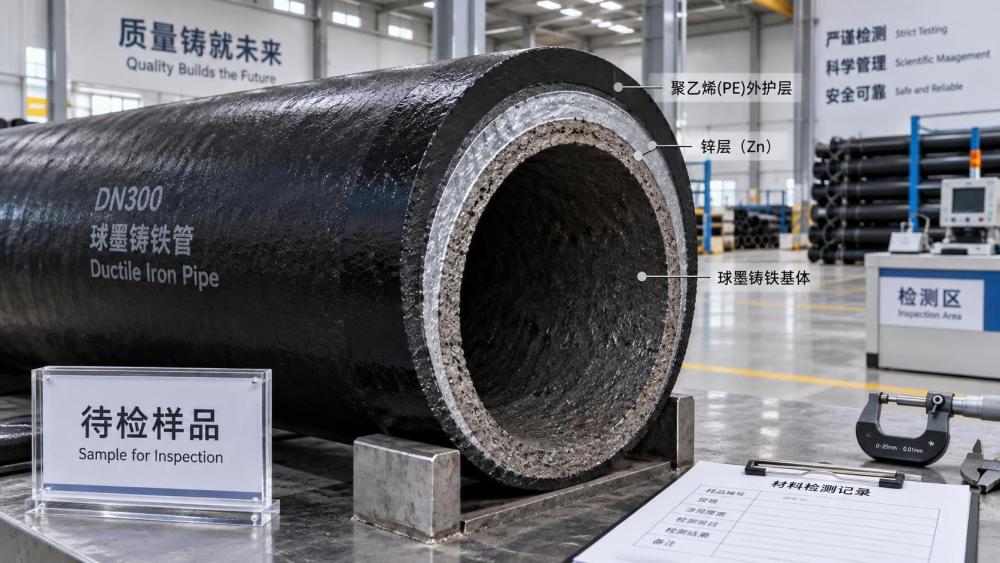
Ductile iron pipe relies on coatings—not inherent corrosion resistance—for longevity in buried applications. The choice isn’t between “coated” and “uncoated,” but between systems engineered for specific soil resistivity, pH, chloride content, and stray current exposure.
Three layers typically define system robustness:
1. **Metallic barrier** (e.g., centrifugally applied zinc, 200 g/m² minimum per ISO 8178);
2. **Polymer overcoat** (e.g., polyethylene, fusion-bonded epoxy, or dual-layer FBE/PE);
3. **Joint protection method**, often overlooked in specs.
The table below compares common configurations by typical service life in moderate-to-aggressive soils (resistivity < 1,000 Ω·cm):
Crucially, coating specifications must include joint protection requirements—not just pipe body coverage. A pipe with full-body PE sleeve offers no advantage if bell-and-spigot joints are sealed only with rubber gaskets and no supplemental barrier. Procurement language should mandate joint coverage equivalent to pipe body (e.g., “PE sleeve shall extend ≥150 mm beyond spigot end and be heat-fused to adjacent sleeve”).
Delivery Readiness: Why “Ex-Works” Dates Are Insufficient
In competitive bidding, delivery terms like “FOB Origin” or “ex-works” mask real schedule risk. Procurement must assess not just *when* pipes ship, but *whether* they ship ready for immediate installation.
Readiness hinges on four verifiable conditions:
- **Final dimensional verification completed**: Not just rough casting, but final machining of bells, spigots, and flanges per AWWA C151/A21.51.
- **Coating cure status documented**: FBE requires post-cure thermal cycles; PE sleeves require 72-hour ambient cure before handling. Certificates must state “coating fully cured per manufacturer’s procedure.”
- **Joint components included and matched**: Gaskets, lubricants, and restraint hardware must ship with pipe—not separately ordered or substituted onsite.
- **Documentation completeness**: Packing lists, test reports, coating certificates, and mill certificates must accompany each shipment—not follow later.
Late or incomplete documentation triggers customs delays, site storage costs, and rework. A supplier quoting “12-week lead time” but requiring 3 additional weeks for coating certification and document packaging effectively delivers in 15 weeks—not 12.
Selection Factors for Water Projects: A Practical Comparison Framework
Water project conditions vary widely—from low-pressure irrigation mains in arid soil to high-head transmission lines crossing marshland or urban corridors. Selection cannot rely on generic specs. Key differentiators include:
- **Pressure class vs. design factor**: AWWA C150 defines pressure classes (e.g., Class 350), but actual design factor (burst pressure / working pressure) varies with pipe diameter and wall thickness. Procurement should verify minimum wall thickness per AWWA C151 Table 3—not just pressure class.
- **Joint type suitability**: Push-on joints dominate for rapid installation, but restrained joints (e.g., Tyton® or GRINNELL®) are mandatory where thrust forces exceed soil resistance—especially at bends, tees, or dead ends. Specifying “push-on” without defining restraint requirements invites costly field modifications.
- **Material consistency across fittings**: Valves, bends, and tees must match pipe in ASTM A536 grade, coating system, and joint compatibility. Mixing coating types (e.g., FBE pipe with bituminous-coated fittings) creates galvanic corrosion risk at connections.
Frequently Asked Questions
Q: Can ASTM A536 compliance be verified solely from a supplier’s certificate?
No. Certificates must reference actual test data per lot, not generic compliance statements. Cross-check heat numbers against casting records and request third-party verification if lot size exceeds 100 tons.Q: Is polyethylene sleeving always superior to bituminous enamel?
Not universally. PE excels in high-chloride, low-resistivity soils but performs poorly where abrasion risk is high (e.g., rocky backfill). Bitumen remains viable where UV exposure is minimal and handling controls are strict.Q: What’s the minimum acceptable zinc coating mass for ductile iron pipe in aggressive soil?
AWWA C104/A21.4 recommends ≥200 g/m² for general use. For soils with resistivity < 500 Ω·cm or pH < 5.5, ≥300 g/m² is advisable—but only if paired with a compatible, fully cured overcoat.Q: How should procurement handle suppliers quoting “ASTM A536” without specifying grade?
Require grade designation (e.g., 60–40–18) in the bid submission. Absent specification, default to AWWA C151’s minimum requirement: 60–40–18. Do not accept “complies with ASTM A536” as sufficient.
No. Certificates must reference actual test data per lot, not generic compliance statements. Cross-check heat numbers against casting records and request third-party verification if lot size exceeds 100 tons.Q: Is polyethylene sleeving always superior to bituminous enamel?
Not universally. PE excels in high-chloride, low-resistivity soils but performs poorly where abrasion risk is high (e.g., rocky backfill). Bitumen remains viable where UV exposure is minimal and handling controls are strict.Q: What’s the minimum acceptable zinc coating mass for ductile iron pipe in aggressive soil?
AWWA C104/A21.4 recommends ≥200 g/m² for general use. For soils with resistivity < 500 Ω·cm or pH < 5.5, ≥300 g/m² is advisable—but only if paired with a compatible, fully cured overcoat.Q: How should procurement handle suppliers quoting “ASTM A536” without specifying grade?
Require grade designation (e.g., 60–40–18) in the bid submission. Absent specification, default to AWWA C151’s minimum requirement: 60–40–18. Do not accept “complies with ASTM A536” as sufficient.
A Technical Procurement Checklist
Before accepting a bid, procurement should confirm the following for each pipe lot:
- Mill test report includes tensile, yield, and elongation values—not just “meets ASTM A536”;
- Test bar source is explicitly stated as cut from production pipe (not pattern);
- Zinc coating mass is certified per EN ISO 1460 or ASTM A653, with sampling plan documented;
- Overcoat thickness is measured per ASTM D7091 (for FBE) or ISO 2808 (for PE), with min/max values reported;
- Joint protection method matches pipe body system (e.g., PE sleeve extends to and fuses with adjacent sleeve);
- Delivery schedule includes dates for coating cure completion and document issuance—not just shipment;
- All fittings and valves share identical ASTM A536 grade and coating system.
For buyers sourcing ductile iron pipe, verifying these elements upfront reduces field rejection risk, avoids change orders, and ensures alignment between bid assumptions and installed performance. Material selection remains a technical decision—not a procurement formality.
Conclusion: Compliance Is Continuous, Not Transactional
ASTM A536 compliance, coating integrity, and delivery readiness are not discrete boxes to check once. They represent overlapping technical domains where gaps in specification, verification, or communication cascade into schedule delays, cost overruns, and premature failure. Procurement’s role is not to certify—but to demand evidence, question assumptions, and align contractual obligations with physical reality. In water infrastructure, where asset life spans exceed 50 years, the most cost-effective pipe is the one installed correctly the first time—with no rework, no waivers, and no ambiguity in what was promised versus what was delivered.
Related News
- 00
0000-00
Which drilling systems are suited to long-lateral shale wells? - 00
0000-00
Which sectors are driving demand in the chemical engineering market? - 00
0000-00
How to assess lifecycle emissions from CCUS for low-carbon cement - 00
0000-00
How do energy storage technologies compare for 8-hour discharge? - 00
0000-00
Do mill test reports prove industrial alloys meet ASTM standards?
Related tags
Weekly Insights
Stay ahead with our curated technology reports delivered every Monday.