




What Safety Protocols Are Mandatory for Heavy-Industry Welding?




In heavy-industry welding, mandatory safety is not limited to wearing a welding helmet and gloves. A compliant job normally requires a controlled work area, a pre-job risk assessment, trained personnel, suitable personal protective equipment, safe electrical and gas systems, fire prevention measures, ventilation, and documented authorization for higher-risk conditions. The exact legal requirements vary by jurisdiction and site, but the operational controls are consistent across fabrication shops, refineries, pipelines, power facilities, shipyards, mines, and structural steel projects.
For teams asking what safety protocols are mandatory in heavy industry welding, the practical answer is this: welding must not begin until the hazards of the location, material, equipment, and surrounding work have been assessed and controlled. A qualified welder can still create a serious incident if sparks reach combustible residues, welding fumes build up in a poorly ventilated area, a damaged cable causes an electric shock, or hot work starts near a live process line.
Start with a job-specific hot-work assessment
Heavy-industry welding is rarely performed in a clean, isolated space. Work may take place beside process equipment, on elevated platforms, inside tanks, near pipelines, around stored materials, or during maintenance shutdowns where several contractors are working at once. That is why the first mandatory control is usually a job-specific assessment before the arc is struck.
The assessment should identify more than the welding method. It should cover the base material, coatings, nearby flammables, possible gases or residues, access and escape routes, weather exposure for outdoor work, overhead and adjacent work, electrical sources, lifting activities, and the condition of the workpiece. A vessel that appears empty, for example, may still contain vapors or residues that turn hot work into an ignition hazard.
For planned welding away from a permanent welding bay, this assessment commonly leads to a hot-work permit. The permit is not paperwork for its own sake. It records where the job will occur, what precautions are required, who has authorized the activity, how long the authorization is valid, and what must happen when the work is complete. If conditions change, such as a process line is opened nearby or weather drives fumes into an enclosed area, the permit conditions must be reviewed before work continues.
Control the fire and explosion risk before welding begins
Arc welding, cutting, gouging, and grinding can project sparks and hot metal well beyond the immediate work zone. In heavy industry, the risk is not only visible combustible material. Oil deposits, insulation, paint, dust, packaging, process residues, hidden voids, and vapors can all become fuel.
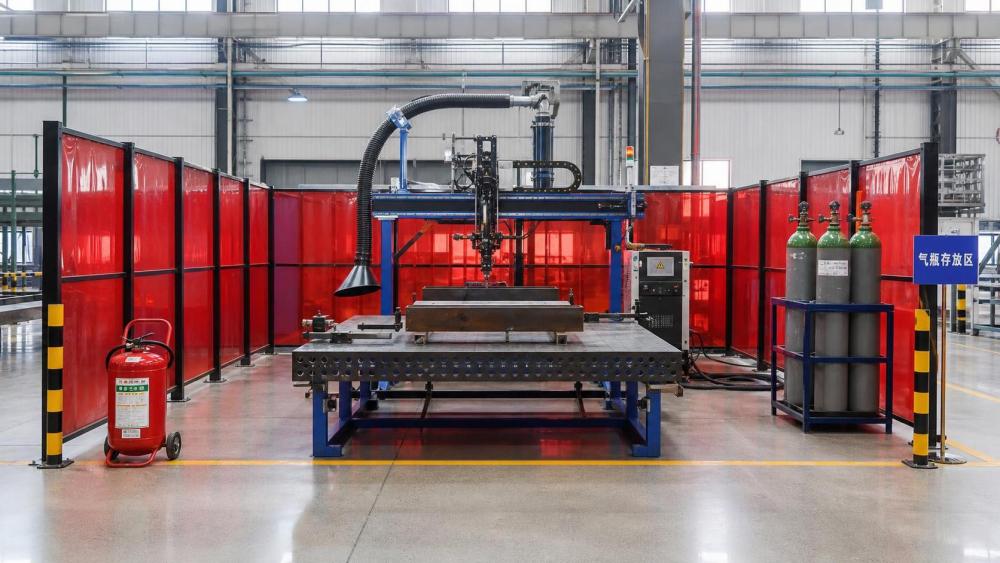
A proper hot-work setup normally includes removal or protection of combustible materials, fire-resistant screens or blankets where appropriate, and a designated fire watch. The fire watch needs a clear view of the hazard area and access to suitable extinguishing equipment. Assigning this role to someone who is also lifting materials, managing traffic, or performing another task weakens the control because they cannot continuously observe developing ignition points.
Attention must extend below, behind, and on the opposite side of the work surface. Sparks can pass through grating, gaps, wall penetrations, and pipe openings. Welding on a metal wall, deck, or vessel can transfer heat to materials that are not visible to the welder. The work area should also be checked after welding stops, because smoldering material may not become obvious immediately.
Hot work must not proceed where an explosive atmosphere may be present. In process plants and storage areas, isolation, cleaning, gas testing, and coordination with operations may be necessary before a permit is issued. “It does not smell like gas” is not a valid test. Odor is not a reliable measure of atmospheric safety.
Use PPE as a matched system, not a basic checklist
Personal protective equipment is mandatory, but the correct selection depends on the process and task. Standard site PPE may be insufficient for overhead welding, high-amperage gouging, confined-space work, welding coated steel, or handling recently welded components.
- Eye and face protection: A welding helmet with the appropriate filter shade protects against arc radiation and spatter. Safety glasses should still be worn underneath to protect against flying particles when the helmet is raised.
- Flame-resistant clothing: Clothing should cover exposed skin and resist ignition. Synthetic garments that can melt against the skin are unsuitable around welding heat and sparks.
- Gloves, sleeves, and footwear: Welding gloves must suit the process and permit enough control of the torch or electrode holder. Protective boots should resist impact, heat, and penetration from hot debris.
- Hearing protection: It may be needed where welding is combined with grinding, gouging, impact work, or noisy production equipment.
- Respiratory protection: It is required when ventilation cannot adequately control hazardous fumes, but it must be selected for the contaminant and used within a respiratory protection program.
A common mistake is treating a respirator as a substitute for ventilation. Respiratory protection is an important final barrier, especially for maintenance work in constrained locations, but it does not remove fumes from the area or protect nearby workers. Source extraction and general airflow should be addressed first.
Manage welding fumes, coatings, and gases
Fume hazards change with the consumable, base metal, coating, welding process, and environment. Stainless steels, galvanized materials, painted surfaces, and contaminated equipment can create hazards that are very different from those associated with clean mild steel. Grinding or thermal cutting can add dust and metal particles to the exposure.
Before work begins, identify what is actually on the material. Old coatings, corrosion products, process deposits, and unknown residues should not be treated as harmless simply because the substrate is steel. The preferred approach is to remove hazardous surface contamination where feasible, provide local fume extraction close to the arc, and ensure the work area has sufficient air movement without creating unstable shielding-gas conditions.
Ventilation becomes more critical in pits, tanks, enclosed buildings, and areas sheltered from natural airflow. Fans must be positioned to move contaminants away from workers and avoid pushing fumes through adjacent work zones. Oxygen must never be used to ventilate a work area or cool a worker; it greatly increases fire intensity.
Apply confined-space controls when the work location demands them
Welding inside a tank, vessel, pit, boiler, duct, or other restricted enclosure introduces hazards that cannot be handled by ordinary hot-work precautions alone. The space may have poor ventilation, limited access, difficult rescue conditions, an oxygen-deficient atmosphere, or flammable and toxic contaminants.
Confined-space welding requires formal entry controls in addition to the hot-work permit. This typically includes isolation of connected lines and energy sources, atmospheric testing before entry and at intervals during the job, forced ventilation where needed, reliable communication, an attendant outside the space, and a rescue arrangement appropriate to the entry conditions. The welder should not be left to manage atmospheric monitoring, ventilation adjustments, and emergency communication while welding.
Gas cylinders and fuel-gas equipment should generally remain outside the confined space. Hoses, leads, and torches must be protected from damage and routed so they do not obstruct exit. At every pause, the welding equipment should be made safe; leaving energized equipment or active gas flow unattended inside an enclosure creates unnecessary risk.
Prevent electrical shock and equipment failure
Welding power sources, electrode holders, cables, clamps, and return leads must be inspected before use. Damaged insulation, loose connections, exposed conductors, and improvised repairs can turn normal welding conditions into a shock hazard, particularly in wet, cramped, or conductive locations.
The return clamp should be attached securely and as close as practical to the weld area. Using plant structures, pipework, wire rope, or bearings as an unintended return path can damage equipment and create overheating or arcing in locations far from the welder. Cables should be routed to prevent crushing, sharp-edge damage, trip hazards, and contact with water or hot surfaces.
Wet clothing, wet gloves, and standing water require additional caution. Where the environment cannot be made suitable for safe welding, the work method or work schedule should change rather than relying on the welder to compensate.
Secure gas cylinders and cutting equipment
Compressed-gas cylinders must be handled as pressurized equipment, not as portable supports or convenient anchors. They should be kept upright, secured against falling, protected from vehicle impact and heat, and fitted with the correct regulators and hoses. Valve protection is particularly important during storage and movement.
Oxygen equipment must be kept free from oil and grease. Fuel-gas and oxygen hoses should be inspected for leaks, deterioration, and incorrect connections. Flashback protection and safe shutdown procedures are essential where fuel-gas cutting or heating is used. Cylinders should not be dragged, rolled on their side, or moved with regulators attached unless the equipment and handling method are designed for that purpose.
Coordinate welding with the rest of the site
In major industrial facilities, welding safety depends on coordination as much as individual behavior. A welder may be working safely within a barricaded area while another crew opens equipment, sprays coatings, moves a suspended load, or starts work above the welding position. Permit coordination, shift handovers, area barriers, signage, and communication with operations help prevent these conflicts.
This is especially important during turnarounds, shutdowns, and construction peaks. The workfront can change faster than the original plan. Supervisors should confirm that isolation points remain effective, access routes remain clear, fire controls are still in place, and no new incompatible activity has entered the area.
Training, supervision, and inspection are operational controls
Mandatory protocols only work when people understand both the procedure and the reason behind it. Welders need training in the equipment and processes they use, while helpers, fire watchers, permit issuers, and supervisors need role-specific competence. A fire watch should know when work must stop. A supervisor should recognize when a changed condition invalidates the original assessment.
Pre-use inspections should be routine rather than reserved for incident investigations. Check the welding machine, leads, electrode holder or torch, return clamp, extraction equipment, screens, gas hoses, regulators, fire equipment, and PPE. The workpiece itself also deserves inspection: confirm its stability, identify stored energy or pressure, and ensure it is supported so heat distortion or cutting does not cause movement.
For project teams sourcing welding equipment, consumables, ventilation systems, protective gear, or fabrication services, technical information should be reviewed alongside safety compatibility. GEMM’s structured resources can help users compare relevant equipment categories, material applications, supplier capabilities, and technical documentation before making a sourcing or project decision. The useful question is not simply whether an item is available, but whether it fits the planned process, material, work environment, and site control system.
Use this pre-weld decision sequence
- Define the task, welding process, material, location, and surrounding operations.
- Identify fire, explosion, fume, electrical, pressure, movement, access, and fall hazards.
- Decide whether hot-work, confined-space, isolation, or other site permits are required.
- Remove or control hazards before work starts: isolate equipment, clean surfaces, establish ventilation, protect combustibles, and set barriers.
- Inspect welding equipment, gas equipment, PPE, and emergency controls.
- Confirm responsibilities for the welder, fire watch, attendant, supervisor, and operations contact.
- Stop and reassess when conditions change, then inspect the area again after the work is complete.
The most reliable welding safety programs do not depend on a single control. They combine permits, competent people, suitable equipment, atmospheric and fire controls, effective ventilation, and active supervision. When one layer is weakened, such as a missing fire watch or an untested confined space, the remaining precautions may not be enough to prevent a serious event.
Related News
- 00
0000-00
Which drilling systems are suited to long-lateral shale wells? - 00
0000-00
Which sectors are driving demand in the chemical engineering market? - 00
0000-00
How to assess lifecycle emissions from CCUS for low-carbon cement - 00
0000-00
How do energy storage technologies compare for 8-hour discharge? - 00
0000-00
Do mill test reports prove industrial alloys meet ASTM standards?
Weekly Insights
Stay ahead with our curated technology reports delivered every Monday.