




How Can Oil Refining Distillation Columns Be Optimized?




Start With the Separation Problem, Not the Hardware
Improving a refinery distillation column begins with a practical question: is the column limited by separation efficiency, hydraulic capacity, energy use, feed variability, or downstream operating constraints? These problems can look similar in daily production data. A rise in product endpoint, for example, may be blamed on poor tray performance when the underlying cause is unstable feed composition, inadequate reflux cooling, a fouled pumparound circuit, or a furnace constraint that has changed the feed condition.
For engineers asking how to optimize oil refining distillation column efficiency, the first useful conclusion is that there is rarely a single adjustment that improves every outcome at once. Higher reflux may sharpen a cut but increase condenser duty and pumping demand. Raising furnace outlet temperature may improve vaporization but can raise coking risk, alter flash-zone behavior, and put pressure on downstream vacuum systems. A good optimization program identifies the active constraint first, then improves the column while preserving product specifications, throughput, equipment reliability, and operating safety.
That distinction matters because many columns are operated close to several limits at the same time. Atmospheric crude towers may face furnace duty, overhead corrosion, pumparound availability, and draw quality constraints. Vacuum towers may be constrained by ejector or vacuum pump performance, steam availability, wash section behavior, entrainment, or heater coil limits. Treating every issue as a tray-efficiency problem can lead to costly modifications that do not remove the actual bottleneck.
Establish a Reliable Operating Baseline
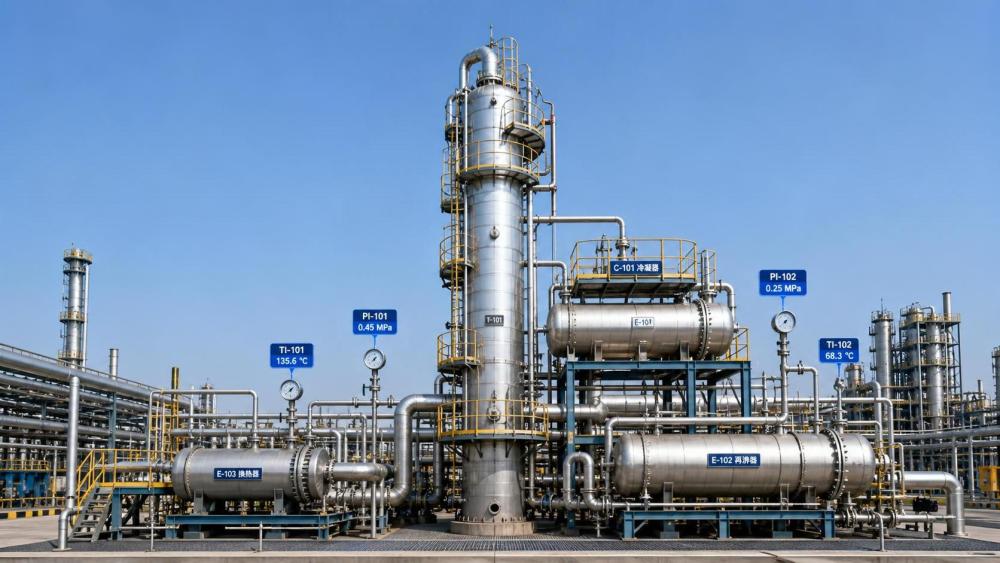
Before changing reflux ratios, cut points, steam rates, or internal hardware, establish whether the available measurements describe the real operating condition. Refinery columns are often controlled through pressure, temperature, flow, level, and laboratory-quality data collected at different frequencies. If these signals are poorly reconciled, operators may optimize against noise rather than column behavior.
A practical baseline should combine the following:
- Feed rate, density, distillation curve, water content, salt content, and major compositional changes.
- Overhead, side-draw, and bottoms product quality, including boiling-range indicators relevant to each unit.
- Temperature and pressure profiles from top to bottom, with attention to changes in differential pressure.
- Reflux, pumparound, stripping steam, wash oil, and utility rates.
- Furnace outlet temperature, flash-zone pressure, condenser performance, and exchanger duty where applicable.
- Evidence of fouling, corrosion, damaged internals, unstable levels, or instrument bias.
The most valuable part of this exercise is not the data list itself. It is the comparison between periods when the unit met its targets and periods when it did not. A stable, high-performing operating period provides a more useful reference than a generic design target because it reflects the actual crude slate, equipment condition, and site utility limitations.
Material and energy balances should be reconciled before major decisions are made. A column model based on inconsistent flow measurements can suggest that reflux is insufficient when the apparent issue is an unmeasured loss, a density error, or a delayed laboratory result. The balance does not need to be perfect to be useful, but it must be credible enough to distinguish a process problem from a measurement problem.
Control Feed Conditions Before Chasing Internal Efficiency
The feed entering a distillation column determines much of the separation burden. A crude unit may receive feed with different light-end content, heavier fractions, water, or contaminants from one campaign to the next. Vacuum residue properties can also shift with upstream cut points and crude selection. When feed quality changes, maintaining the previous setpoints can produce off-spec products even if the column internals are functioning normally.
Feed temperature and vapor fraction deserve particular attention. If the feed is too cold, the flash zone receives less vapor and the lower section may be asked to provide separation it was not designed to handle. If it is overheated, excess vapor traffic can overload the flash zone and lower trays, increase pressure drop, or carry liquid upward. In fired systems, a higher outlet temperature must be evaluated against coil coking, tube metal temperature, residence time, and feed stability, not simply against improved distillation yield.
Desalting and upstream water removal also influence column stability. Excess water can disrupt overhead condensation, aggravate corrosion risk in wet sections, and make temperature signals harder to interpret. Salt and metals do not directly determine tray efficiency, but they can contribute to fouling and corrosion that gradually degrade heat transfer and pressure control. A column optimization plan should therefore include upstream operating discipline where feed contaminants are part of the recurring problem.
For crude towers, the selected cut points must also be realistic for the feed slate. Trying to recover more middle distillate by repeatedly tightening cut points may move undesirable material into jet, diesel, or other side draws. The value of higher apparent yield can be lost through product reprocessing, blending limitations, catalyst impact downstream, or missed specifications. The right target is the highest economic recovery that the full refinery can absorb, not the maximum recovery from the column alone.
Use Reflux, Pumparounds, and Steam as Coordinated Levers
Reflux is often the first operating variable considered when separation deteriorates. It is effective because it provides internal liquid traffic and condensation duty at the top of the column. Yet more reflux has diminishing returns. Beyond a certain point, it can raise vapor and liquid loads, increase pressure drop, consume pumping and cooling capacity, and worsen flooding risk without delivering a meaningful quality improvement.
Reflux should be adjusted in relation to overhead pressure, condenser approach temperature, accumulator behavior, and product quality. A column that appears reflux-limited may actually be condenser-limited during hot weather or utility constraints. If the overhead pressure rises because heat rejection is inadequate, relative volatility falls and the top section loses separation strength. Increasing reflux under those conditions can increase hydraulic load while leaving the fundamental thermodynamic disadvantage largely unchanged.
Pumparounds require the same discipline. Their role is not merely to remove heat; they shape the internal vapor and liquid traffic across specific tower sections. A poorly selected pumparound rate or return temperature can shift the burden to another section, alter side-draw quality, and affect flash-zone conditions. Fouled pumparound exchangers can produce a gradual loss of separation that operators compensate for with additional reflux or furnace firing. This may preserve production temporarily while increasing fuel use and concealing the maintenance issue.
Stripping steam can improve removal of light components from side draws and reduce hydrocarbon partial pressure, especially in vacuum service. It also adds vapor volume. Excess steam can contribute to hydraulic loading, condenser duty, sour-water handling requirements, and vacuum-system limitations. Steam optimization should be based on product quality response and column pressure behavior rather than a fixed rule that more steam always produces better separation.
Read the Column Profile for Hydraulic Warning Signs
Temperature profiles are useful, but they should not be interpreted in isolation. A temperature shift can result from feed changes, pressure changes, changed draw rates, altered reflux, or internal damage. The combination of temperature profile, pressure profile, differential pressure, product quality, and controllability is far more diagnostic than any one signal.
Rising differential pressure across a column can indicate fouling, flooding, excess vapor traffic, liquid backup, damaged trays, plugged distributors, or deposits in demisters and packing. A lower-than-expected differential pressure can also be a problem if it reflects vapor bypassing, damaged tray decks, missing valves, poor liquid distribution, or internal leaks. The direction of the change matters less than whether it matches the expected hydraulic behavior and quality response.
Common symptoms should be treated as hypotheses, not conclusions:
- Flooding or approaching flood: increasing pressure drop, erratic levels, unstable temperatures, and declining separation as rates rise.
- Weeping or dumping: weak tray liquid seal at low vapor rates, often accompanied by poorer fractionation in a section designed for higher load.
- Entrainment: heavy material appearing in lighter products, sometimes aggravated by high vapor velocity, foaming, or damaged disengagement equipment.
- Maldistribution: localized loss of performance, particularly in packed sections, caused by poor liquid distribution, fouling, or uneven vapor flow.
- Foaming: unstable pressure drop and separation, potentially linked to contaminants, corrosion products, process chemicals, or changes in feed characteristics.
These symptoms can overlap. For example, entrainment may be caused by flooding, but it can also occur because a mist eliminator is fouled or damaged. A shutdown inspection should be planned around evidence gathered during operation, including profile changes, gamma scans where appropriate, exchanger performance, and product-quality patterns. Replacing all internals without identifying the likely failure mechanism can consume turnaround scope without preventing recurrence.
Evaluate Internals Only After Defining the Constraint
Tray replacement, packing conversion, high-capacity trays, improved distributors, and upgraded demisters can produce substantial benefits when existing internals are the limiting factor. They are not universal upgrades. A high-capacity tray design may raise throughput potential but offer limited benefit if the column is constrained by furnace duty, condenser capacity, side stripper performance, or downstream unit demand.
The selection between trays and structured packing should reflect the operating window, fouling tendency, turndown requirement, pressure-drop sensitivity, mechanical layout, maintenance approach, and expected feed variability. Structured packing can be attractive where low pressure drop is especially valuable, such as vacuum distillation. However, it depends heavily on effective liquid distribution and can be vulnerable to fouling or maldistribution in difficult services. Trays can provide robust contacting and easier visual inspection in some applications, but their hydraulic behavior must suit both normal and upset conditions.
For a revamp, the engineering question should be framed in measurable terms: how much additional capacity, pressure-drop reduction, energy reduction, or product-quality margin is required, and under which feed cases? This avoids evaluating internals by nominal performance claims alone. Vendors and licensors can provide useful design input, but the final basis should include site-specific pressure profile, fouling history, allowable outage scope, mechanical constraints, and anticipated crude or feed variability.
Reduce Energy Use Through Heat Integration, Not Just Lower Setpoints
Distillation is inherently energy-intensive because it depends on repeated vaporization and condensation. Reducing furnace firing or steam consumption without considering the overall heat balance can simply transfer a duty to another utility system or reduce product recovery. The best opportunities usually come from recovering heat at the temperature level where it remains useful.
Crude preheat train performance is a central example. Fouling in exchangers can lower feed temperature to the furnace, increase fuel demand, and change the flash-zone condition. Cleaning intervals should be based on the economic effect of lost heat recovery, pressure-drop increase, and operational risk, rather than only on a calendar schedule. The optimum interval may vary with crude properties, exchanger configuration, chemical treatment, and available maintenance windows.
Heat integration also requires attention to operability. A tightly integrated exchanger network can improve energy efficiency while making startup, shutdown, and feed transitions harder to control. Bypass arrangements, control-valve authority, exchanger pressure drop, and thermal stability of the streams involved should be reviewed alongside the energy target. A lower-energy configuration that creates frequent control instability is unlikely to deliver its predicted annual benefit.
Move From Manual Correction to Constraint-Based Control
Experienced operators remain essential because they recognize abnormal behavior that models may not capture. Still, columns with changing feed and multiple interacting heat-removal circuits often benefit from advanced process control and well-maintained inferential quality measurements. These tools can coordinate reflux, pumparounds, draw rates, furnace duty, and stripping steam around operating constraints more consistently than isolated manual adjustments.
The value comes from defining the right controlled objectives. A control system should not be configured simply to maximize throughput or minimize energy. It should respect product specifications, flooding margin, furnace limits, vacuum capacity, corrosion constraints, exchanger duty, and downstream unit requirements. When those limits are visible and prioritized, the system can move toward the most profitable feasible operating point rather than oscillating between quality corrections and rate reductions.
Model quality is critical. An advanced controller built on outdated tray efficiency, inaccurate flowmeters, unreliable analyzers, or obsolete feed assumptions can make operation appear more sophisticated while adding risk. Maintaining the instrumentation and validating the model after turnarounds, feed changes, and major equipment modifications are part of the optimization work.
A disciplined approach to column efficiency therefore follows a sequence: confirm the measurements, identify the constraint, stabilize feed and utilities, tune the interacting operating variables, then determine whether an internal or heat-integration investment is justified. This sequence produces decisions that are more durable than chasing a single temperature, reflux ratio, or equipment upgrade in isolation.
Related News
- 00
0000-00
Which drilling systems are suited to long-lateral shale wells? - 00
0000-00
Which sectors are driving demand in the chemical engineering market? - 00
0000-00
How to assess lifecycle emissions from CCUS for low-carbon cement - 00
0000-00
How do energy storage technologies compare for 8-hour discharge? - 00
0000-00
Do mill test reports prove industrial alloys meet ASTM standards?
Weekly Insights
Stay ahead with our curated technology reports delivered every Monday.