




Rubber Science for Oil-Resistant Applications: What Drives Swell, Heat, and Service Life?




Why oil-resistant rubber fails in practice even when the polymer looks correct on paper
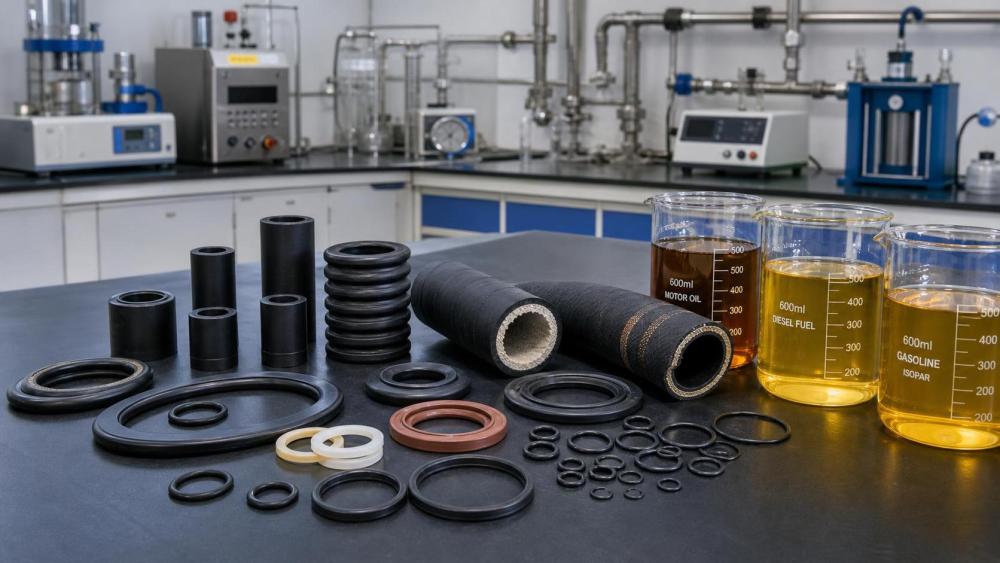
In rubber science for oil-resistant applications, the first mistake is to treat “oil resistance” as a single property. It is not. A seal, hose liner, diaphragm, or cable sheath may survive one hydrocarbon fluid and fail quickly in another, even when both are casually described as oil. What matters is how the fluid interacts with the polymer network over time: how much it penetrates, how much the rubber swells, whether plasticizers are extracted, how heat accelerates chemical change, and whether the part still holds compression, tensile strength, and dimensional stability after exposure.
That is why material selection for oil and fuel service is rarely a simple NBR-versus-FKM decision. Acrylonitrile content, cure system, filler package, crosslink density, and the actual temperature profile often decide service life more than the trade name of the base elastomer. Technical evaluation goes wrong when buyers compare datasheets at room temperature while the real duty involves hot fluid, intermittent pressure, oxygen, additives, and shutdown cycles that repeatedly stress the compound.
Swell is usually the earliest visible sign that compatibility is being misunderstood. A rubber part swells because the liquid diffuses into the polymer and pushes chains apart. Whether that happens mildly or aggressively depends on chemical affinity between the fluid and the elastomer, but also on how tightly the rubber is crosslinked. Moderate swelling is not always immediate failure; some compounds are designed to tolerate limited volume change. The problem begins when swell causes loss of hardness, dimensional drift, extrusion at sealing gaps, or a drop in compression set performance. In dynamic service, even a manageable swell number in a lab report can become a practical failure if the geometry has little tolerance.
A useful industry distinction is that fluid compatibility is not the same as retention of properties. A material may show acceptable volume change after immersion but still suffer severe decline in elongation, tear resistance, or sealing force. For gaskets and O-rings, that distinction matters more than a single swell percentage. For hose and lining compounds, extraction and embrittlement can be just as important as swelling, especially where aromatic content, oxygenated fuels, or aggressive additives are present.
Heat changes the whole picture. Elevated temperature increases diffusion, accelerates oxidative aging, and can alter the crosslinked structure itself. A compound that performs well in lubricating oil at 40°C may age very differently at 120°C, particularly in the presence of air. This is why service life cannot be predicted from fluid compatibility charts alone. Heat aging data, compression set behavior, and retention of key mechanical properties after immersion are usually more meaningful for real equipment decisions than a broad claim of “excellent oil resistance.”
The common families used in oil-resistant service illustrate this tradeoff clearly. NBR is widely selected because it offers a practical balance of oil resistance, processing ease, and cost. But its behavior shifts with acrylonitrile content: higher ACN content generally improves resistance to nonpolar oils and fuels while reducing low-temperature flexibility. HNBR extends the envelope where heat, oxidation, and mechanical stress are more demanding. FKM is often preferred for higher temperatures and more aggressive fluids, though not every grade behaves the same across fuels, amines, steam, or low-temperature duty. ACM and AEM appear where hot oils matter but fuel resistance or cold flexibility requirements differ. EPDM, despite good resistance in other chemical systems, is usually a poor choice for petroleum oils, which is a common selection error outside specialist teams.
What evaluators should actually compare
When reviewing compounds for oil-resistant applications, it helps to separate four questions that are often blurred together:
This is also where standards and test methods matter. In practice, engineers often refer to immersion and property-retention methods such as ASTM or ISO rubber testing standards, but the result is only meaningful if the fluid, duration, temperature, and specimen condition resemble the intended service. A passing result in one reference oil does not automatically validate a compound for biofuel blends, synthetic lubricants, drilling fluids, or refinery-side mixed hydrocarbons.
Another point that gets missed: service life is often governed by combined stresses rather than the dominant one named in procurement documents. A buyer may specify oil resistance because that is the visible requirement, while the actual failure driver is compression set at elevated temperature, ozone attack on external surfaces, rapid decompression, or contamination from process chemicals. Rubber parts fail at the intersection of environment, geometry, and time. The polymer family narrows the field; the compound and duty cycle decide the outcome.
Common misunderstandings around “better” materials
There is no universal ranking where the most expensive elastomer is automatically safer. FKM is often treated as the premium answer, yet it may be unnecessary for moderate oil service and may introduce avoidable cost or performance tradeoffs in low-temperature conditions. NBR is sometimes dismissed as basic, although a well-compounded grade can be entirely appropriate for many lubricating oil and fuel-contact parts. The technical question is not which polymer has the strongest reputation; it is which compound maintains function inside the exact fluid and thermal window of the application.
Another misunderstanding is to rely on a single datasheet hardness value as if it predicts resistance. Hardness can shift after immersion, and two 70 Shore A compounds may behave very differently because formulation details are different. Fillers, plasticizers, and cure chemistry all affect extraction resistance, permeability, and aging. For evaluators, supplier discussions are often more useful when they move away from nominal hardness and toward test conditions, media exposure history, and retained properties after aging.
In sourcing and technical review, the practical discipline is straightforward: define the fluid precisely, define the real temperature range, identify whether the part is static or dynamic, and ask for compatibility evidence tied to those conditions. Where the application is critical, compare not just initial properties but post-exposure performance. That approach turns rubber science for oil-resistant applications from a vague material label into a defensible engineering decision.
Related News
- 00
0000-00
Virgin vs Recycled Resin: How to Switch Without Disrupting Production? - 00
0000-00
Why Bio-Based Plastics Still Have to Prove Themselves on the Molding Floor - 00
0000-00
Industrial decarbonization targets slip when baselines are weak - 00
0000-00
How to verify whether a circular economy certification is credible - 00
0000-00
How to evaluate upstream energy systems suppliers for project reliability
Weekly Insights
Stay ahead with our curated technology reports delivered every Monday.