




Evaluating Used Rubber Processing Machines for Material and Output Fit




A used rubber processing machine can look suitable on paper and still be a poor fit for the compound, throughput target, and downstream process it must support. For project managers, the purchase decision is rarely limited to whether a mill, internal mixer, extruder, calender, or press can be powered up. The more relevant question is whether the machine can repeatedly produce the required material condition within the planned operating window.
That distinction matters because rubber processing is sensitive to formulation, temperature history, shear, residence time, contamination, and material handling. A machine that previously ran a relatively soft natural-rubber compound may require substantial review before it is assigned to a highly filled EPDM, nitrile, silicone, fluorocarbon, or recycled-rubber application. Likewise, equipment that is mechanically sound may still create a project delay if its controls, guarding, utility requirements, or documentation cannot be integrated into the intended production cell.
Used equipment can be a practical route when lead time, budget, or temporary capacity needs make new machinery impractical. It should, however, be evaluated as part of a material-and-output system rather than as an isolated asset.
Start with the material route, not the machine category
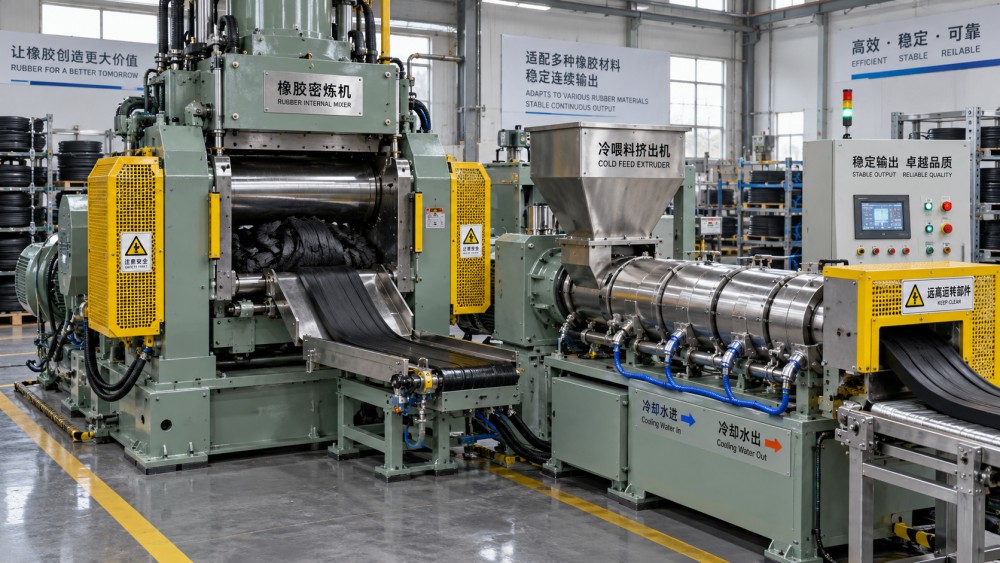
Rubber processing lines are often described by equipment type: a two-roll mill, Banbury-style internal mixer, cold-feed extruder, strainer, calender, curing press, or autoclave. That terminology is useful, but it does not answer whether a particular machine can handle a specific formulation. The same machine type may be configured very differently in terms of rotor design, roll surface condition, screw geometry, heating or cooling circuits, drive capacity, feeding arrangement, and controls.
Before reviewing available equipment, the project team should document the intended material route. At a minimum, that document should identify:
- Polymer family or blend, including whether the compound is tacky, highly filled, abrasive, heat-sensitive, or difficult to feed.
- Form of incoming material, such as bales, pellets, pre-mixed strips, crumb rubber, masterbatch, or return scrap.
- Required process stages: mastication, mixing, straining, extrusion, calendering, preforming, molding, curing, cooling, or cutting.
- Target batch size or continuous output, including expected product mix and changeover frequency.
- Quality limits for dispersion, dimensional consistency, moisture, contamination, surface finish, cure condition, and traceability.
- Available utilities, floor loading, lifting access, ventilation, dust collection, cooling-water capacity, and electrical supply.
A machine’s nominal capacity is only one part of this assessment. For example, an internal mixer may have a chamber volume that appears adequate for a planned batch, but the practical batch weight will vary with compound density, fill factor, rotor condition, and the heat generated during mixing. Running a machine too close to its workable limit can reduce mixing consistency, extend cycle time, or cause temperature excursions that make the compound unsuitable for the next operation.
For extrusion equipment, the stated screw diameter alone is similarly incomplete. Screw profile, length-to-diameter ratio, barrel temperature zones, feeding method, die design, and head pressure determine whether the machine can maintain a stable profile. A unit that performs acceptably with a simple solid strip may behave differently when processing a compound with volatile ingredients, high filler loading, or a narrow temperature tolerance.
Translate output requirements into measurable acceptance conditions
Projects frequently fail at the handoff between a broad production target and a machine inspection. “Need more output” is not a sufficient acceptance criterion. The target should be expressed in operating terms that can be observed during review, commissioning, or a controlled trial.
For a batch mixer, those conditions may include usable batch mass, mixing cycle duration, repeatability of ram movement, discharge behavior, temperature control response, and the ability to reach a defined mixing endpoint without unusual vibration or drive overload. For a mill, the team may need to assess roll temperature stability, nip adjustment accuracy, roll face wear, bearing condition, friction ratio, and how reliably the machine handles the planned sheet width.
For an extruder or strainer, acceptance conditions can include stable material feed, screw-speed control, pressure behavior, barrel-zone response, die temperature stability, and product consistency over an adequate run period. A brief no-load demonstration cannot establish these conditions. It may identify obvious mechanical problems, but it cannot show whether the equipment delivers repeatable process behavior under material load.
Inspect the machine as a system with a production history
Age alone is not a reliable indicator of suitability. A well-maintained machine with accessible documentation and a clear service history can present less execution risk than a newer unit that has been modified repeatedly or stored improperly. The inspection should focus on evidence: condition records, maintenance notes, electrical drawings, spare-parts information, photos before dismantling, and the ability to identify major components.
When project teams view used machinery details, they should separate the seller’s general description from information that can be verified against the intended process. Machine dimensions, motor ratings, serial identification, tooling included, and known refurbishment work are useful starting points. They do not replace confirmation of actual operating condition.
A practical inspection plan normally covers the mechanical structure, process interfaces, and control architecture together. Mechanical review may include frame condition, gearbox noise, hydraulic cylinder condition, lubrication points, bearing play, drive coupling alignment, roll or screw wear, and signs of corrosion in cooling passages. Where feasible, electrical review should include cabinet condition, control voltage, wiring identification, motor drives, sensors, interlocks, emergency-stop circuits, and the availability of current drawings.
Process utilities deserve equal attention. A machine that was originally installed in a different region or plant may require changes to voltage, frequency, compressed-air quality, cooling-water connections, thermal-oil systems, exhaust provisions, or dust collection. These changes can be manageable, but they should be included in the project scope rather than left for site installation.
Why controls and safety upgrades affect the real project cost
Older machinery may have robust mechanical components while relying on outdated relays, unsupported programmable controllers, incomplete safety circuits, or guarding arrangements that do not suit a new installation. Retrofitting can be justified, particularly when the base machine is mechanically appropriate, but it changes the schedule, engineering effort, and commissioning risk.
In the United States, machine safeguarding requirements are addressed in OSHA’s general requirements for all machines, 29 CFR 1910.212, while the control of hazardous energy during servicing and maintenance is covered by OSHA 29 CFR 1910.147. The applicable obligations will vary by jurisdiction and installation, but these references provide a useful baseline for identifying why physical guards, accessible isolation points, documented lockout procedures, and functioning safety devices cannot be treated as optional accessories. ISO 12100:2010 also provides a widely used framework for risk assessment and risk reduction in machinery design. Sources: U.S. Occupational Safety and Health Administration, 29 CFR 1910.212 and 29 CFR 1910.147; ISO 12100:2010, Safety of machinery—General principles for design—Risk assessment and risk reduction.
A safety review should be performed before the machine is committed to a layout. It is much easier to specify new guards, light curtains, safety-rated control components, access platforms, or lockable disconnects before foundations, material handling, and adjacent machinery are installed. The review should also consider cleaning and changeover. Rubber residue, process oils, powders, and release agents can create access and housekeeping problems if the machine cannot be safely isolated and reached.
Match refurbishment scope to the consequences of failure
Not every used machine requires a full rebuild. The correct refurbishment level depends on how the asset will be used and what a failure would interrupt. A machine intended for pilot production, secondary operations, or contingency capacity may justify a different investment level from equipment feeding a high-volume molding line with strict delivery commitments.
A useful approach is to divide required work into three groups. The first includes mandatory items: defects that affect personnel safety, legal compliance, structural integrity, or the machine’s ability to perform its primary process function. The second includes reliability items, such as seals, bearings, hoses, drives, instrumentation, and control components with uncertain remaining life. The third group covers improvements that may increase convenience or capacity but are not essential for initial operation.
This distinction prevents two common errors. One is under-scoping the work because the purchase price appears attractive. The other is over-restoring an asset before confirming that it can meet the actual material and output requirement. For some projects, a staged plan is sensible: inspect, repair critical deficiencies, conduct an acceptance run with representative material, then decide whether a more extensive control or automation upgrade is justified.
Plan the acceptance run around representative conditions
The strongest evidence of fit is a documented run using the planned compound or a technically comparable material. If that is not possible before shipment, the purchase agreement and project schedule should recognize the remaining uncertainty. A no-load test, while useful, does not test compound behavior, heat generation, pressure response, or product consistency.
The acceptance plan should state who provides the material, what operating conditions will be recorded, how long the run should continue, and what constitutes a pass, conditional pass, or failure. Measurements will depend on the equipment, but may include batch temperature, motor current, pressure, screw speed, roll temperature, platen temperature, cycle time, product dimensions, and visible contamination. If the machine connects to downstream equipment, the trial should also examine transfer points. A mixer may discharge satisfactorily into a pan but fail to integrate smoothly with a conveyor, batch-off system, or extruder feed arrangement.
For projects with compressed schedules, it is tempting to rely on visual condition and proceed directly to shipment. That may be reasonable only when the machine is well understood, the intended duty is low risk, and the cost of adjustment is contained. Where the machine will determine line throughput or compound quality, a more disciplined inspection and acceptance process usually protects the overall project schedule better than a fast purchase decision.
Build the decision around fit, recoverability, and integration
A used rubber processing machine is a good project candidate when its process capability is compatible with the material, its realistic operating rate supports the production plan, and foreseeable upgrades can be defined before installation. The decision should also consider recoverability: whether spare parts, drawings, competent service support, and workable replacement options exist if a critical component fails.
The purchase price is only one line in the project budget. Transport, rigging, foundations, utilities, controls work, guarding, commissioning, tooling adaptation, and contingency can determine whether a used-equipment plan remains economical. A disciplined material-and-output review gives project leaders a clearer basis for deciding which risks can be accepted, which should be repaired before delivery, and which indicate that a particular machine is not the right fit.
- Last One:No more articles
- Next Article:Which metal property standards apply to tensile testing of steel?Oct 15, 2026
Related News
- 00
0000-00
Which metal property standards apply to tensile testing of steel? - 00
0000-00
Can polymer processing simulation predict injection molding warpage? - 00
0000-00
An export controls compliance guide to checking U.S. license requirements - 00
0000-00
How Do Metals Compare in Physical Properties and Heat Resistance? - 00
0000-00
Which Standards Apply to Tensile Strength Testing of Metal Alloys?
Related tags
Weekly Insights
Stay ahead with our curated technology reports delivered every Monday.