




How Do Bioplastics Costs Compare with Petroleum-Based Plastics?




A packaging team may find that a bioplastic resin quote is higher than the familiar petroleum-based grade and assume the decision is already made. That comparison is incomplete. A lower resin price can be offset by heavier parts, slower cycle times, scrap, added drying, new tooling, compliance exposure, or disposal costs. Conversely, a bioplastic that costs more per kilogram may be economical in a lightweight item, a composting program with real collection capacity, or an application where renewable-content requirements matter.
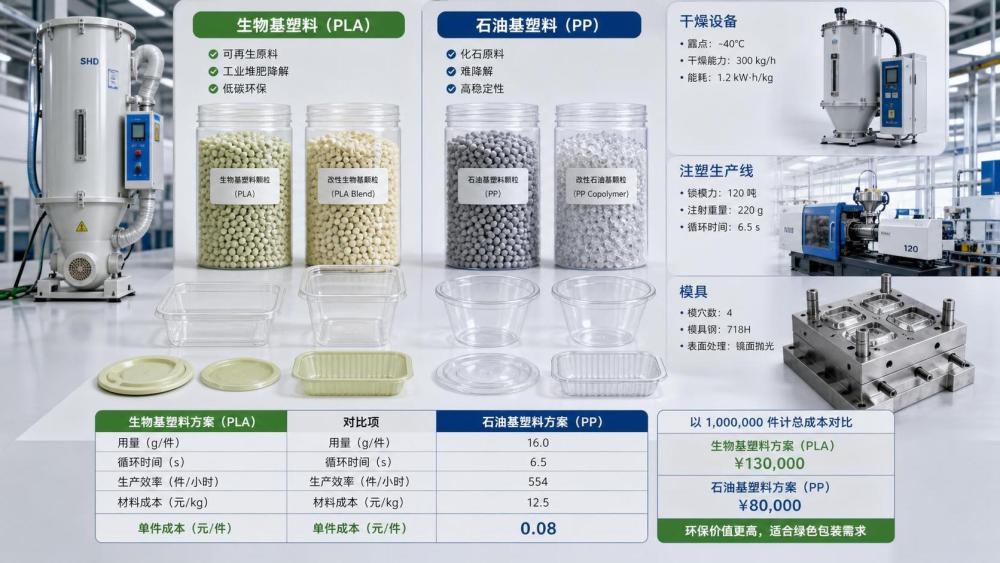
The practical answer to how to compare bioplastics cost vs petroleum-based plastics is to compare the delivered cost of a functional finished part over its intended life, not simply the quoted resin price. Start with the performance specification, then test processing, yield, logistics, end-of-life route, and commercial risk. The material with the lowest price per kilogram is not automatically the lowest-cost option.
Begin with the part requirement, not the material label
“Bioplastic” is not one material family with one cost profile. It can describe bio-based materials, biodegradable materials, compostable materials, or polymers that meet more than one of those descriptions. Some are designed for rigid packaging, others for films, fibers, disposable food-service items, durable molded goods, or blends. Petroleum-based plastics also vary widely in cost and behavior. Comparing a general bioplastic price with a general conventional plastic price does not produce a usable sourcing decision.
Write down what the part must do before requesting comparable quotations. For example, a container may need specified stiffness, impact resistance, heat tolerance, barrier performance, transparency, food-contact suitability, printability, and shelf-life protection. A molded technical component may need dimensional stability, chemical resistance, creep resistance, and a defined service temperature. The correct comparator is the conventional resin currently meeting those requirements, not necessarily the cheapest polymer available.
A material that cannot meet the requirement without a multilayer structure, thicker wall, coating, additive package, or redesigned geometry should be costed in that finished configuration. Otherwise, the comparison hides the real engineering work needed to make the alternative function.
Use a cost boundary wide enough to reveal the trade-offs
Resin purchase price remains important, but it is only one line in the calculation. A useful comparison follows material from purchase through conversion, use, and disposal. The depth of analysis should match the volume, product risk, and expected duration of the program. A short-run trial may need a practical estimate; a long-term material conversion needs a more disciplined model.
This approach avoids a common mistake: comparing one kilogram of material A against one kilogram of material B when the buyer actually sells trays, caps, films, housings, or molded components. The relevant unit is usually cost per conforming part, cost per package delivered, or cost per period of use.
Calculate material cost per acceptable part
Convert each quote into the same commercial basis. Include currency, delivery location, order quantity, payment terms, packaging format, freight assumptions, and any minimum purchase commitment. Then calculate the net resin cost based on the actual mass used in each good part.
A simple working expression is:
Material cost per good part = delivered resin cost per kg × part mass in kg ÷ production yield
Production yield should reflect more than visible scrap at steady operation. It may include purge during color or grade changes, startup waste, trim, rejected parts, and losses created by moisture sensitivity or handling damage. Regrind can alter the economics substantially, but it should not be assumed available until the supplier’s processing guidance and the part’s performance requirements support it.
Density matters, particularly when the same part volume is required. A lower-density material may use less mass for a given geometry, while another polymer may require a thicker section to reach stiffness or impact targets. Neither relationship is universal. Product designers should check the part’s actual required dimensions and mechanical behavior rather than applying a generic “lighter” or “stronger” claim.
For film and sheet, compare cost per square meter at the required thickness and performance level. For bottles and containers, compare cost per unit at the required fill volume, top-load strength, drop performance, and barrier properties. For injection-molded components, use the measured or modeled part weight and include runner-system losses where applicable.
Check whether processing changes erase the quoted savings
Many conversion decisions are won or lost on the production floor. A resin can be technically compatible with existing equipment while still requiring meaningful operating changes. Drying requirements are a frequent example. Some materials need controlled drying and careful residence-time management because moisture degradation can affect molecular structure, appearance, or mechanical performance. The cost is not only the dryer energy; it can include equipment availability, operator attention, storage discipline, and the cost of rejected output when procedures slip.
Cycle time deserves equal attention. In injection molding, cooling behavior, melt flow, mold filling, shrinkage, and ejection can change the seconds required for each shot. A small increase in cycle time affects machine output across every shift. In extrusion, a lower stable line speed, more frequent screen changes, or narrower processing window can reduce throughput. These effects should be confirmed in trials using the intended grade, tooling, part geometry, and production conditions rather than inferred from a generic data sheet.
Record trial results in operational units
During a production-representative trial, capture the information that purchasing and engineering both need: stable cycle or line speed, energy use where available, drying time, setup changes, scrap categories, acceptable regrind level, part weight, dimensional consistency, and defect rate. Also note whether the machine settings approach equipment limits. A grade that runs acceptably only in a narrow processing window may introduce an ongoing operational risk even if the initial run succeeds.
Tooling should be separated into two questions. First, can existing tooling produce an acceptable part? Second, can it do so at the required output and quality level? A material change may require adjustments to gates, vents, cooling, wall thickness, shrinkage allowance, or sealing conditions. Costing only the resin while ignoring tool modifications and validation work can make a proposed conversion appear easier than it is.
Separate renewable-content value from end-of-life value
A frequent source of confusion is treating bio-based, biodegradable, and compostable as interchangeable economic features. They are not. A bio-based polymer may be intended for conventional recycling streams or durable use. A compostable material may offer an intended disposal route only where appropriate collection and processing infrastructure exists. Some products are neither practically recyclable nor compostable in the places where they are sold, despite having attractive material attributes on paper.
End-of-life cost should be assessed as a system question. Ask what users will do with the product, what waste stream it will enter, whether local facilities accept that format, and whether labels or sorting instructions are needed. Food-contaminated serviceware, for example, may have a different disposal reality from clean industrial packaging. A compostable product has limited operational value if it is likely to enter a residual-waste stream, while a recyclable conventional polymer has limited recovery value if the product format is too small, contaminated, or hard to sort.
Do not count avoided disposal cost, recycled-content value, or environmental claim value unless the organization has a credible mechanism to realize it. The cost model should distinguish between a potential benefit and a contracted, operationally available benefit.
Include supply and commercial risk without guessing future prices
Both bioplastics and petroleum-based plastics can experience price movement, availability constraints, and regional supply differences. It is not necessary to predict future markets to compare risk sensibly. Instead, review the commercial conditions that are known today: number of qualified supply sources, lead time, approved manufacturing locations, minimum order quantities, inventory requirements, grade consistency, and the ability to obtain replacement material during an interruption.
Specialty bioplastic grades may involve longer lead times, fewer distributors, or larger order commitments than widely traded commodity resins. That can raise working-capital exposure and the cost of holding safety stock. On the other hand, an established material with volatile feedstock exposure may require a different purchasing strategy. Build scenarios using the supplier’s quoted terms and internally approved assumptions, rather than presenting one temporary quote as a permanent cost relationship.
Qualification cost also belongs in the decision. Depending on the application, it may include formulation trials, tooling evaluation, product testing, packaging-line validation, documentation updates, artwork changes, and customer approval. These are often one-time costs, but they should be spread across a realistic production volume. A switch that looks uneconomic for a short run may become viable over a longer program; the reverse can also be true when annual volume is too low to absorb the work.
A practical comparison sequence
- Define the functional baseline. Specify the current part, performance limits, processing route, annual volume, and actual disposal route.
- Select like-for-like candidates. Compare grades designed for the same application instead of comparing broad material categories.
- Normalize supplier quotations. Convert all offers to delivered cost at the same location, quantity, and commercial terms.
- Model the finished part. Include part weight, yield, scrap, regrind limits, secondary materials, and any required design change.
- Run a representative conversion trial. Verify throughput, quality, energy, drying, and machine stability under realistic conditions.
- Add implementation and end-of-life costs. Include validation, tooling, labeling, collection arrangements, and waste-stream realities where relevant.
- Test the sensitive assumptions. Identify whether the decision changes with yield, cycle time, annual volume, freight, or material price.
The sensitivity step is especially useful when the results are close. Instead of arguing over a single assumed number, identify the break point. For instance, determine the maximum acceptable cycle-time increase, the yield level required, or the production volume at which a tooling change is recovered. That turns a vague material debate into a set of conditions that engineering, operations, and procurement can verify.
When a higher-cost bioplastic can still be the sound choice
A higher delivered resin price may be justified when the alternative meets the part specification with similar or lower material use, runs reliably at the required output, and supports a real business requirement that conventional plastic does not address. The requirement may involve renewable feedstock preference, product positioning, a defined composting program, customer material specifications, or internal material targets. The key is to state that value separately from manufacturing cost rather than hiding it inside a broad claim of sustainability.
By the same standard, petroleum-based plastic may remain the better economic and technical choice where it offers superior durability, barrier performance, heat resistance, established recycling compatibility, broad supply availability, or dependable production efficiency. Material selection is not a contest between labels. It is a decision about whether a specific grade can deliver the required part at an acceptable total cost and with a disposal route that matches the product’s real use.
A reliable comparison ends with a documented cost per acceptable finished unit, a list of assumptions that materially affect that number, and trial evidence for the processing assumptions. That record makes it easier to revisit the decision when volumes, material offers, product design, or waste-handling conditions change.
Related News
- 00
0000-00
Which sectors are driving demand in the chemical engineering market? - 00
0000-00
How to assess lifecycle emissions from CCUS for low-carbon cement - 00
0000-00
How do energy storage technologies compare for 8-hour discharge? - 00
0000-00
Do mill test reports prove industrial alloys meet ASTM standards? - 00
0000-00
How to verify plastic recycling system suppliers' throughput claims
Weekly Insights
Stay ahead with our curated technology reports delivered every Monday.