




How does compounding affect plastic material properties?




Why can the same base polymer perform differently across applications? The answer often lies in plastic processing compounding, where materials are blended to achieve specific properties.
Depending on the formulation and processing conditions, compounding can influence strength, flexibility, heat resistance, appearance, and durability. Each improvement, however, can involve trade-offs.
For example, glass fibers can make a plastic stiffer and stronger, while also reducing impact resistance in some formulations and increasing processing challenges.
Understanding these relationships helps researchers and engineers compare material options, interpret supplier data, and assess whether a compound suits its intended manufacturing conditions and application.
How does compounding change plastic properties?
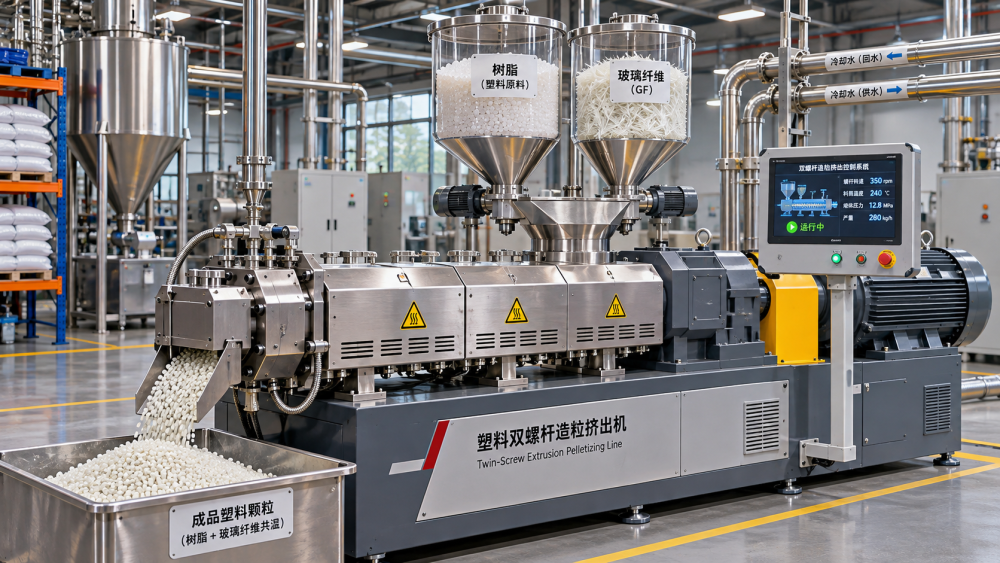
Compounding combines a base polymer with selected ingredients under controlled mixing conditions. The resulting material can behave differently from the original resin in several ways.
Fillers, fibers, modifiers, stabilizers, and pigments each serve different purposes. Their effects depend on their type, concentration, dispersion, and compatibility with the polymer matrix.
Processing also matters. Excessive heat or shear can degrade a polymer, while poor mixing can leave additive clusters that weaken the finished material.
Consequently, two compounds based on the same polymer may perform differently even when their ingredient lists look similar. Testing the finished compound is essential.
Which properties can compounding improve?
Strength, stiffness, and dimensional stability
Reinforcements such as glass fibers can increase tensile strength and stiffness, making a polymer more suitable for structural housings, brackets, and other load-bearing components.
Mineral fillers such as talc or calcium carbonate can increase stiffness and influence shrinkage. Their effect on strength depends on particle characteristics and formulation.
These additions may make the material less able to stretch before breaking. Fiber reinforcement can also make properties vary with fiber orientation in molded parts.
Impact resistance and flexibility
Impact modifiers, often based on rubbery materials, can help a brittle polymer absorb energy during a sudden load, including under some low-temperature conditions.
Plasticizers can increase flexibility by making polymer chains more mobile. They are widely used in flexible PVC, although suitability depends on exposure and regulatory requirements.
Improved toughness or flexibility may come with lower stiffness or heat resistance. Some plasticizers can also migrate over time, depending on the formulation and environment.
Heat resistance and thermal stability
Certain reinforcements can improve a compound’s ability to retain stiffness under heat. This can increase its heat deflection temperature under specified test conditions.
Heat stabilizers and antioxidants help limit degradation during processing or service. They do not necessarily increase the polymer’s melting point or make every application safe.
For a heated component, compare the actual operating temperature and load with relevant test results. Short-term heat deflection values alone cannot establish long-term performance.
Weathering, appearance, and electrical behavior
UV stabilizers and suitable pigments can slow sunlight-related discoloration and property loss. Their effectiveness depends on exposure, part thickness, and the overall formulation.
Pigments and fillers can also change color, opacity, gloss, and surface texture. Reinforcement may create visible fibers or a rougher finish on molded surfaces.
Conductive carbon or other specialized additives can modify electrical behavior. The required formulation depends on whether the goal is static control, conductivity, or electrical insulation.
What trade-offs should researchers expect?
A property improvement rarely tells the whole story. A compound selected for stiffness may become heavier, harder to process, or less resistant to impact.
For example, adding mineral filler may reduce cost per kilogram when the filler is less expensive than the resin. Its higher density can offset savings per part.
Glass fiber reinforcement can support thinner designs in some applications, but it can also increase tool wear and cause directional shrinkage or surface appearance issues.
Flame retardants can help a compound meet a specified fire test, yet their effects on mechanical properties, processing, and compliance depend on the chemistry used.
Recycled content may support material recovery goals, but variable feedstock quality can affect consistency. Stabilizers and compatibilizers can help, provided the formulation is properly controlled.
The useful question is therefore not whether an additive is good or bad, but whether the finished compound balances the properties a specific application needs.
How do processing conditions affect the final compound?
During plastic processing compounding, ingredients are typically melted and mixed in an extruder, then cooled and pelletized for later molding, extrusion, or other conversion processes.
Temperature, residence time, screw design, and mixing intensity influence dispersion and polymer condition. Poorly dispersed additives can create weak points or inconsistent color and performance.
Too much heat or mechanical shear can damage sensitive polymers. Excessive shear can also shorten reinforcing fibers, changing the strength achieved in the final part.
Moisture control matters for polymers such as nylon and PET, which can degrade during melt processing if insufficiently dried. Follow the material supplier’s drying guidance.
Downstream manufacturing adds another variable. Mold temperature, cooling rate, and flow direction can affect crystallinity, shrinkage, fiber orientation, and the properties of the finished component.
How can you compare compounded plastics reliably?
Start with the application rather than an additive name. Define the loads, temperatures, exposure conditions, service life, appearance needs, and manufacturing process for the part.
Then identify the properties most relevant to failure or acceptance. These may include impact resistance, stiffness, chemical resistance, flammability, dimensional stability, or weathering performance.
When reviewing datasheets, check the test method, specimen preparation, temperature, and units. Values measured under different conditions may not support a direct comparison.
For example, tensile modulus describes stiffness, while tensile strength describes resistance to a particular loading condition. Neither value alone predicts impact performance or part durability.
Ask suppliers for the full grade designation, base polymer, reinforcement or filler content, density, processing guidance, and relevant test results for the proposed compound.
Where applicable, request documentation for regulatory, food-contact, electrical, or fire-performance requirements. A generic claim about an additive does not establish compliance for a finished part.
Finally, validate promising candidates in representative parts and conditions. Aging, chemical exposure, assembly stresses, and manufacturing variation can reveal issues that standard specimens do not.
When does compounding offer the most value?
Compounding is useful when an unmodified resin falls short of a defined requirement and a targeted formulation can close that gap without unacceptable trade-offs.
A manufacturer might choose reinforced nylon for a stiff component near a heat source, or impact-modified polypropylene for a housing exposed to occasional knocks.
These are starting points, not universal recommendations. Moisture, chemical exposure, cost, surface finish, and expected service life can change which compound is appropriate.
Researchers can use GEMM’s material and application resources to explore polymer categories, technical information, and supplier references before requesting grade-specific data and samples.
Conclusion
Compounding changes plastic properties through both formulation and processing. It can improve performance in targeted areas, but each benefit should be assessed alongside its trade-offs.
The strongest material decision combines application requirements, comparable test data, supplier information, and validation of the finished part under realistic manufacturing and service conditions.
Related News
- 00
0000-00
How to verify product purity claims from chemical feedstock distributors - 00
0000-00
Will feedstock availability constrain biofuel production in 2026? - 00
0000-00
How to select corrosion-resistant agrochemical manufacturing reactors - 00
0000-00
How to verify an injection molding supplier in China - 00
0000-00
How to account for supplier lead times in raw material supply chain planning
Weekly Insights
Stay ahead with our curated technology reports delivered every Monday.