




How to check chemical material compliance under EU REACH




Checking whether a chemical material complies with EU REACH requires more than reviewing a safety data sheet. Quality and safety managers need evidence matched to the material and its intended use.
This chemical material compliance guide explains how to identify relevant substances, clarify supply chain responsibilities, check registration and legal controls, and document purchasing or use decisions.
Start with a practical question: can your organization show that this specific material, from this supplier, can be legally supplied and used for its intended purpose?
What information do you need before checking REACH compliance?
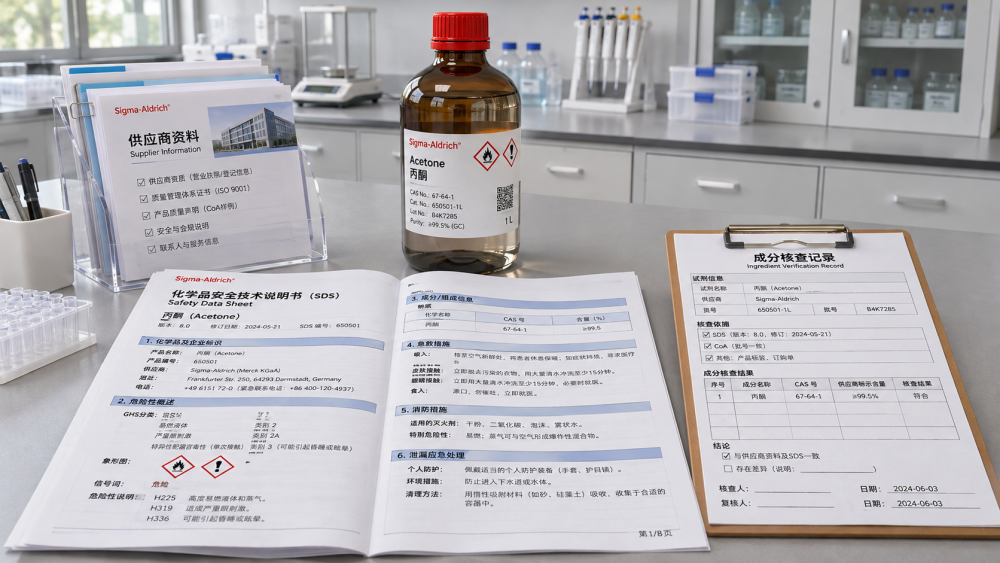
First, determine whether you are assessing a substance, a mixture, or an article. REACH obligations differ, so the product’s commercial name alone is insufficient.
A solvent is typically a substance or mixture; a coated component is generally an article. A substance supplied inside an article can require additional checks.
Request the product name, composition, substance identifiers, concentration ranges, supplier identity, manufacturing location, intended uses, and the latest applicable safety data sheet, or SDS.
For substances, use the CAS number, EC number, and chemical name together where available. Check inconsistencies with the supplier before relying on a database result.
For mixtures, assess relevant ingredients individually. An SDS may not disclose every ingredient or precise concentration, especially where disclosure thresholds or confidentiality rules apply.
Ask suppliers for targeted declarations or confidential confirmation when ingredient information is insufficient to evaluate a specific restriction, authorization requirement, or customer specification.
Which company is responsible for the REACH checks?
Your obligations depend on your position in the supply chain. An EU manufacturer, importer, downstream user, distributor, and article supplier do not have identical duties.
An EU importer generally takes responsibility for applicable import obligations. Purchasing from an EU supplier usually makes the buyer a downstream user or distributor instead.
If a non-EU manufacturer has appointed an EU-based only representative, obtain written confirmation that the appointment covers your legal entity, substance, and relevant import volumes.
Record the legal entities involved, not just brand names. A declaration from one company does not automatically cover purchases or imports made by another.
For Northern Ireland, assess the arrangements applicable to the transaction separately. Great Britain operates UK REACH, so EU REACH evidence alone does not establish UK compliance.
How do you check whether a substance is registered?
Registration generally applies to substances manufactured in or imported into the EU at one tonne or more per year per legal entity, subject to applicable exemptions.
For mixtures, calculate the annual quantity of each relevant substance, not just the total mixture weight. Imports from multiple suppliers may need to be aggregated.
Use the European Chemicals Agency, or ECHA, website to search substance information and published registration data. Match identifiers and substance identity carefully before interpreting results.
A published registration shows that registration information exists; it does not prove that your supplier, import route, tonnage, or intended use is covered.
Ask the responsible supplier or only representative for evidence appropriate to the transaction, such as relevant registration details and confirmation of coverage for your supply.
Registration numbers may be partially redacted in an SDS under permitted conditions. A missing or incomplete number alone does not establish noncompliance; investigate the reason.
Check whether an exemption applies before assuming registration is required. Exemptions are condition-specific, so document the legal basis and evidence supporting the conclusion.
Does the safety data sheet cover your intended use?
The SDS supports safe handling and supply chain communication, but it is not a universal REACH compliance certificate. Review it against the actual material and operation.
Check substance identification, supplier details, hazards, composition, exposure controls, storage, transport, and disposal information. Verify that the document is current and appropriate for the receiving country.
Where required, the SDS must be supplied in an official language of the relevant Member State, unless that Member State provides otherwise.
Compare identified uses and any attached exposure scenarios with actual conditions, including process temperature, ventilation, worker contact, quantities, and environmental release controls.
If your use or operating conditions are not covered, contact the supplier. Depending on the circumstances, you may need different controls, an alternative supplier, or downstream user action.
Some downstream users must prepare their own chemical safety report or notify ECHA when relying on certain options. Assess the relevant conditions and deadlines before proceeding.
Are restrictions, authorization, or SVHC duties relevant?
Search REACH Annex XVII for restrictions applicable to the substance, mixture, or article. Check the precise concentration limit, application, exemptions, and effective dates.
A substance may be restricted in a particular consumer application while remaining permitted elsewhere. Treat the legal entry, rather than a generic supplier statement, as decisive.
Check Annex XIV for substances subject to authorization. After the applicable sunset date, a covered use generally requires authorization unless an exemption or transitional provision applies.
Confirm whether an authorization covers the relevant actor, substance, use, and conditions. A downstream user relying on an upstream authorization may need to notify ECHA.
Also check ECHA’s Candidate List of substances of very high concern, or SVHCs. Candidate List inclusion does not itself mean a substance is banned.
It can trigger information duties. Suppliers of articles containing a Candidate List substance above 0.1% weight by weight must provide recipients with available safe-use information.
Consumers can request this information from an article supplier. Where the duty applies, the supplier must respond free of charge within 45 days.
Article producers or importers may also need to notify ECHA when the applicable 0.1% concentration and one-tonne-per-year conditions are met, subject to exemptions.
Assess SCIP notification separately under EU waste legislation. It can apply to articles containing Candidate List substances above 0.1%, depending on the supplier and transaction.
How should quality and safety teams verify supplier evidence?
Request evidence proportionate to the risk: an SDS, composition information, restriction declarations, registration coverage, and confirmation that intended uses are supported where relevant.
Make declarations specific to the product, supplier, legal requirements, and issue date. A broad statement that a product is “REACH compliant” rarely resolves every obligation.
For example, a coating supplier should address restricted substances relevant to the coating and application, while an article supplier should address applicable Candidate List information duties.
When information conflicts, place the material on hold until the responsible team resolves the gap. Escalate questions about substance identity, authorization, or exemptions to specialists.
Testing can help verify a concentration or identify contamination, but it cannot establish registration coverage or replace a review of the applicable legal conditions.
What should a defensible compliance record include?
Keep a product-specific assessment linking the supplier, legal entity, substance identifiers, purchase route, intended use, annual quantities, and applicable checks to supporting documents.
Record each conclusion, evidence source, review date, unresolved issue, and responsible owner. Include the version or access date of the legal information consulted.
Assign a review trigger for supplier changes, reformulation, new applications, increased volumes, updated SDSs, and changes to restrictions, authorizations, or the Candidate List.
Use ECHA’s REACH pages, substance information, Candidate List, and legal texts as primary starting points. Confirm binding requirements against current legislation and relevant national rules.
A reliable decision combines substance identity, supply chain responsibility, intended use, and current legal requirements. Document remaining gaps before approving a material for purchase or use.
Related News
- 00
0000-00
How to verify product purity claims from chemical feedstock distributors - 00
0000-00
Will feedstock availability constrain biofuel production in 2026? - 00
0000-00
How to select corrosion-resistant agrochemical manufacturing reactors - 00
0000-00
How to verify an injection molding supplier in China - 00
0000-00
How to account for supplier lead times in raw material supply chain planning
Related tags
Weekly Insights
Stay ahead with our curated technology reports delivered every Monday.