



How Do Polymer Recycling Processes Compare?




Mechanical recycling is generally the first route to assess for clean, well-sorted thermoplastic waste. Solvent-based purification can be useful when a valuable polymer needs to be separated from contaminants or other materials while retaining its molecular structure. Chemical recycling becomes relevant when recovering usable material requires breaking polymer chains into monomers or other chemical feedstocks. Each route solves a different problem, so the best choice depends on the waste stream and the specification of the intended product.
A meaningful polymer materials recycling process comparison must follow the material beyond the recycling plant. Buyers need to know whether the output can meet application requirements consistently, how much usable material survives the full processing chain, and whether the economics depend on unusually favorable feedstock or energy conditions. A process that accepts difficult waste may still require extensive preparation, produce several outputs, or need additional conversion before yielding a new polymer.
Start with the waste stream and the required output
The first distinction is between thermoplastics, which can generally be softened and reprocessed with heat, and crosslinked materials, which do not melt into a reusable processing fluid. Polyethylene, polypropylene, and PET are familiar candidates for thermoplastic recycling routes. Cured thermoset resins and vulcanized rubber require different treatment. Grinding these materials can produce useful fillers or particles, but that does not restore the original polymer’s processing behavior.
Even within thermoplastics, polymer identity alone is insufficient. A clean production offcut, a used food container, and a multilayer packaging film can contain the same principal polymer while presenting very different recycling challenges. Moisture, labels, adhesives, pigments, fillers, degradation, and incompatible plastics affect both processing and final properties.
The intended application provides the second boundary. A material suitable for a dark-colored construction component may be unsuitable for transparent packaging or a part requiring tight impact-performance control. Food-contact applications add requirements concerning input control, decontamination, and regulatory acceptance. No recycling category automatically establishes suitability for every end use.
Before comparing technologies, define the polymer composition, contamination profile, variability between deliveries, and target material specification. Otherwise, apparently competing processes may be treating different feedstocks or supplying different products.
Mechanical recycling: strongest when sorting protects material quality
Mechanical recycling typically combines sorting, size reduction, washing where necessary, drying, melt processing, filtration, and pelletizing. The polymer remains a polymer throughout the main recovery process. This relatively direct route makes it attractive when the incoming material already has a composition and condition close to what the next application needs.
Its practical advantage is clearest with segregated production scrap or adequately sorted post-consumer streams. Avoiding deliberate molecular breakdown and resynthesis can reduce processing complexity. Established equipment and operating experience also support deployment, although a well-developed process category does not guarantee that a particular plant can handle every waste grade.
The main limitation is that mechanical treatment cannot fully reverse previous degradation or remove every contaminant. Heat, oxygen, moisture, and shear can affect polymer chains during use and reprocessing. The resulting changes depend on the resin and its history; they should not be reduced to a universal rule that every recycling cycle causes the same loss of strength.
Incompatible polymers can create weak interfaces or unstable processing behavior. Melt filtration can remove some solid contaminants, but dissolved substances, certain odors, and embedded pigments may remain. Washing and decontamination can improve quality, while their effectiveness depends on the contaminant and treatment conditions.
Blending, stabilizers, compatibilizers, and other formulation measures can make mechanically recycled material suitable for demanding applications. They also change the cost and composition of the supplied grade. When comparing offers, buyers should establish whether quoted performance comes from the recycled feedstock itself or from a formulated blend containing virgin resin and additives.
Mechanical recycling therefore deserves priority when the stream can be sorted economically and the resulting material meets the target specification. Moving to a more complex route needs a specific justification, such as contamination that cannot be removed sufficiently, an inseparable material combination, or a quality requirement that reprocessing cannot achieve.
Solvent-based purification: selective recovery without rebuilding the polymer
Solvent-based purification uses a solvent system to dissolve a target polymer or otherwise enable selective separation. Insoluble materials can be removed, and the polymer is then recovered through steps such as precipitation or solvent removal. Unlike depolymerization, the intended mechanism preserves the polymer chains rather than converting them into monomers.
This distinction matters commercially. Solvent processing may recover a polymer from a mixture that would perform poorly after direct melt blending. It can also remove certain contaminants that mechanical operations struggle to separate. However, selectivity depends on the polymer, solvent, temperature, and contaminants involved. A substance that dissolves alongside the target polymer may require an additional separation step.
Multilayer materials illustrate both the opportunity and the constraint. A suitable process may selectively recover one constituent, but the other layers, adhesives, coatings, and fillers still need destinations. Successful recovery of the main polymer does not establish that the entire package has been recycled into useful products.
Preserving molecular structure also preserves some of the material’s history. If incoming polymer chains are already degraded, purification alone does not necessarily restore their original length or properties. The recovered resin must still be evaluated for its intended application.
Solvent recovery is central to both operating cost and environmental performance. Heating, cooling, precipitation, drying, and solvent circulation can create significant utility requirements. Solvent losses, residual solvent in the product, and the treatment of separated contaminants require attention. A technically effective separation can become commercially difficult if these demands are high relative to the value of the recovered material.
This route is most compelling when selective purification provides a measurable quality benefit and sufficient material value to support the additional processing. Assess commercial readiness at the level of the specific polymer, waste composition, and plant. Evidence from a clean demonstration feedstock gives limited assurance about variable industrial waste.
Chemical recycling: distinguish monomer recovery from broader feedstock conversion
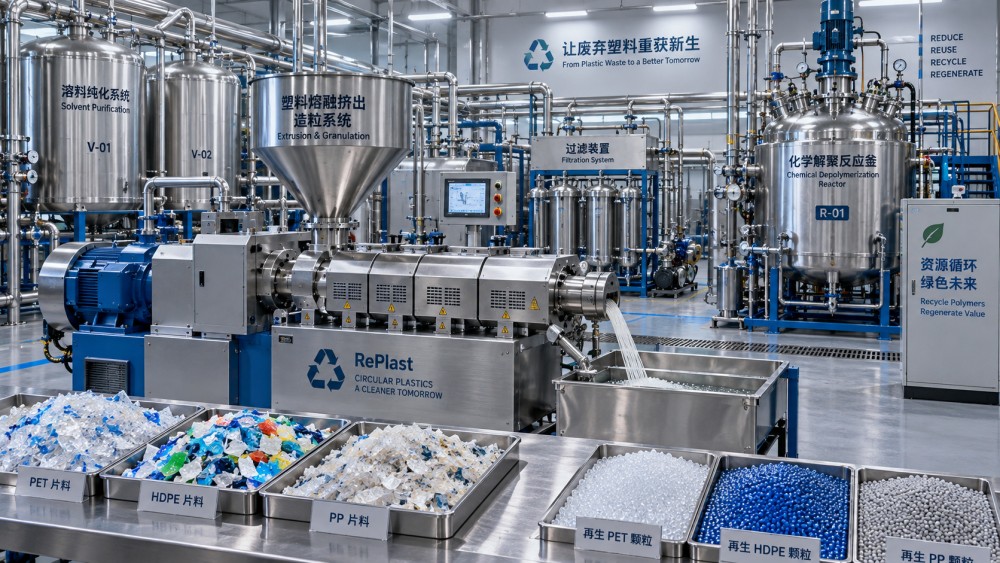
Chemical recycling covers processes with substantially different outputs. Depolymerization aims to break suitable polymers into monomers or related intermediates that can be purified and used to manufacture polymer again. Pyrolysis produces a mixture of hydrocarbons through thermal decomposition without oxygen, while gasification converts material into synthesis gas that requires further processing. Comparing these routes as a single option obscures their differences in selectivity and downstream requirements.
Depolymerization can provide a route back to defined building blocks
Some polymers have chemical structures that lend themselves to selective breakdown. PET, for example, can be treated through different chemical pathways to recover intermediates for subsequent polymer production. Whether a particular process is attractive depends on reaction conditions, reagent recovery, purification requirements, and the composition of the incoming waste.
Purified building blocks can support the manufacture of polymer with properties comparable to conventional material when they meet the necessary specifications and polymerization is properly controlled. That outcome still requires several stages. Reaction products may contain dyes, additives, by-products, or unwanted compounds that must be separated before reuse.
Depolymerization can therefore address quality constraints that are difficult to solve through mechanical reprocessing. Its selectivity also limits the feedstock window. A process designed for one polymer should not be assumed to accept mixed plastic waste indiscriminately.
Pyrolysis and gasification require a longer view of material recovery
Pyrolysis can process suitable hydrocarbon-rich plastic streams into oils, gases, and solid residues. The output is an intermediate feedstock, rather than a finished recycled polymer. Producing new plastics may require upgrading, separation, conversion in chemical manufacturing facilities, and polymerization.
Feedstock composition strongly affects this chain. Chlorine-containing materials, oxygen-containing polymers, metals, fillers, and other contaminants can affect product quality or create treatment requirements. Claims that a process handles “mixed plastics” need a defined acceptance specification, including permitted contamination and excluded materials.
Gasification produces synthesis gas that can enter chemical production pathways after cleaning and conditioning. Its broad conversion potential comes with substantial processing requirements. The assessment must follow the actual route to the intended chemical or polymer, including the energy and material losses along the way.
For both routes, distinguish material returned to polymer production from outputs used as fuels or consumed to supply process energy. These destinations can contribute differently to plant economics and resource use. Treating all useful output as an equivalent measure of plastic-to-plastic recycling can overstate polymer recovery.
Compare cost, yield, and emissions across the same boundary
A gate fee, pellet price, or headline energy figure cannot establish which process performs best. Comparisons become meaningful when they use equivalent feedstock assumptions and follow production to an equivalent usable output. Mechanical recycled pellets, purified polymer, recovered monomers, and pyrolysis oil represent different stages of the manufacturing chain.
Four questions make the comparison more useful:
- What preparation is included? Sorting, washing, drying, transport, and removal of unsuitable material can shift costs and emissions outside the quoted recycling operation.
- How much specification-compliant product is recovered? Separate total output from saleable resin or intermediates that actually qualify for the intended use.
- What happens to the remaining material? Rejects, contaminated water, spent chemicals, gases, and residues affect disposal costs and environmental results.
- Which downstream steps remain? Include purification, upgrading, chemical conversion, and polymer manufacture where these are needed to reach a comparable product.
Mechanical recycling often offers an energy advantage for suitable streams because it avoids deliberate decomposition and rebuilding. That advantage should be assessed against actual sorting losses, washing requirements, processing conditions, and product performance. A poorly matched mechanical route can generate low-value material or require substantial blending.
Solvent and chemical routes can recover value from some streams that mechanical processing cannot adequately handle, but their environmental performance depends on utility demand, reagent and solvent recovery, yield, and downstream processing. Electricity supply, heat integration, and the treatment of co-products can materially change an assessment. A technology label alone provides insufficient evidence for a lower-carbon claim.
Economics also depend on supply consistency and plant utilization. A facility designed around a narrow feedstock specification may face higher costs when deliveries vary or suitable material is scarce. For an investment decision, sustained operation with representative waste is more informative than nominal capacity or a successful demonstration run.
Choose the route that closes the specific quality gap
For clean, segregated thermoplastic scrap, assess mechanical recycling first. For a contaminated but recoverable polymer, investigate whether better sorting, washing, filtration, or formulation can achieve the required grade. Solvent purification becomes relevant where selective separation offers a clear benefit. Depolymerization deserves consideration where the polymer chemistry supports monomer recovery and purification can deliver usable building blocks. Pyrolysis or gasification requires a credible downstream pathway and a full-chain account of polymer recovery.
Purchasers should then translate the route into evidence about the supplied material: composition, melt-flow behavior, mechanical properties, color, odor, relevant contaminant limits, and consistency between batches. Qualification should reflect the intended manufacturing conditions and application. Recycled-content claims, including any mass-balance allocation, should be understood separately from physical performance and application approval.
The decisive comparison is between complete, workable systems for a defined waste stream. Once the feedstock limits, usable yield, downstream requirements, and product specification are visible, the preferred route becomes easier to judge—and claims of universal superiority become much less persuasive.
- Last One:No more articles
- Next Article:Which Mining Equipment Brands Offer Better After-Sales Support?Oct 18, 2026
Related News
- 00
0000-00
How to size process technology equipment for fine chemical batches - 00
0000-00
Can industrial energy storage for factories lower demand charges? - 00
0000-00
How energy costs are shaping the global heavy industry outlook - 00
0000-00
Which metal property standards apply to tensile testing of steel? - 00
0000-00
Can polymer processing simulation predict injection molding warpage?
Weekly Insights
Stay ahead with our curated technology reports delivered every Monday.