




What Happens If a Carbon Storage Site Leaks After Closure?




What Happens If a Carbon Storage Site Leaks After Closure?
What happens if a carbon storage site leaks after closure is a critical question for regulators, project developers, investors, insurers, and nearby communities. Carbon capture and storage is designed around the long-term containment of captured carbon dioxide in deep geological formations. The engineering case may be robust, the injection period may have ended years earlier, and the site may have entered formal closure. Yet closure does not mean that responsibility for the stored CO2 simply disappears.
A suspected leak after closure can trigger a sequence of technical investigation, safety management, regulatory review, financial exposure, and public communication. The consequences depend heavily on where the CO2 is moving, how much is escaping, how quickly it is detected, and whether the migration creates a credible risk to people, groundwater, ecosystems, infrastructure, or other subsurface resources. A small anomaly beneath a monitoring threshold is not the same event as gas reaching a shallow aquifer or accumulating in a low-lying enclosed area.
The practical issue is therefore not whether every storage project can promise zero uncertainty forever. It is whether the site was selected, operated, monitored, documented, and financially structured well enough to identify a loss of containment early and respond before a localized problem becomes a wider one.
A closed site is still a managed asset
In carbon storage, “closure” usually marks the end of routine injection, not the end of subsurface stewardship. Pressure conditions continue to evolve after injection stops. CO2 and formation water may redistribute within the storage complex, while operators and regulators assess whether the plume is behaving as predicted and whether the reservoir is approaching a stable long-term condition.
This is why post-injection monitoring matters. Site-specific plans may use a combination of pressure measurements, well integrity checks, seismic surveys, soil-gas monitoring, groundwater sampling, satellite or airborne observations, and repeat reservoir modelling. No single method provides a complete answer in every geological setting. A deep saline formation beneath a remote offshore area presents different monitoring choices from an onshore project near agricultural land, legacy wells, or potable groundwater resources.
A reported anomaly is not automatically proof of leakage. Measurements can be affected by seasonal biological activity, natural CO2 flux, equipment drift, changes in atmospheric conditions, or incomplete baseline data. The first task is to distinguish an unusual signal from a genuine migration pathway. That requires records from before injection, operational data from the active life of the project, and a defensible understanding of the local geology.
Where could CO2 escape?
Most storage projects rely on a porous reservoir rock beneath a low-permeability caprock. CO2 is retained through a combination of structural trapping, residual trapping in rock pores, dissolution into formation water, and, over longer periods, mineral interactions. A post-closure leak would generally require a pathway that bypasses or compromises those containment mechanisms.
Potential pathways are well understood in principle, although their relevance is highly site dependent:
- an improperly sealed injection well or monitoring well;
- a legacy oil, gas, water, or exploration well that intersects the storage interval;
- faults or fractures that become transmissive under changing pressure conditions;
- weaknesses in cement, casing, plugs, or wellhead abandonment work; and
- migration into an unintended formation rather than all the way to the surface.
The last point is often overlooked. A containment issue may first appear as movement into an overlying geological unit. That can still matter greatly if it affects groundwater quality, interferes with another licensed subsurface activity, or changes pressure in a sensitive formation. But it is analytically different from an atmospheric release.
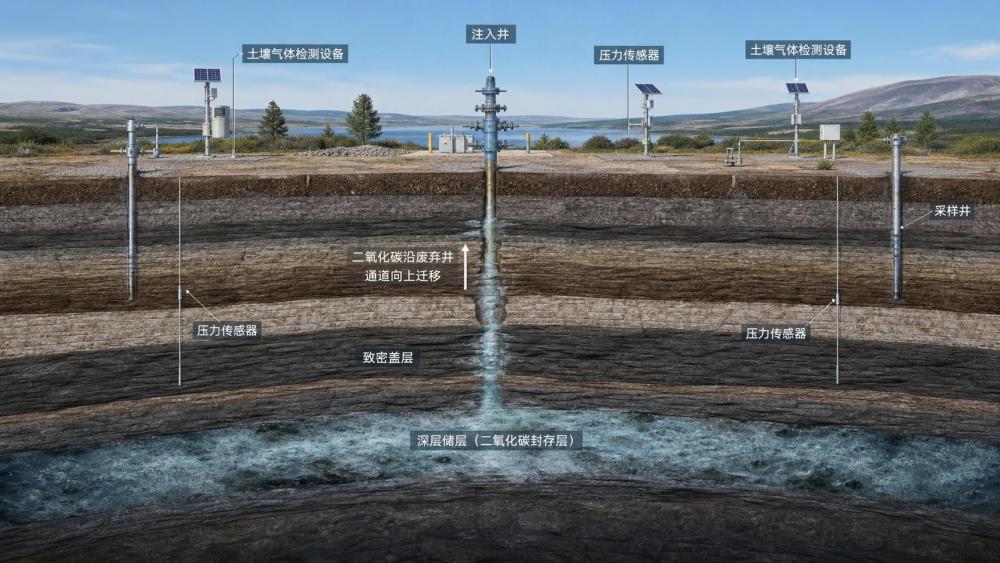
Well integrity is often the most tangible concern because wells create a direct engineered penetration through otherwise confining rock layers. A storage developer must investigate not only its own wells, but also the historical well inventory within the area influenced by the stored plume and pressure front. Older records may be incomplete, and construction practices can vary substantially by era. For investors and project partners, the quality of this legacy-well assessment can be as consequential as the reservoir’s headline storage capacity.
The immediate consequences depend on the leak scenario
CO2 is not combustible, but at high concentrations it can displace oxygen. If gas reaches the surface and accumulates in enclosed, poorly ventilated, or topographically low areas, it can create an asphyxiation hazard. Emergency controls would focus on restricting access, measuring concentrations, ventilating where appropriate, and protecting workers and local residents. A credible surface-release scenario requires a different response from a deep subsurface pressure anomaly with no present exposure pathway.
Environmental consequences may involve groundwater chemistry. When CO2 dissolves in water, it can lower pH. In some settings, that change may mobilize naturally occurring constituents from rock or soil. The actual outcome depends on the aquifer chemistry, mineral composition, groundwater use, flow conditions, and concentration of dissolved CO2. It should not be assumed that every detected migration event will contaminate drinking water, but neither should groundwater risk be dismissed without sampling and hydrogeological assessment.
There may also be climate-accounting consequences. Carbon capture projects are often supported by emissions targets, contractual commitments, tax or credit frameworks, or voluntary carbon claims. If stored CO2 is later released, the project may need to revisit how stored volumes were reported and whether any associated credits, allowances, or contractual representations remain valid. The governing rules differ by jurisdiction and project structure, so this becomes a matter for technical, commercial, and legal teams rather than a simple engineering calculation.
Detection is only useful if the response plan is credible
When monitoring indicates possible leakage, the operator normally needs to verify the signal quickly, establish its source, estimate the migration route, and assess immediate risks. That investigation can involve repeat measurements, downhole logging, pressure analysis, fluid sampling, tracer interpretation where available, and updated reservoir simulation. Surface observations alone rarely tell the whole story.
If a well is implicated, remediation may include re-entering the well, repairing casing or cement barriers, installing additional plugs, or permanently abandoning the well to an approved standard. If the issue is pressure-related, operators may consider pressure management options, which can include controlled fluid withdrawal where technically and legally feasible. A suspected fault-related pathway is more complex: the response may require revised plume modelling, expanded monitoring, changes to nearby operations, or intervention at a connected well rather than at the fault itself.
The response plan should not be written as a generic emergency document. It needs practical decision thresholds: who receives an alarm, who can authorize field work, which contractor has access to the necessary well-control equipment, what baseline samples are available, and how results will be communicated to authorities and affected stakeholders. During a real incident, uncertainty is unavoidable. Poor coordination makes it worse.
Liability after closure is a commercial issue, not just a legal footnote
One of the hardest questions is who pays if leakage occurs after a site is formally closed. In many project structures, the operator remains responsible through a defined post-closure period and must demonstrate that the stored CO2 is stable before any transfer of responsibility can be considered. In some jurisdictions, long-term stewardship may eventually shift to a public authority under specified conditions. In others, the operator’s obligations may continue for much longer. The terms cannot be generalized across countries.
For developers, liability planning should cover more than the cost of plugging a well. It may include monitoring continuation, investigation, groundwater studies, emergency response, site access, restoration work, reporting, disputes with landowners or other resource users, and possible revisions to carbon-accounting positions. Financial security arrangements, insurance availability, contractual allocation among capture, transport, and storage parties, and parent-company support all deserve review before final investment decisions.
Cross-border CO2 transport adds another layer. A capture facility, pipeline network, offshore store, and credit holder may sit in different legal and commercial systems. If containment fails, the operating agreement needs clarity on data ownership, notification obligations, access rights, remediation authority, and the allocation of costs that may arise years after injection ceased.
What a serious due-diligence review should examine
The quality of a storage project is not captured by a single capacity number or a favorable reservoir description. A useful review asks whether the storage complex has been characterized as a whole: reservoir, caprock, faults, nearby formations, legacy wells, pressure footprint, monitoring network, and closure assumptions.
Procurement decisions influence this risk profile. Pressure gauges, wellhead components, corrosion-resistant materials, cementing services, seismic systems, gas analyzers, sampling equipment, pipeline controls, and data platforms may be purchased through different packages and suppliers. Their specifications need to fit the actual storage scenario, not merely meet a broad category description. Compatibility, calibration support, traceability, maintenance access, and the availability of replacement parts can become decisive during the long post-injection period.
Better information reduces avoidable uncertainty
Carbon storage projects sit at the intersection of subsurface engineering, drilling, pipelines, process equipment, environmental monitoring, finance, and regulation. Information is often fragmented across technical studies, supplier documentation, operating procedures, market reports, and regional requirements. That fragmentation can obscure critical connections—for example, between legacy well risk and the availability of intervention services, or between a monitoring specification and the data needed for future liability decisions.
GEMM helps industry users work through this wider information landscape by organizing product categories, technical knowledge, supplier references, application guidance, market developments, export information, and pricing intelligence across energy and industrial supply chains. For carbon capture and storage work, that can support more structured comparisons of drilling equipment, pipeline technologies, carbon capture systems, monitoring-related components, materials, and associated industrial services. It is not a substitute for a site-specific reservoir study or legal advice, but it can make early-stage research and sourcing due diligence more disciplined.
The central answer to what happens if a carbon storage site leaks after closure is that the outcome depends on preparation made long before closure. Projects with clear baseline data, realistic leakage scenarios, verified well records, practical corrective-measures planning, and defined financial responsibility are better positioned to contain both the physical event and its commercial consequences. Before committing to a storage chain, stakeholders should test the closure plan as seriously as the injection plan: ask how a leak would be detected, who would act, what intervention is possible, and who remains accountable when the site is no longer generating revenue.
Related News
- 00
0000-00
Which sectors are driving demand in the chemical engineering market? - 00
0000-00
How to assess lifecycle emissions from CCUS for low-carbon cement - 00
0000-00
How do energy storage technologies compare for 8-hour discharge? - 00
0000-00
Do mill test reports prove industrial alloys meet ASTM standards? - 00
0000-00
How to verify plastic recycling system suppliers' throughput claims
Weekly Insights
Stay ahead with our curated technology reports delivered every Monday.