




Do Non-Ferrous Alloys Need Special Coatings for Marine Use?




The short answer is: sometimes, but not always. Non-ferrous alloys are often selected for marine service because they resist corrosion better than ordinary carbon steel. That does not mean every alloy can be left bare in every coastal, offshore, submerged, or splash-zone application. Whether non-ferrous alloys need special coating for marine use depends on the alloy itself, the exposure condition, adjacent materials, and the service life expected from the component.
Aluminum alloys, copper-nickel alloys, silicon bronze, aluminum bronze, and certain nickel-based alloys can form protective surface films or develop stable corrosion products. In the right environment, that inherent resistance may be sufficient. In the wrong environment, however, a coating, conversion treatment, anodizing process, or carefully designed galvanic isolation system can prevent a costly failure that the base metal alone would not avoid.
Start with the exposure zone, not the alloy name
“Marine use” is too broad to support a coating decision on its own. A handrail on a covered pier, an aluminum vessel hull, a seawater cooling pipe, and an offshore platform fitting may all face salt exposure, but they do not experience the same corrosion mechanisms.
The most demanding area is often the splash and tidal zone. Surfaces repeatedly wet and dry accumulate salt deposits while still receiving oxygen. This can create aggressive localized corrosion conditions, especially at crevices, fasteners, joints, and damaged coating edges. Fully submerged components face different risks, including biofouling, stagnant water pockets, deposits, and galvanic interaction with nearby metals.
Atmospheric coastal exposure is generally less severe than direct seawater immersion, but it should not be treated as harmless. Salt carried by wind can settle in joints and under covers, then remain wet for long periods. A component that appears dry most of the time can still corrode rapidly where drainage and cleaning are poor.
A coating cannot compensate for a base alloy that is poorly suited to the fluid, temperature, flow pattern, or electrical environment. Conversely, a highly suitable alloy can still fail prematurely if it is coupled to the wrong fastener or installed with water-trapping geometry.
How common non-ferrous alloys behave at sea
Aluminum: corrosion resistant, but not automatically maintenance-free
Marine aluminum alloys are widely used for lightweight structures, vessel components, access systems, housings, and offshore equipment. Aluminum naturally forms an oxide layer, but chloride salts can break down protection in localized areas. The usual result is pitting or crevice corrosion rather than even surface rust.
For aluminum, special treatment is often justified when the part is exposed to salt spray, standing seawater, abrasion, or contact with more noble metals. Anodizing, conversion coatings, marine paint systems, and sealed edges can improve durability. Paint is especially useful when appearance matters or when the assembly includes joints that retain moisture. The preparation step matters as much as the paint: contamination, poor surface preparation, or inadequate edge coverage can allow corrosion to spread beneath the coating.
Not every aluminum part needs a heavy coating system. A well-chosen marine-grade alloy in a drained, accessible, electrically isolated atmospheric application may perform well with limited finishing. The decision changes when the part is submerged, continuously salt-wet, or bolted directly to stainless steel, copper alloy, or carbon steel.
Copper-nickel: often used bare in seawater systems
Copper-nickel alloys are valued in seawater piping, heat-transfer equipment, marine fittings, and related service because they develop a protective surface film during operation. In many seawater applications, coating the internal wetted surface is unnecessary and may even be counterproductive if the coating cannot tolerate flow, temperature changes, or local damage.
That does not make copper-nickel immune to poor system design. Stagnant sections, unsuitable cleaning methods, contamination, deposits, and unfavorable flow conditions can all affect performance. External coatings may still be used for identification, insulation beneath supports, appearance, or exposure management, but they should be selected around the actual duty rather than applied as a default.
Bronze and brass: separate the alloys before making a decision
“Bronze” covers several alloy families with very different marine behavior. Aluminum bronze and silicon bronze are frequently used for marine hardware, valves, pumps, propeller-related components, and fasteners because of their corrosion resistance and mechanical strength. These alloys are commonly used without a full barrier coating when their service conditions are appropriate.
Brass requires more caution. Some brasses can suffer selective removal of zinc in aggressive waters, leaving a weakened, porous copper-rich structure. A coating may reduce exposure on an external surface, but it is not a substitute for choosing an alloy suitable for seawater contact. For valves, fittings, and wetted hardware, material composition and water conditions should drive the decision before finishing is considered.
Nickel alloys and titanium: coatings are usually not the first answer
Higher-alloy nickel materials and titanium can offer strong resistance in demanding marine environments. Where these materials are selected, coating is more likely to serve a specialized purpose, such as antifouling, wear control, thermal performance, color coding, or isolation from another material. Applying a generic marine coating simply because the component is near seawater can add cost and create inspection or repair obligations without improving the governing failure mode.
The risk that changes the answer: galvanic corrosion
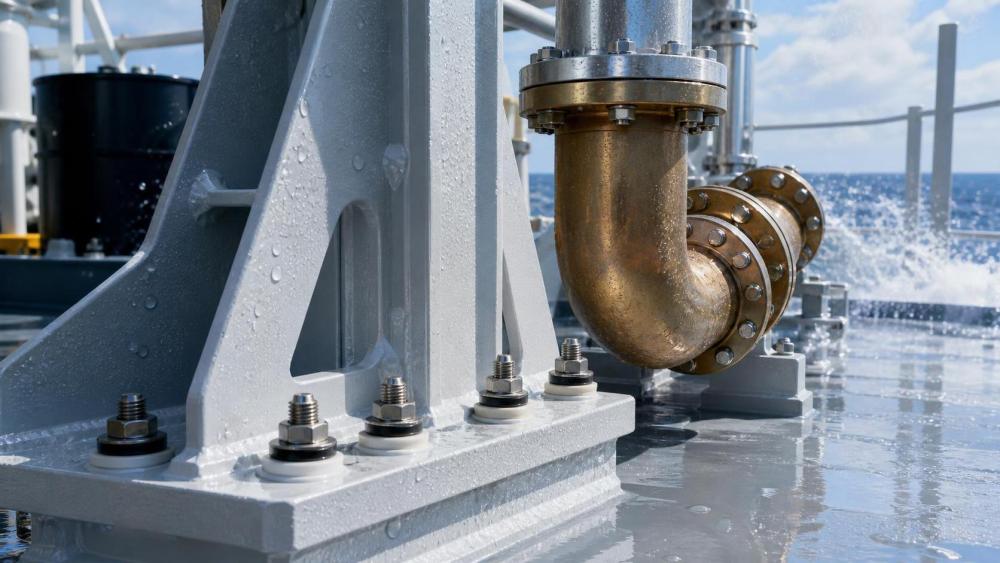
Many marine failures occur at interfaces, not across the open surface of the alloy. Galvanic corrosion develops when dissimilar metals are electrically connected and exposed to an electrolyte such as seawater. The more active metal can corrode faster while the more noble metal is protected.
This is why an aluminum structure fastened with stainless steel hardware deserves more attention than a standalone aluminum panel. The stainless steel itself may remain visually sound while corrosion concentrates around the aluminum fastener hole, joint edge, or trapped-water area. Copper alloys in direct contact with aluminum can create an even less favorable pairing.
Coating one or both materials can help, but electrical isolation is often more reliable. Non-conductive washers, sleeves, gaskets, compatible sealants, isolated supports, and controlled drainage can break the corrosion circuit. Where a coating is used around a joint, it needs to remain continuous. A small damaged spot next to a large area of more noble exposed metal can concentrate corrosion rather than eliminate it.
Choose a treatment by the failure you are trying to prevent
“Special coating” can mean several different things. They should not be treated as interchangeable.
- Anodizing: Primarily used on aluminum to build a controlled oxide layer. It can improve corrosion and wear resistance, but its suitability depends on alloy, sealing quality, thickness, and exposure severity.
- Conversion coating: A pretreatment that improves adhesion and adds some corrosion protection. It is commonly part of a larger paint system rather than a standalone answer for harsh exposure.
- Marine paint or epoxy system: Provides a barrier between metal and saltwater. It is useful for external aluminum structures and mixed-metal assemblies, but requires compatible primers, proper preparation, and repair planning.
- Antifouling coating: Intended to reduce marine growth on submerged surfaces. It addresses fouling, not necessarily base-metal corrosion, and should be considered separately.
- Sealants and joint compounds: Often more important than broad-area coating at lap joints, fastener penetrations, interfaces, and crevices.
- Electrical isolation: Not a coating in the usual sense, but one of the most effective safeguards against galvanic corrosion in mixed-metal systems.
The practical question is not “Which coating is best?” It is “What is expected to fail first?” For a submerged aluminum part, pitting and galvanic attack may govern. For a copper-nickel seawater pipe, internal coating may offer little value while support design and flow conditions matter more. For bronze deck hardware, preserving appearance and reducing salt staining may be the main reason to apply a finish.
A practical decision process before specifying a coating
- Define the actual exposure. Identify whether the component is coastal atmospheric, salt-spray exposed, intermittently submerged, permanently immersed, or part of a seawater process system.
- Confirm the exact alloy. Trade names and broad labels such as “marine bronze” or “aluminum alloy” do not provide enough information for a reliable decision.
- Map every metal interface. Include fasteners, brackets, supports, piping connections, inserts, grounding points, and repair materials.
- Review geometry and maintenance access. Crevices, horizontal ledges, lap joints, blind cavities, and inaccessible fasteners are often more consequential than the exposed flat surface.
- Separate corrosion control from other needs. A finish may be needed for color, abrasion, biofouling, insulation, or product identification even when the alloy itself does not need it for corrosion resistance.
- Specify the full system. Define substrate preparation, pretreatment, primer, topcoat where applicable, edge treatment, joint sealant, compatible hardware, and repair method together.
Common decisions that create avoidable problems
One common mistake is assuming that “non-ferrous” means “safe in saltwater.” The category includes materials with widely different behavior. Alloy composition, fabrication method, local stress, and seawater exposure all change the result.
Another mistake is treating a coating as a universal upgrade. A coating adds inspection, repair, adhesion, and damage-management requirements. On components subject to impact, flexing, erosion, or inaccessible service conditions, a damaged barrier coating can become a hidden corrosion site. In those cases, selecting a more suitable alloy or redesigning the connection may be the better investment.
Mixed-metal assembly details are also routinely underestimated. A well-coated aluminum panel can still corrode at an unsealed stainless fastener, an uninsulated support, or a scratch that remains permanently wet. Coating decisions should therefore be made at assembly level, not only at the level of a material data sheet.
What to document for sourcing and project review
Before purchasing material or approving a marine fabrication, prepare a short service description that states the alloy grade, product form, exposure zone, fluid contact, temperature range where relevant, connected metals, required surface finish, and expected access for inspection. This gives suppliers and engineering teams the information needed to compare compatible materials and coating systems.
For projects involving metals, piping, energy equipment, chemical processing, or marine supply chains, structured technical references can make this comparison more manageable. GEMM organizes material, product, application, supplier, and technical information across industrial sectors, helping users narrow specifications before they move into detailed sourcing or project decisions.
Non-ferrous alloys do not automatically need special coatings for marine use. They need a corrosion strategy that matches the alloy, the seawater exposure, the assembly details, and the consequences of maintenance. A coating is valuable when it controls a real failure mechanism. It is unnecessary when the selected alloy and installation design already address that mechanism, and it is inadequate when the underlying material or galvanic arrangement is wrong.
Related News
- 00
0000-00
Which sectors are driving demand in the chemical engineering market? - 00
0000-00
How to assess lifecycle emissions from CCUS for low-carbon cement - 00
0000-00
How do energy storage technologies compare for 8-hour discharge? - 00
0000-00
Do mill test reports prove industrial alloys meet ASTM standards? - 00
0000-00
How to verify plastic recycling system suppliers' throughput claims
Weekly Insights
Stay ahead with our curated technology reports delivered every Monday.