




How to store laboratory chemicals to avoid degradation from humidity




Humidity control begins with a simple rule: store each laboratory chemical in the container and environment that limit its contact with water vapor, while still meeting its safety and compatibility requirements. That means more than placing bottles in a cabinet. Powders, salts, standards, hygroscopic solvents, and moisture-sensitive reagents can degrade for different reasons, so the right storage method depends on what the material is, how often it is opened, and how much water exposure would affect the intended work.
Learning how to store laboratory chemicals to avoid degradation is especially important when inconsistent test results, clumping powders, changed solution concentrations, or damaged packaging begin to appear. In many cases, the chemical was not exposed to a dramatic spill or leak. It absorbed small amounts of moisture during repeated use, long storage, or poor resealing.
Start with the chemical's actual sensitivity to moisture
Not every chemical needs the same humidity-control method. A sealed bottle of a relatively stable inorganic salt may tolerate normal laboratory storage conditions better than a reagent that reacts readily with water. Treating all materials alike can waste storage capacity, but assuming every unopened bottle is protected can lead to avoidable degradation.
The safety data sheet, product label, and supplier handling guidance should determine the baseline. Terms such as “keep tightly closed,” “protect from moisture,” “store under inert gas,” or “store in a dry place” are not interchangeable. A dry place may be adequate for one reagent, while another may need a desiccator, a controlled dry cabinet, or a closed transfer system.
The container seal matters more than the cabinet label
A humidity-controlled room cannot protect a container that is poorly closed, has a damaged liner, or is opened repeatedly in humid air. For many routine reagents, the most effective improvement is to restore a reliable primary seal immediately after dispensing.
Check the cap, bottle neck, threads, liner, septum, and closure gasket for chemical attack, cracking, residue buildup, or cross-threading. A cap that looks closed but no longer seals properly can allow gradual moisture entry. Do not replace a damaged closure with a random spare cap unless its material is compatible with the chemical. Some chemicals can attack or permeate unsuitable plastics and liners, while others may be contaminated by them.
For frequently used chemicals, consider dividing stock into smaller working containers only when the procedure and chemical compatibility allow it. This reduces the number of times the main container is opened. The working container should be correctly labeled with the chemical identity, concentration where relevant, hazard information, and the date it was opened or prepared. Decanting is not automatically safer: every transfer creates an opportunity for moisture exposure, contamination, and labeling errors.
Control exposure during use, not only during storage
Many humidity-related problems begin at the bench. Opening a bottle for several minutes while preparing equipment, leaving a scoop in a powder jar, or dispensing near a steam source can introduce more moisture than the chemical absorbs during weeks in a closed cabinet.
- Prepare the required tools before opening a moisture-sensitive container.
- Open the container only long enough to remove the required quantity.
- Use clean, dry spatulas, funnels, syringes, and transfer equipment.
- Never return unused material to the original bottle unless the established procedure specifically permits it.
- Close the container before recording results or moving on to the next step.
- Keep wet cleaning activities, wash stations, and steam-generating processes away from chemical dispensing areas.
Powders deserve particular attention. A damp spatula or repeated exposure to humid air can cause localized clumps, even when the rest of the bottle appears normal. Those clumps may not dissolve at the expected rate or may make accurate weighing difficult. Breaking them apart does not restore the original water content or purity.
Choose the right dry-storage method
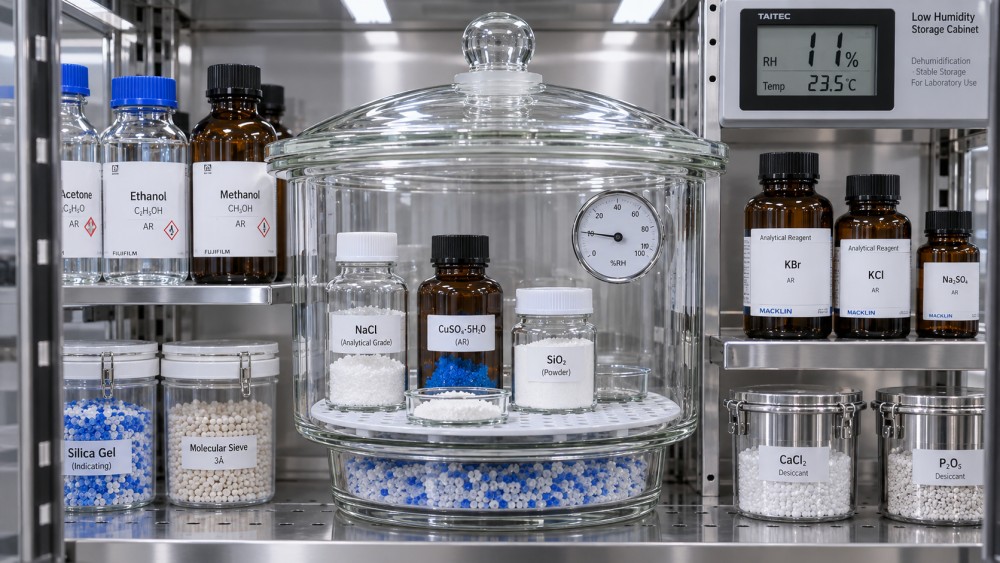
A standard chemical cabinet is useful for segregation and physical protection, but it does not necessarily provide low humidity. Use a desiccator when small quantities of moisture-sensitive materials need a dry, enclosed space and are accessed periodically. Make sure the desiccant is suitable for the intended use and is replaced or regenerated according to its condition. A spent desiccant gives a false sense of protection.
A dry cabinet is more practical when several chemicals require controlled low-humidity storage and need routine access. It can be a good fit for analytical reagents, reference materials, and moisture-sensitive components, provided the cabinet is compatible with the chemicals stored there. It should not become a mixed holding area for incompatible materials simply because it is dry.
Some chemicals require more than dry air. Reagents that react strongly with moisture or oxygen may need sealed packaging, inert gas protection, or specialized handling equipment. In these cases, a desiccator alone may slow degradation without meeting the storage requirement. The correct solution follows the chemical's documented handling conditions rather than the apparent dryness of the storage space.
Keep humidity control separate from chemical segregation
Dry storage does not override compatibility rules. Acids, bases, oxidizers, flammables, toxic materials, and water-reactive chemicals may require separate storage because of the hazards created by leaks, spills, or accidental mixing. Do not place incompatible containers together in a desiccator or dry cabinet merely to conserve space.
Secondary containment can help manage leaks, but it must also be compatible with the stored chemicals and should not trap residues that interfere with labels or closures. Keep containers upright and avoid overfilling shelves. Crowded storage makes it easier to knock over bottles and harder to notice crusting, corrosion, or a closure that has failed.
Use labeling and inspection to catch degradation early
Humidity damage is often detected through changes in appearance or performance. Record the receipt date, opening date, preparation date for solutions, and any storage condition that matters to the material. This makes it easier to identify chemicals that have been opened for a long time or repeatedly moved between storage and use areas.
During routine inspection, look for clumping, unexpected liquid in a solid reagent, discoloration, cloudiness, crystals where they should not be, corrosion around a closure, swollen packaging, or labels lifting from damp surfaces. These signs do not always prove that a reagent is unusable, but they justify removing it from routine use until its condition is assessed under the laboratory's quality and safety procedures.
Do not rely on appearance alone for reagents used in quantitative analysis, calibration, or sensitive synthesis. A solvent can absorb enough water to affect results while remaining clear, and a standard can drift without showing visible change. For critical work, storage control should be paired with the checks appropriate to the method.
A practical storage check before putting a chemical away
- Identify whether the chemical is hygroscopic, water-reactive, or sensitive to water content.
- Read the container instructions and safety documentation for the required storage condition.
- Confirm that the bottle, cap, liner, and label are intact and clean.
- Place it in the correct compatible storage group before selecting a dry cabinet or desiccator.
- Reduce future exposure by using a properly labeled working quantity when repeated access is necessary.
- Record the opening date and inspect the material before use when quality is critical.
When comparing laboratory reagents, storage equipment, or supplier documentation, structured technical resources can make it easier to review product categories, handling guidance, material compatibility, and supply options. Platforms such as GEMM organize laboratory reagent and chemical-sector information so purchasing and operating decisions can be based on the conditions a chemical actually requires, rather than on a generic storage label.
Effective humidity protection is usually built from small, consistent controls: the right container, a sound seal, limited open time, dry transfer tools, compatible segregation, and a storage environment matched to the reagent's sensitivity. That combination protects chemical quality without turning routine storage into an unnecessarily complicated process.
Related News
- 00
0000-00
Virgin vs Recycled Resin: How to Switch Without Disrupting Production? - 00
0000-00
Why Bio-Based Plastics Still Have to Prove Themselves on the Molding Floor - 00
0000-00
Industrial decarbonization targets slip when baselines are weak - 00
0000-00
How to store laboratory chemicals to avoid degradation from humidity - 00
0000-00
What makes a mining resources supplier database reliable for sourcing?
Weekly Insights
Stay ahead with our curated technology reports delivered every Monday.