




Rubber Processing Equipment Market: Buying Risks Beyond Initial Machine Cost




A low purchase price can conceal the most expensive decision in a rubber plant. A mixer, mill, extruder, calender, press, or curing system may appear comparable on a quotation sheet, yet the equipment can perform very differently once it is exposed to real compounds, shift patterns, operators, utility conditions, maintenance practices, and customer quality requirements.
For business leaders, the relevant question is rarely “Which machine costs less?” It is “Which machine creates the lowest operational risk over the period we expect to use it?” The answer depends on much more than rated capacity. A lower-cost unit may require more frequent cleaning, consume more energy per batch, struggle with process repeatability, need hard-to-source replacement parts, or introduce bottlenecks that reduce the value of upstream and downstream assets.
Rubber processing is especially sensitive to these hidden effects because material behavior changes with formulation, temperature history, shear, moisture, filler loading, and cure chemistry. Equipment that is adequate for a relatively simple compound may be unsuitable for a high-viscosity, highly filled, heat-sensitive, or tightly specified product. Procurement decisions need to connect machine specifications with the actual production process rather than treating equipment as a standalone capital item.
Initial price is only one part of the ownership equation
Capital expenditure is visible, easy to compare, and often subject to budget approval pressure. Operating costs and process risks are less visible because they emerge over months or years. Still, they can be more consequential. An inexpensive internal mixer that produces inconsistent dispersion, for example, may generate downstream variation in extrusion, calendering, molding, or vulcanization. The direct problem may look like a mixing issue, while its financial effect appears later as scrap, excess inspection, rework, late delivery, or disputed product quality.
A more useful ownership assessment should account for the following categories:
- Productivity under actual conditions: batch time, changeover time, material handling delays, warm-up requirements, and the ability to sustain output over a full shift.
- Process consistency: repeatability of temperature, rotor speed, pressure, gap, feed rate, and other variables that affect compound quality.
- Utilities and energy: electrical demand, cooling-water requirements, compressed air quality, thermal-oil systems, ventilation, and heat recovery where applicable.
- Maintenance exposure: wear parts, lubrication access, sealing arrangements, gearbox condition, control-component availability, and the practical time required for servicing.
- Integration cost: foundations, guarding, conveyors, dust collection, controls, material feeding, discharge handling, and connection to existing production data systems.
- Commercial resilience: spare-part lead times, documentation quality, commissioning support, training needs, warranty boundaries, and service response arrangements.
These factors do not always favor the most expensive proposal. They do, however, make simple price comparisons unreliable. A well-maintained used machine with documented refurbishment scope can be a sound investment in some applications. Conversely, a new machine with a low headline price may carry substantial risk if its controls, materials of construction, safety system, or service access are poorly matched to the intended duty.
Material behavior should drive equipment selection
Rubber is not one material category with one processing profile. Natural rubber, styrene-butadiene rubber, nitrile rubber, EPDM, silicone, fluoroelastomers, butyl compounds, and recycled-rubber blends can impose very different demands on processing equipment. Fillers, plasticizers, curatives, pigments, reinforcing fibers, and flame-retardant additives further affect mixing energy, heat generation, flow behavior, and cleaning requirements.
Buyers should begin with a material-and-process map. It should identify the compound families to be run, expected batch sizes, allowable temperature windows, viscosity range, contamination sensitivity, and frequency of recipe changes. The map should also show whether the equipment will process masterbatch, final mix, reclaim, strip, sheet, profile, hose, seal, tire-related components, molded parts, or another product form.
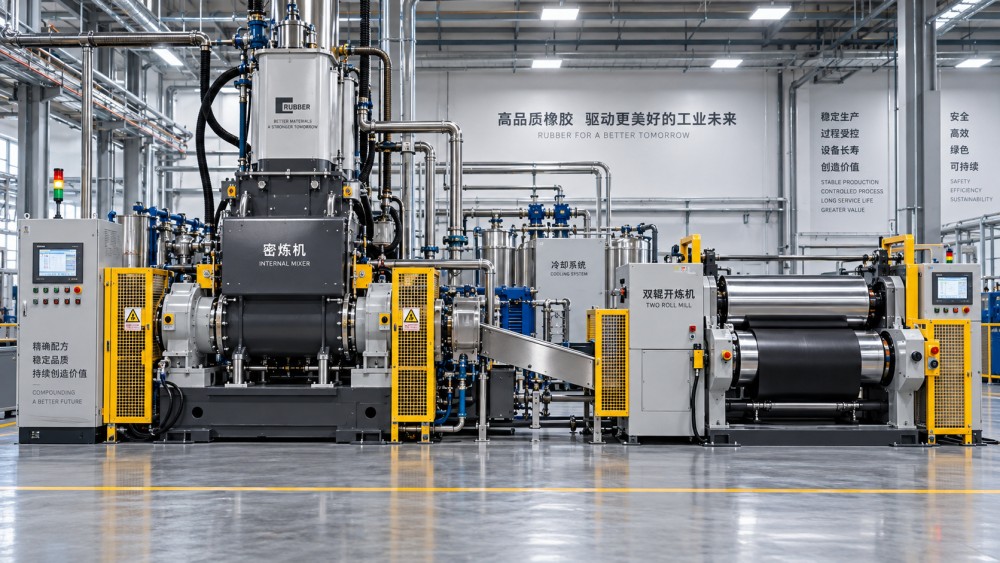
For an internal mixer, the rotor design, chamber volume, ram pressure, cooling arrangement, discharge mechanism, and torque capacity all influence whether a compound can be mixed consistently without overheating. For a two-roll mill, roll diameter, friction ratio, roll temperature control, nip adjustment, safety bars, and bearing condition affect sheeting and blending performance. In extrusion, screw geometry, barrel temperature zones, feed stability, die design, and vacuum or venting arrangements can determine whether the output profile remains dimensionally stable.
A useful overview of material, process, and purchasing relationships can be found when reviewing the rubber processing equipment market in the context of how raw materials move through mixing, shaping, and curing stages. The practical lesson is that equipment suitability cannot be judged by capacity figures alone. The same nominal output rating can represent very different real-world throughput when compounds, recipes, and operating temperatures change.
Capacity claims need to be translated into usable output
Suppliers may state hourly or batch capacities based on favorable operating assumptions. Procurement teams should ask what those assumptions are. Is the output estimate based on continuous running or a normal production cycle that includes feeding, discharge, cleaning, inspection, compound changes, and operator intervention? Does it assume one material grade, a particular fill factor, or a certain ambient temperature? Is it based on a clean product trial rather than routine production?
Usable output is constrained by the slowest stable step. A high-output mixer offers limited value if the downstream mill cannot accept the batch at the required pace. A fast extruder may create waste if curing capacity, cooling length, cutting equipment, or inspection capability cannot match its output. In plants with a broad product mix, changeover performance can matter more than maximum speed.
The quality risk often begins with control and measurement
Mechanical condition matters, but repeatable manufacturing also depends on measurement. In many rubber operations, temperature, mixing time, rotor speed, pressure, screw speed, roll gap, line speed, and cure parameters must remain within a process window established by the manufacturer. A machine may be mechanically robust yet still create quality risk if sensors drift, controls are obsolete, alarm functions are unreliable, or operating data cannot be reviewed after a deviation.
When evaluating a used or refurbished asset, decision-makers should distinguish between “running” and “production-ready.” A machine can start, rotate, and appear functional during an inspection while having unresolved issues in temperature control, instrumentation, hydraulic response, guarding, electrical documentation, or interlocks. These gaps become expensive when the equipment is installed, production schedules have been committed, and faults must be diagnosed under pressure.
Acceptance planning should include more than a basic run test. Where appropriate, buyers can define a test protocol that checks direction of rotation, speed range, temperature response, pressure response, safety circuits, emergency stops, leakage, vibration, motor load, and control functionality. For equipment intended for a demanding compound, a trial using representative material may be more informative than an empty-machine demonstration. The scope needs to reflect the commercial importance of the process; not every purchase requires a full production trial, but every purchase benefits from clear acceptance criteria.
Maintenance economics are shaped by design details
Maintenance cost is not simply the price of parts. It includes the frequency of intervention, accessibility of service points, need for specialist labor, risk of collateral damage, and duration of unplanned downtime. In rubber processing, abrasive fillers, high torque, heat, chemical exposure, and repeated load cycles can accelerate wear in rotors, chamber liners, screws, barrels, dies, bearings, seals, hydraulic systems, and drives.
Some maintenance questions are straightforward but frequently omitted from early procurement discussions:
- Which components are expected to wear in normal service, and what is their replacement method?
- Are drawings, electrical schematics, hydraulic diagrams, and operating manuals available and current?
- Which controls, drives, sensors, and safety components are installed, and are they still commercially supported?
- Can routine inspection be completed without dismantling major assemblies?
- Are critical spare parts standardized, or are they unique to a particular build?
- What condition evidence is available for gearboxes, motors, cylinders, cooling circuits, and major rotating elements?
Documentation has practical value during breakdowns, audit preparation, operator training, and future modifications. Missing documentation does not automatically disqualify an asset, but it should be treated as a measurable risk with a budgeted mitigation plan. Reverse engineering wiring, validating safety circuits, or sourcing an obsolete drive after installation can turn an apparent bargain into an open-ended project.
Safety, compliance, and site integration should be priced before award
Rubber equipment may involve nip points, hot surfaces, rotating shafts, high hydraulic pressure, heavy tooling, dust, fumes, and manual material handling. Guarding and emergency-stop arrangements need to suit the machine’s actual installation, not merely its condition at a previous site. A machine moved across regions may also need electrical adaptation, control modifications, documentation review, and risk assessment to align with local requirements and the buyer’s internal safety policies.
Site preparation can materially alter project cost. Foundations may need reinforcement to manage machine mass, vibration, or dynamic loads. Cooling-water quality and flow may be inadequate for the required temperature control. Dust collection may need resizing if a new feeding or mixing step changes airborne particulate load. Door openings, lifting capacity, transport route, installation clearances, and maintenance access should be checked before a purchase order is issued.
These items are often assigned to engineering after procurement has selected the machine. That sequence creates avoidable exposure. A cross-functional review involving production, maintenance, engineering, quality, safety, and finance is usually more effective because it reveals conflicts between the quoted equipment and the operating environment before costs become committed.
A disciplined procurement file reduces avoidable surprises
The most reliable buying process turns assumptions into documented questions. Instead of asking whether a machine is “good,” buyers can define the duty cycle, materials, target output, allowable variation, utility limits, site constraints, maintenance strategy, and required evidence. Suppliers can then respond against a more meaningful scope, and proposals become easier to compare.
A procurement file may include a process description, compound or product requirements, layout constraints, utility information, desired control functions, safety expectations, inspection criteria, delivery responsibilities, installation boundaries, training needs, spare-parts list, and warranty terms. For pre-owned equipment, it should also distinguish clearly between observed condition, repairs included in the offer, excluded work, and items that require verification after delivery.
The objective is not to eliminate all risk; industrial equipment decisions always involve uncertainty. It is to identify which risks the business can manage and which ones could disrupt production, quality, or customer commitments. In the rubber processing equipment market, the strongest purchase decision is usually the one that links machine cost to material behavior, process control, maintainability, installation reality, and the financial consequences of lost production.
- Last One:No more articles
- Next Article:How to store laboratory chemicals to avoid degradation from humiditySep 25, 2026
Related News
- 00
0000-00
Virgin vs Recycled Resin: How to Switch Without Disrupting Production? - 00
0000-00
Why Bio-Based Plastics Still Have to Prove Themselves on the Molding Floor - 00
0000-00
Industrial decarbonization targets slip when baselines are weak - 00
0000-00
How to store laboratory chemicals to avoid degradation from humidity - 00
0000-00
What makes a mining resources supplier database reliable for sourcing?
Related tags
Weekly Insights
Stay ahead with our curated technology reports delivered every Monday.