




Is Heavy Industry Automation a Worthwhile Investment in 2026?




Heavy industry automation is worth the investment in 2026 only when it addresses a defined operating constraint: unstable throughput, exposure to hazardous work, excessive energy loss, quality variation, maintenance downtime, or a shortage of skilled operators. It is not automatically justified by the availability of robots, sensors, AI software, or digital-control platforms.
The central comparison is not “automated versus manual.” It is between a targeted system that improves a constrained process and a broad automation program that adds technical complexity without improving the economics of the plant. In energy, metals, chemicals, bulk materials, and process manufacturing, the difference determines whether automation becomes a durable operating asset or an expensive integration project.
For many facilities, the strongest case in 2026 lies in automating repeatable, high-consequence tasks around existing production assets rather than attempting a full autonomous plant transformation. Remote operations in hazardous zones, automated sampling, machine vision inspection, predictive condition monitoring, closed-loop process control, and digitally coordinated material handling can each have a clearer value path than a large platform deployment with uncertain adoption.
Automation value is created at the bottleneck, not at the dashboard
A modern industrial site may have hundreds of available data points and still lack useful automation. Connecting equipment to a supervisory system does not, by itself, increase output or reduce risk. Value appears when data is translated into a decision or control action that changes a measurable operating result.
Consider a furnace, compressor train, pumping station, flotation circuit, extrusion line, or bulk-handling system. If its economic limitation is unplanned stoppage, then condition monitoring and maintenance workflow integration may be more valuable than additional production analytics. If product quality is limited by inconsistent feedstock or temperature control, then online measurement and closed-loop control deserve priority. If personnel must work near heat, pressure, corrosive chemicals, moving equipment, or confined spaces, remote or robotic operation may be justified even where direct labor savings are modest.
Automation projects fail financially when they optimize what is easy to instrument rather than what limits production. A polished control room interface can coexist with poor plant performance if the underlying equipment is unreliable, the measurement quality is inadequate, or operators cannot act on the information in time.
A useful investment question is therefore: what physical or operational constraint will this system remove, and how will the improvement be verified? If the answer is limited to “better visibility” or “digital transformation,” the project scope is not yet investment-ready.
Where the business case is strongest
Some industrial applications have a more defensible automation case because the benefits are tied to observable costs, risks, or production losses.
- Hazardous or inaccessible operations. Remote manipulation, autonomous inspection, and robotic handling can reduce routine exposure to heat, toxic substances, dust, high voltage, high pressure, heavy loads, or unstable ground conditions. The value is not simply headcount reduction; it includes safer task execution, more consistent inspection intervals, and less reliance on manual access during abnormal conditions.
- High-cost unplanned downtime. Automation supporting vibration analysis, temperature monitoring, lubricant condition tracking, electrical diagnostics, or process anomaly detection may be valuable where a failure stops a critical asset. The benefit depends on whether the site can convert an early warning into planned maintenance, spare-parts availability, and a realistic shutdown window.
- Process variability with measurable material or energy consequences. Advanced process control can be justified when variables such as feed rate, pressure, temperature, composition, residence time, or power load materially affect yield, energy consumption, emissions, or off-spec output.
- Repetitive handling and inspection tasks. Conveying, palletizing, weighing, sorting, loading, welding, coating inspection, and dimensional verification are often suitable for automation when product flow is reasonably standardized and the physical environment can be controlled.
- Compliance-critical records. Automated capture of operating parameters, batch conditions, calibration status, alarms, maintenance actions, and material traceability can improve the integrity and retrieval of records. It does not replace the need for governance, validation, and review, but it can reduce the fragility of paper-based or manually consolidated records.
These applications differ, but they share a common trait: the improvement can be linked to an operational baseline. Without a baseline for downtime, reject rate, energy intensity, labor exposure, cycle time, maintenance cost, or inventory loss, projected return is usually speculation.
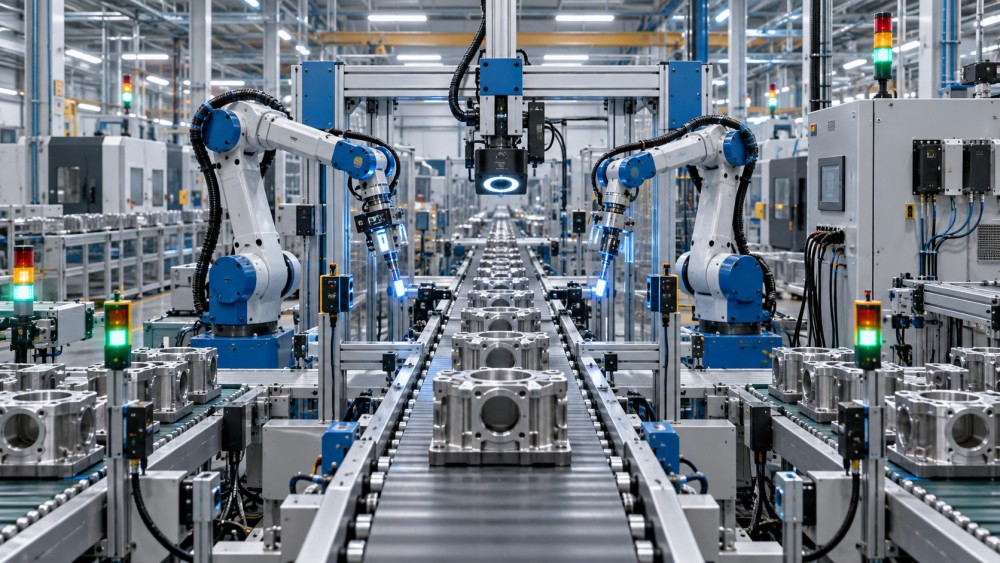
Targeted automation and full-scale transformation are not equivalent investments
The term “heavy industry automation” can describe projects with radically different cost, risk, and implementation profiles. Treating them as one category leads to poor comparisons.
Point automation is often underestimated because it lacks the visibility of a site-wide initiative. Yet it can be the more rational choice when a plant has one dominant safety, quality, or capacity problem. A robotic ladle-area inspection system, automated chemical dosing skid, or machine-vision quality gate may deliver a stronger result than a broad data program that does not change frontline decisions.
Conversely, isolated projects can become costly if every new system uses a separate software environment, proprietary data format, or unsupported communication method. The appropriate comparison is therefore not local return versus enterprise return. It is local return with a defined integration path versus enterprise scope with a credible implementation capability.
Upfront price is a poor measure of investment quality
Capital cost matters, but it is rarely the full economic question. Automation changes the cost structure of an operation over its life. A project can appear inexpensive at purchase and become costly through custom engineering, shutdown requirements, controls integration, spares, calibration, software licensing, cybersecurity controls, specialist support, retraining, and future upgrades.
For equipment buyers, the most important commercial distinction is between a standardized solution and a bespoke system. Standardized components may offer simpler replacement, more predictable documentation, and wider service options. Custom automation can be necessary in unusual environments or legacy facilities, but its lifecycle cost should include dependency on the original integrator and the availability of replacement parts, software access, and technical documentation.
Financial evaluation should also distinguish avoided cost from realized cash savings. Reducing manual intervention does not necessarily reduce payroll if personnel are reassigned to maintenance, quality, logistics, or supervision. That does not make the project unviable; it means the business case should be based on the actual gain—higher availability, reduced overtime, lower exposure, greater capacity, fewer defects, or more reliable reporting—rather than assumed labor elimination.
The same discipline applies to energy claims. Variable-speed drives, optimized control, automated scheduling, and better process stability can reduce avoidable consumption in the right setting. But a model based on a short operating period may not capture changes in feedstock, ambient conditions, production mix, equipment fouling, or production rate. Energy benefits should be tested against operating ranges, not a single favorable baseline.
Legacy integration is often the deciding factor
Heavy industrial plants are rarely blank-sheet environments. They may contain equipment installed across several decades, control systems from different suppliers, incomplete drawings, undocumented logic changes, and instrumentation whose calibration history is uneven. A technically capable automation package can still fail at the interface between new controls and old equipment.
This is why front-end engineering deserves more attention than product demonstrations. The project team needs a defensible view of signal availability, instrument condition, control-loop behavior, network capacity, physical installation constraints, electrical compatibility, shutdown opportunities, and failure modes. For process changes, it must also be clear whether the automation is advisory, operator-confirmed, or permitted to act autonomously.
Automation should degrade safely. If a sensor fails, communications are interrupted, or an algorithm produces an implausible output, the process needs defined fallback behavior. In a low-consequence application, that may mean returning to manual control. In higher-risk environments, it may require an engineered safe state, independent protective layers, and formal management of change.
It is a mistake to assume that more autonomy is always better. In a stable, well-characterized process, automatic control may be appropriate. In a process with variable raw materials, irregular equipment condition, or limited measurement confidence, decision support with operator confirmation may provide more value and less risk.
Cybersecurity and maintainability belong in the investment case
Connecting operational technology expands the number of systems that must be managed over time. Remote access, cloud data transfer, vendor support connections, wireless sensors, and integration with business platforms can all be useful, but each introduces governance requirements. Cybersecurity cannot be added as a procurement clause after system design is complete.
The practical issue is not whether a facility can eliminate all cyber risk; it cannot. The issue is whether responsibilities are clear for asset inventory, account control, remote access approval, patching, backups, network segmentation, incident response, and recovery testing. These responsibilities often sit across engineering, IT, operations, maintenance, and external service providers. If ownership is ambiguous, the operating risk persists after commissioning.
Maintainability is equally important. A system that requires rare programming skills for minor changes may have an attractive initial specification but poor long-term usability. Before contracting, buyers should establish who can modify setpoints, adjust recipes, replace failed components, retrieve historical data, restore a backup, and diagnose a communications issue. Documentation, source-code access where appropriate, training depth, and spare-parts strategy are operational requirements, not administrative extras.
How to judge whether the investment is justified
The answer to “is investing in heavy industry automation worth it in 2026?” depends less on the technology category than on the quality of the decision process. A credible proposal should survive several practical tests.
It should identify a specific baseline problem, such as hours of critical downtime, unsafe manual interventions, material loss, quality deviation, or control instability. It should explain the mechanism by which the proposed system improves that problem. It should include the costs of integration, commissioning, training, support, spares, and cybersecurity rather than only equipment purchase. It should also define what happens when the system is unavailable and how performance will be measured after startup.
Projects that cannot pass these tests may still be useful experiments, but they should be funded as such: limited in scope, instrumented for measurement, and designed to produce a decision about broader deployment. Calling an exploratory digital initiative a guaranteed productivity project creates the wrong expectation and makes later investment decisions harder.
Automation is most worthwhile where it makes a difficult industrial operation more stable, safer, more controllable, or less wasteful in a way that can be verified. It is least worthwhile when it is purchased as a symbolic modernization effort, disconnected from asset reliability, workforce capability, and the physical realities of the process. In 2026, disciplined scope selection—not the pursuit of maximum autonomy—is the more reliable route to long-term value.
Related News
- 00
0000-00
Can polymer processing simulation predict injection molding warpage? - 00
0000-00
An export controls compliance guide to checking U.S. license requirements - 00
0000-00
How Do Metals Compare in Physical Properties and Heat Resistance? - 00
0000-00
Which Standards Apply to Tensile Strength Testing of Metal Alloys? - 00
0000-00
Petroleum refining technology trends reshaping refinery decarbonization
Weekly Insights
Stay ahead with our curated technology reports delivered every Monday.