




How to Size High Capacity Mineral Processing Systems for Throughput and Ore Variability




Throughput Is Not the Same as Plant Capacity
The most common mistake in sizing high capacity mineral processing systems is treating design throughput as a single number. A plant may be specified for a certain tonnage per hour, but that figure only means something when the ore body, grindability, moisture, competency, and mineral liberation behavior are understood in the same frame. Nameplate capacity is a reference point. Real capacity is the rate a circuit can sustain without pushing recovery, water balance, wear life, or downstream stability out of tolerance.
For technical evaluation, the better question is not “What tonnage do we need?” but “At what ore condition can this tonnage be maintained, and what happens when the feed moves away from that condition?” In large concentrators, variability is usually the design issue that separates a robust system from an expensive bottleneck. A circuit that performs well on average ore but loses control on hard blends, clay-rich intervals, or shifting particle size distribution is not really well sized.
Where Sizing Really Starts
High capacity mineral processing design starts upstream of equipment selection. Before mills, crushers, screens, cyclones, flotation cells, thickeners, or filters are compared, the ore must be described in terms that matter to the circuit. That typically includes hardness profile, abrasion characteristics, bulk density, moisture range, fines content, clay behavior, liberation size, and the degree to which ore domains vary over the mine plan.
This is where many evaluations become too narrow. A crushing and grinding circuit sized only from average comminution results may look reasonable on paper, yet the installed power, liner strategy, transfer chute geometry, and classification duty can all become mismatched once ore variability appears in operation. The same applies in flotation or gravity separation. Residence time, reagent regime, and recirculating load are tied to feed behavior, not just to nominal tonnes.
In practical terms, sizing work should reflect at least three conditions: expected ore, hard or difficult ore, and upset or transition ore. The difficult condition does not need to drive every equipment dimension, but it must be visible in the design logic. Otherwise, the plant may meet budget assumptions while failing the actual operating envelope.
The Bottleneck Is Often Outside the Main Machine
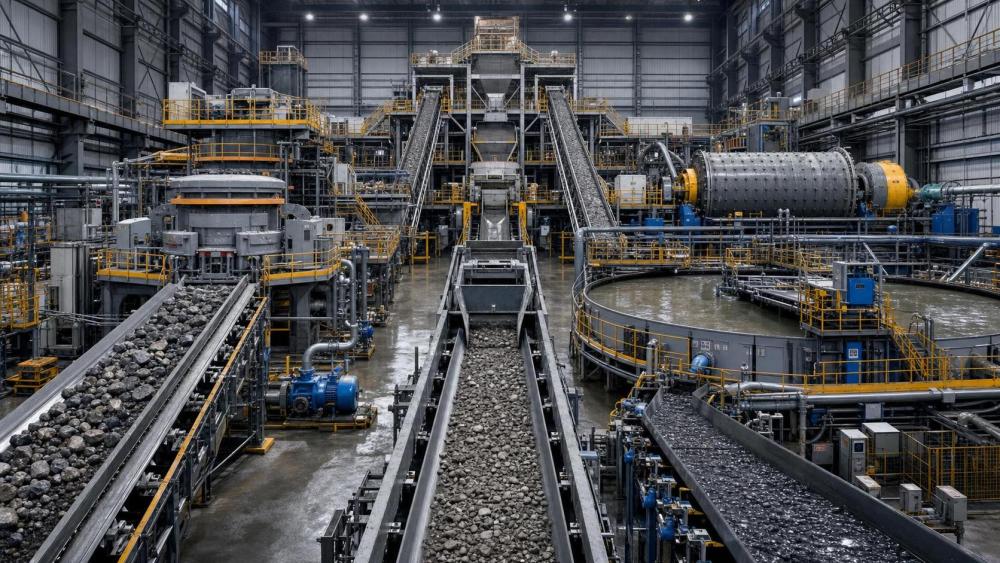
Large projects often focus too heavily on primary equipment size: SAG mills, ball mills, crushers, flotation trains, or filtration units. Those are obviously critical, but high-throughput systems are frequently limited by secondary elements that look minor during specification. Transfer points, feeders, pumps, cyclone clusters, screen aperture strategy, launder design, tailings handling, water reclaim systems, and control response can all cap plant performance well before the flagship equipment reaches theoretical duty.
That matters because high capacity systems amplify small design weaknesses. A chute that handles moderate variation at a lower rate may plug regularly at scale. A pump selected close to best efficiency at one slurry density may drift into unstable operation as solids concentration changes. A thickener sized around favorable settling assumptions may hold back the whole plant during fine or clay-heavy campaigns. Technical evaluators should read capacity claims as a circuit statement, not a machine statement.
Flexibility Has a Cost, but So Does Rigidity
There is no universal rule that bigger margin is always better. Oversizing can create poor operating efficiency, unstable control, excess energy use at part load, and unnecessary capital intensity. But undersizing around a narrow feed assumption creates a different kind of cost: chronic debottlenecking, loss of recovery, reduced equipment life, and constant operating intervention.
The evaluation task is to decide where flexibility is worth paying for. In some sections, installed standby capacity or modular expansion paths are sensible. In others, turndown performance matters more than peak duty. A dewatering circuit, for example, may need enough resilience to handle seasonal moisture changes and fines variability even if average annual throughput looks moderate. A comminution circuit may justify a conservative allowance if ore hardness is poorly bounded across future phases. The answer depends on how hard it is to modify that section later, how much production is exposed if it underperforms, and whether process control can absorb normal variation.
Questions That Usually Improve the Specification
When reviewing a high capacity mineral processing system, a few questions are more useful than generic efficiency claims:
- What ore domains were used to set design throughput, and which domains were excluded?
- Is capacity based on dry tonnes, wet tonnes, or slurry flow under defined solids concentration?
- What recirculating loads, residence times, or circulating factors were assumed at design rate?
- How much of the system depends on operator intervention to stay inside that envelope?
- Which items are true bottlenecks if hardness, moisture, or fines increase beyond expected levels?
- Can critical sections be isolated, bypassed, or expanded without a major plant shutdown?
These questions do not produce a single formula, but they expose whether the design has been built around operational reality or around a headline throughput target.
Why Ore Variability Deserves Equal Weight with Throughput
Ore variability is not just a geology issue handed off to operations. It is a sizing issue because it changes breakage behavior, pulp rheology, separation efficiency, reagent response, tailings characteristics, and water demand. In one ore zone the constraint may be grinding power; in another, it may be flotation kinetics or concentrate handling. Designing around average feed can hide the fact that the plant will spend a meaningful portion of its life away from average.
That is why testwork quality matters more than large volumes of loosely interpreted data. Variability programs do not need to answer every future question, but they should establish the operating range that the plant must survive. Technical evaluators should be cautious when specifications present narrow design windows without showing how variability was treated. In most mineral systems, uncertainty does not disappear because it was left out of the equipment schedule.
A Better Way to Read Capacity Claims
A credible sizing basis usually shows more than rated throughput. It connects ore characterization, process assumptions, equipment duty, control philosophy, and maintenance strategy. It also makes clear whether the plant is expected to hit peak rate continuously, seasonally, or only under favorable feed conditions. That distinction is often more valuable than a larger nominal number.
For procurement or project screening, the strongest position is to compare systems on their operating envelope: the range of ore and process conditions under which throughput and recovery remain commercially acceptable. That shifts the discussion from brochure capacity to decision-grade capacity. In high capacity mineral processing, that is usually the difference between equipment that looks adequate and a system that is actually fit for the ore body it must treat.
A sound specification, then, is less about choosing the largest machine and more about defining the limits of stable performance. Once those limits are explicit, tradeoffs around capital, flexibility, energy use, and future expansion become much easier to judge with discipline.
Related News
- 00
0000-00
Virgin vs Recycled Resin: How to Switch Without Disrupting Production? - 00
0000-00
Why Bio-Based Plastics Still Have to Prove Themselves on the Molding Floor - 00
0000-00
Industrial decarbonization targets slip when baselines are weak - 00
0000-00
How to verify whether a circular economy certification is credible - 00
0000-00
How to evaluate upstream energy systems suppliers for project reliability
Related tags
Weekly Insights
Stay ahead with our curated technology reports delivered every Monday.