




What Are the Key Differences Between Smelting and Casting?




Smelting and casting are often mentioned together because both involve high temperatures and molten metal, but they solve fundamentally different industrial problems. Smelting is an extractive metallurgical process: it separates valuable metal from ore, concentrate, or secondary feedstock through heat-driven chemical reactions. Casting is a shaping process: it pours already-produced molten metal into a mold so that it solidifies in a required geometry.
The distinction matters whenever a specification, quotation, plant description, or supply-chain claim refers to “metal production.” A smelter can produce crude metal, matte, alloy intermediates, or refined feedstock, but it does not necessarily make usable parts. A foundry can produce engine blocks, valves, billets, fittings, or machine housings, but it normally depends on externally supplied metal, ingot, return scrap, or alloying additions rather than mineral ore.
They begin with different feedstocks and end with different outputs
Smelting starts with material that still contains unwanted mineral matter or chemically bound metal. Typical feeds include iron ore, copper concentrate, lead sulfide concentrate, nickel laterite intermediates, and recycled materials containing recoverable metals. The central objective is to remove or separate gangue, oxygen, sulfur, and other undesired constituents while collecting the metal-bearing phase.
For example, ironmaking in a blast furnace reduces iron oxides in ore to hot metal. Copper smelting converts sulfide concentrates into copper matte, a molten sulfide phase rich in copper and iron, while producing slag that carries much of the unwanted oxide material. Further converting and refining are then required before high-purity copper is available for wire rod, sheet, or casting applications.
Casting begins after the metal chemistry has been selected or accepted for use. Its feedstock may be aluminum ingot, steel scrap and ferroalloys melted in an electric arc furnace, ductile iron base metal, copper alloy ingot, or a controlled mix of virgin and return material. The primary result is not extracted metal; it is a solid object with a designed shape.
That object may be a near-net-shape component, such as a pump casing or turbine blade, or an intermediate product such as an ingot, slab, bloom, billet, bar, or continuous-cast strip. In many supply chains, continuous casting is the bridge between steelmaking and rolling: liquid steel is solidified into slabs or billets that later undergo hot rolling, forging, machining, coating, or heat treatment.
Smelting changes chemistry; casting mainly controls geometry and solidification
The most important answer to what are the key differences between smelting and casting in metallurgy lies in the dominant transformation taking place. Smelting relies on chemical reactions. Metal compounds are reduced, oxidized, sulfided, volatilized, or separated between molten phases. Fluxes are often added to form slag with impurities. Reductants such as coke, carbon monoxide, hydrogen-bearing gases, or electrical energy may be used depending on the process route and feedstock.
Temperature alone does not define smelting. Simply melting aluminum ingot in a furnace is not smelting because no ore-to-metal extraction reaction is occurring. Likewise, remelting steel scrap to make cast parts is melting and casting, not necessarily smelting. The process becomes smelting when the furnace operation is designed to liberate metal from its chemical or mineral association and partition contaminants through controlled reactions.
Casting does involve metallurgical change, but its central challenge is physical rather than extractive. The liquid metal must enter the mold without excessive turbulence, gas pickup, oxide entrainment, or temperature loss. It must then freeze in a way that controls shrinkage, porosity, segregation, cracking, residual stress, and grain structure.
Alloys do not solidify as perfectly uniform blocks. In many cases, the first solid to form has a slightly different composition from the remaining liquid. This phenomenon, known as microsegregation, can influence machinability, corrosion behavior, hardness distribution, and heat-treatment response. In large castings, long freezing times can produce coarse grains and localized composition variation. These are casting and solidification issues, even though the alloy chemistry may have been accurately adjusted before pouring.
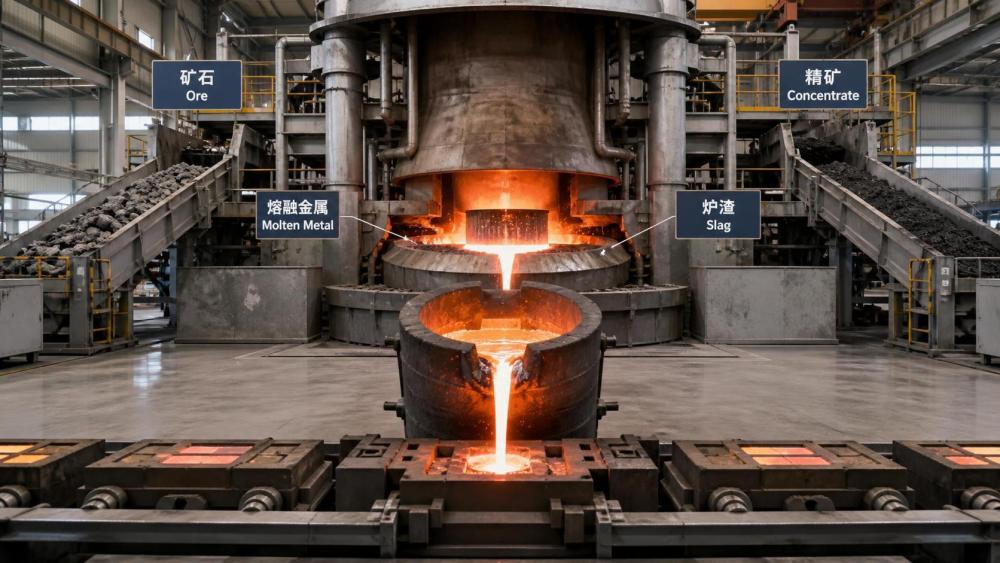
The equipment reveals the difference in process logic
Smelting equipment is designed around reaction control, phase separation, feed preparation, and emissions management. Depending on the metal and production route, it may include blast furnaces, reverberatory furnaces, flash smelters, electric furnaces, rotary furnaces, submerged arc furnaces, converters, roasters, sintering units, concentrate dryers, slag granulation systems, and gas-cleaning equipment.
A smelter must manage more than furnace temperature. Feed particle size, moisture, concentrate composition, flux ratio, oxygen potential, refractory condition, slag viscosity, and off-gas composition can all affect recovery and operating stability. Sulfide ores add another layer of complexity because sulfur-bearing gases require controlled capture and treatment. The off-gas system is therefore often integral to the process rather than an auxiliary feature.
Casting operations use equipment suited to melt handling and mold filling. Common systems include induction furnaces, electric arc furnaces, ladles, tundishes, pouring units, die-casting machines, sand-molding lines, investment-casting shells, permanent molds, centrifugal casting machines, continuous-casting molds, cooling circuits, and finishing stations.
The mold is central to casting but usually irrelevant to smelting. Its material, permeability, thermal conductivity, coating, venting, gating design, and ability to withstand thermal shock influence the quality of the finished item. Sand casting allows complex cavities and low-to-medium production flexibility. Die casting uses steel dies and high-pressure filling, typically for nonferrous alloys and high-volume precision parts. Investment casting is selected where intricate geometry and a good surface finish justify a more involved mold-making route. Continuous casting produces long semi-finished sections rather than individual discrete components.
Purity requirements do not disappear after smelting
A frequent misunderstanding is that smelting automatically produces metal ready for demanding end use. In reality, smelting often creates an intermediate product that requires converting, fire refining, electrorefining, vacuum treatment, degassing, filtration, alloy adjustment, or other downstream processing.
Crude iron from a blast furnace contains substantial carbon and may contain silicon, manganese, phosphorus, sulfur, and other elements. It is not equivalent to specification-grade steel. Copper matte is not the same as cathode copper. Primary aluminum is produced through electrolysis after alumina refining, not simply by melting bauxite. These examples show why process names must be interpreted within the full metallurgical route.
Casting also cannot correct every upstream quality issue. A mold can give metal the desired external shape, but it cannot remove excessive tramp elements, restore depleted alloying elements, or reliably eliminate contamination already dissolved in the melt. Melt treatment can reduce some defects and improve cleanliness, yet it works within limits. If the charge material is unsuitable for the specified alloy, casting control alone cannot guarantee compliance.
This distinction is commercially important when reviewing supplier claims. “Cast steel,” “smelted steel,” “foundry-grade metal,” and “refined metal” describe different points in the production chain and should not be treated as interchangeable descriptions of material quality.
How to identify which process a requirement actually concerns
When a drawing, request for quotation, or technical discussion uses the word “production,” the first practical question is whether the requirement concerns metal origin, composition, or part manufacture. The answer determines what evidence is relevant.
If the concern is the source of the metal, chemical purity, recovery from ore, environmental controls, or primary-metal availability, the discussion is about smelting and refining. Relevant documentation may include feedstock origin, assay results, process route, metal purity, impurity limits, and treatment of slag or process gases.
If the concern is wall thickness, internal passages, surface finish, mechanical integrity, dimensions, machining allowance, or repeatability of a component, the discussion is about casting. Relevant information includes alloy grade, melt practice, molding method, gating and risering design, non-destructive testing requirements, heat treatment, dimensional tolerances, inspection plan, and traceability.
Some requirements cover both. A corrosion-resistant valve body, for example, requires an alloy with controlled chemistry and a casting route capable of avoiding shrinkage cavities in pressure-retaining sections. The metal may originate from primary smelting, recycled scrap, or a mixture of both, but the finished part must still meet composition, mechanical-property, and integrity requirements. Treating the sourcing question and the manufacturing question as one issue can leave important risks unexamined.
Different defects point to different process stages
Smelting problems generally appear as poor recovery, unacceptable impurity levels, unstable slag behavior, excessive metal losses to slag, refractory damage, or off-gas control difficulties. Their causes tend to involve feed variability, reaction balance, furnace conditions, and separation efficiency.
Casting defects are more directly visible in the product. Shrinkage porosity occurs when liquid metal is not available to compensate for volume contraction during solidification. Gas porosity can result from dissolved gases, moisture, inadequate venting, or turbulent filling. Cold shuts and misruns arise when metal loses fluidity before the cavity is fully filled. Inclusions may come from oxide films, slag, refractory erosion, or mold material. Hot tears occur when a casting is restrained as it contracts at high temperature.
Not every internal defect means the metal was “bad,” and not every chemistry deviation means the casting process failed. The defect mechanism must be located before corrective action is chosen. Increasing pouring temperature may help a misrun but can worsen gas pickup, mold erosion, or grain coarsening. Adding more risers may reduce shrinkage in one region while raising yield loss and finishing effort. Changing the charge mix may correct composition but does not automatically solve poor gating design.
Energy, environmental, and supply-chain implications are not the same
Smelting is commonly more energy- and emissions-intensive at the point of metal extraction because it handles ores or concentrates and drives high-temperature reduction or separation reactions. The environmental profile depends heavily on ore grade, fuel source, furnace technology, sulfur content, electricity mix, gas treatment, and slag handling. It should not be assessed merely by the fact that a material is called “primary” or “smelted.”
Casting also consumes substantial energy through melting, holding, mold preparation, cooling, finishing, and scrap remelting. Yet its environmental and material efficiency profile is governed by different variables: casting yield, return-scrap recovery, machining allowance, reject rate, mold material, and the proportion of recycled metal in the charge. A near-net-shape casting can reduce downstream machining, while an inefficient gating system or high rejection rate can offset some of that advantage.
For supply planning, smelting capacity affects the availability of primary metal and certain intermediate products. Casting capacity affects the ability to turn metal into qualified geometries within required lead times and inspection conditions. A producer may have reliable access to metal yet lack the tooling, molding line, heat-treatment capacity, or quality system required for a particular casting. Conversely, a capable foundry may be exposed to volatility in alloying elements or primary-metal supply.
Choosing the right term avoids costly technical mistakes
Use “smelting” when discussing extraction from ore or concentrate, chemical separation, furnace reduction, slag formation, or production of crude and intermediate metals. Use “casting” when discussing molds, pouring, solidification, component geometry, and the conversion of molten metal into a shaped product.
The two processes can be linked in the same value chain, but they are not alternative methods for accomplishing the same task. Smelting makes metal available by changing its chemical state and separating it from unwanted material. Casting makes metal useful in a specific physical form by controlling flow and solidification. Clear separation of these roles leads to more accurate specifications, more meaningful supplier comparisons, and better decisions about where material, quality, cost, and delivery risks actually originate.
Related News
- 00
0000-00
Which drilling systems are suited to long-lateral shale wells? - 00
0000-00
Which sectors are driving demand in the chemical engineering market? - 00
0000-00
How to assess lifecycle emissions from CCUS for low-carbon cement - 00
0000-00
How do energy storage technologies compare for 8-hour discharge? - 00
0000-00
Do mill test reports prove industrial alloys meet ASTM standards?
Weekly Insights
Stay ahead with our curated technology reports delivered every Monday.