




How upstream energy systems monitoring helps detect production losses




A production shortfall rarely begins as a single obvious failure. A well may still be flowing, a separator may still be operating, and a dashboard may still show equipment as “online,” while small pressure changes, unstable flow, rising downtime, or declining efficiency quietly reduce deliverable volume. For a project manager, the difficult part is not simply seeing that output is below plan; it is determining whether the loss comes from the reservoir, the wellbore, artificial lift, gathering system, processing equipment, measurement quality, or the way work is being scheduled.
Upstream energy systems monitoring helps detect production losses by connecting operating signals to an expected production baseline and then tracing deviations through the production chain. The objective is not to collect more readings. It is to identify which deviation is meaningful, how quickly it is developing, what volume or schedule exposure it creates, and which team should act first.
Start with the gap between expected and actual production
Daily production totals alone can conceal the source of a problem. A decline may reflect a planned choke adjustment, a changing well test allocation, a temporary shutdown, poor measurement, or a genuine equipment or flow-assurance issue. Monitoring becomes useful when actual results are assessed against a baseline that reflects current operating conditions rather than an outdated nameplate capacity.
That baseline should account for the well or facility’s normal operating envelope: expected flow rate, pressure range, water cut where relevant, gas-oil ratio, equipment runtime, planned downtime, and operating constraints. A project team can then classify a variance before assigning resources.
This distinction matters because a production loss estimate based on bad data can trigger unnecessary field work, while an unrecognized process constraint can consume days of output before it is escalated.
Monitor the production chain, not isolated tags
A single alarm rarely explains a loss. Pressure, temperature, vibration, motor load, valve position, tank level, run hours, chemical injection status, and flow readings become more valuable when viewed as a sequence. The relevant question is whether the signals behave in a way that is consistent with the physical path from reservoir to export point.
For example, falling wellhead flow accompanied by increasing tubing pressure may suggest a different mechanism than falling flow with declining suction pressure at a pump. Likewise, a rising differential pressure across a filter or restriction can be more informative than either pressure reading alone. Monitoring logic should therefore use relationships between signals, not merely high or low thresholds.
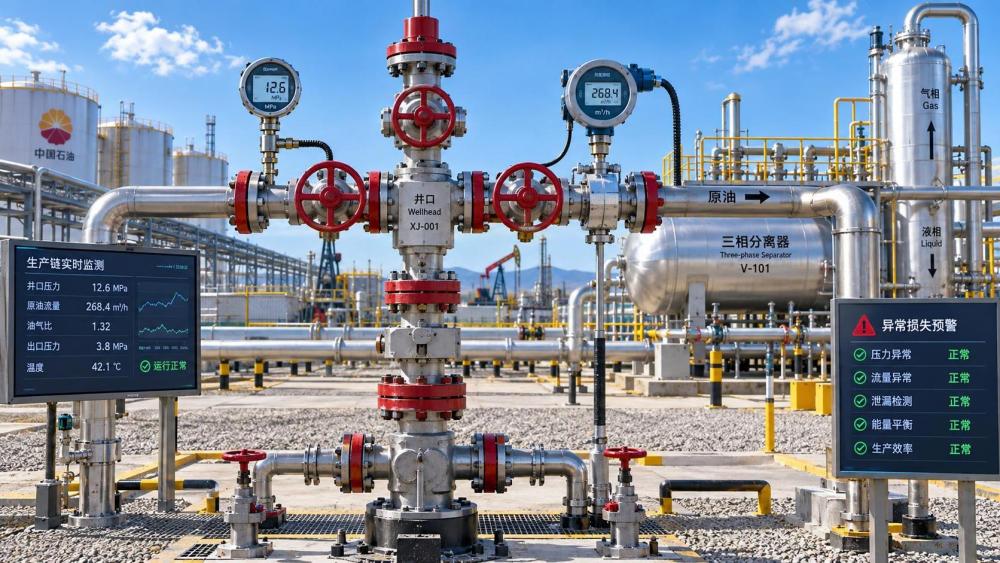
Project managers do not need to diagnose every failure mode personally, but they should ensure that the monitoring design reflects actual operating dependencies. A production dashboard that only combines daily volume, uptime, and a few red alarms may support reporting, yet it may not support timely intervention. The useful view links the loss estimate to the affected asset, supporting evidence, duration, operational consequence, and responsible action.
Separate production loss from unavailable capacity
One recurring source of confusion is treating all downtime as lost production. A compressor may be unavailable, but if upstream wells were already curtailed for another reason, the immediate production impact may be lower than the equipment’s nominal capacity. The reverse can also happen: a brief trip at a constrained point in the system may affect several wells and create a loss greater than expected from the equipment record alone.
Tracking both availability and production impact prevents this distortion. Availability describes whether an asset could operate. Production impact describes the volume that could not be produced, processed, or exported because of the condition. The two should be connected, but not assumed to be identical.
- Record the start and end of the event, including periods of unstable restart.
- Identify the operating constraint immediately before the event.
- Estimate whether other bottlenecks limited output at the same time.
- Distinguish planned maintenance, operational curtailment, equipment failure, and uncertain data.
- Update the event classification after field findings are available rather than leaving an initial assumption unchanged.
That process creates a more reliable loss register. Over time, recurring events can be grouped by equipment type, location, operating mode, and cause category. This makes it easier to decide whether the next action should be corrective maintenance, spare-parts planning, operating-procedure revision, instrumentation validation, or engineering review.
Use exception rules that match the operating context
Fixed alarm limits are necessary for protection, but they are often too blunt for production-loss detection. A flow rate may remain within its safe range while still falling far below the expected rate for that choke setting, lift condition, or separator pressure. Conversely, a pressure that appears abnormal during startup may be acceptable during a controlled transition.
Effective upstream energy systems monitoring uses layered exceptions. The first layer identifies protective limits and communications failures. The second looks for performance deviations against expected operating behavior. A third layer evaluates persistence: a short fluctuation may require observation, while a repeated or sustained deviation may require a work order, production review, or engineering investigation.
Useful exception questions for daily review
Instead of reviewing every tag, focus the operations discussion on deviations that change a decision. Has a well produced below its expected envelope for more than one reporting cycle? Has a pump required more starts than usual? Is increasing line pressure occurring alongside declining facility throughput? Has a manual override remained active after a temporary condition ended? Is a meter reading inconsistent with related process conditions?
These questions turn monitoring into an operational control process rather than a passive display. They also help avoid alarm fatigue, where teams learn to ignore frequent alerts because too many have no practical consequence.
Bring maintenance records into the diagnosis
Field data tells the team what is happening; maintenance history often explains why a pattern deserves attention. A recurring motor overload, repeated valve intervention, intermittent communications loss, or several similar repairs on adjacent equipment can change the priority of a seemingly minor deviation.
Before scheduling an intervention, compare the current signal pattern with maintenance records, outstanding work orders, spare-part availability, and recent operating changes. A pressure issue after a line modification should not be interpreted in the same way as the same reading under unchanged conditions. Similarly, a declining rate after a pump replacement may justify checking installation, control settings, and operating point before assuming reservoir decline.
For project execution, this linkage supports better sequencing. A crew mobilization can address several related risks if the monitoring evidence shows that they share a location, failure mechanism, or access requirement. It can also prevent production-critical work from being delayed behind tasks with little verified impact.
Establish a practical escalation path
Monitoring only reduces losses when someone knows what to do after an exception appears. Each significant deviation should have an owner, an expected response time, and a clear threshold for escalation. The threshold does not need to be based only on volume. It may also reflect safety exposure, risk of equipment damage, risk to a planned campaign, repeated trip frequency, or the possibility that a restriction could spread through the system.
- Validate the signal. Check communication status, timestamp alignment, instrument plausibility, and related measurements before classifying a loss.
- Define the affected boundary. Determine whether the issue is limited to one well, a gathering branch, a processing train, or the export interface.
- Estimate operational exposure. Compare current output with the adjusted baseline and identify whether the shortfall is continuing.
- Select the next response. This may be a remote operating adjustment, a field inspection, maintenance preparation, or engineering analysis.
- Verify recovery. Do not close the event merely because equipment restarts; confirm that rate, pressure, and stability return to the expected range.
The final verification step is often missed. Equipment can return to service while production remains constrained by residual blockage, incorrect setpoints, unstable controls, or downstream limitations. Confirming recovery protects the production forecast and improves the quality of future event classification.
Where monitoring has limits
Monitoring can reveal patterns and narrow the investigation, but it cannot eliminate the need for sound engineering judgment. Production estimates depend on valid allocation methods, current operating assumptions, and reliable instrumentation. In fields with changing fluid behavior, commingled streams, intermittent production, or limited measurement points, the uncertainty around a loss estimate should be visible rather than hidden behind a single number.
When a deviation is persistent, affects pressure containment or process stability, or conflicts with the expected physical behavior of the system, it should be reviewed by the appropriate production, process, reliability, or reservoir specialists. The most useful monitoring process does not claim certainty too early; it makes uncertainty explicit, preserves the evidence, and directs attention to the point where intervention can prevent a manageable deviation from becoming a prolonged production loss.
- Last One:No more articles
- Next Article:How to verify supplier data on a supplier discovery platformSep 12, 2026
Related News
- 00
0000-00
Virgin vs Recycled Resin: How to Switch Without Disrupting Production? - 00
0000-00
Why Bio-Based Plastics Still Have to Prove Themselves on the Molding Floor - 00
0000-00
Industrial decarbonization targets slip when baselines are weak - 00
0000-00
How upstream energy systems monitoring helps detect production losses - 00
0000-00
How to verify supplier data on a supplier discovery platform
Related tags
Weekly Insights
Stay ahead with our curated technology reports delivered every Monday.