




How a plastics innovation database can identify emerging materials




For technical evaluators, the search for emerging plastics rarely begins with a single breakthrough announcement. It usually begins with a practical question: is there a material option that can meet our performance target, fit our process window, support our sustainability goals, and still be sourced with reasonable confidence?
That question has become harder to answer. Polymer innovation is moving across several fronts at once: recycled-content formulations, bio-based feedstocks, low-carbon production routes, mono-material packaging structures, lightweight engineering resins, PFAS alternatives, and grades designed for more demanding recycling streams. New names appear quickly, while the information needed to assess them is often scattered across technical data sheets, supplier presentations, regulatory notices, trade updates, and application reports.
A plastics innovation database gives that fragmented landscape a usable structure. Rather than treating materials as a list of supplier products, it connects polymer families, material properties, processing behavior, certifications, applications, supply references, and market signals. For an evaluator, that changes the task from “finding something new” to building a defensible shortlist of materials worth testing.
Innovation is shifting from new polymers to better material systems
Many teams still associate plastics innovation with the arrival of an entirely new resin chemistry. Those developments matter, especially in high-performance applications, but they are not the only story shaping the market. A growing share of innovation occurs in how familiar polymers are formulated, produced, recovered, and used.
Consider a packaging team seeking to replace a multi-layer structure. The emerging option may not be a novel polymer at all. It could be a polyethylene or polypropylene grade with improved stiffness, sealability, barrier performance, or compatibility with a recycling-oriented design. In automotive interiors, the relevant change may be a recycled polyamide compound with more stable mechanical properties. In electrical applications, evaluators may be watching halogen-free flame-retardant formulations, conductive compounds, or alternatives to materials affected by changing chemical restrictions.
This broader view matters because a technically interesting material is not automatically an emerging market material. It becomes strategically relevant when its performance profile aligns with a real application need, processing equipment can accommodate it, and the supply chain shows signs of becoming viable.
What a plastics innovation database should reveal
Not every materials directory is useful for technical screening. A simple catalog can tell users that a product exists; it may not explain why that product deserves attention. A more effective plastics innovation database allows evaluators to examine multiple evidence layers together.
- Material identity: polymer family, copolymer or blend composition, filler or reinforcement type, additive system, and virgin, recycled, bio-based, or mass-balance attributes.
- Performance data: tensile strength, impact resistance, heat resistance, density, melt flow behavior, chemical resistance, electrical characteristics, barrier properties, and weatherability where relevant.
- Processing context: suitability for injection molding, extrusion, blow molding, thermoforming, film production, compounding, rotational molding, or additive manufacturing.
- Application signals: use in packaging, construction, consumer goods, automotive, medical-adjacent components, electrical equipment, agriculture, and industrial products.
- Compliance and sustainability evidence: recycled-content claims, certification references, food-contact status where applicable, material declarations, recyclability considerations, and relevant regional regulations.
- Commercial and supply indicators: supplier specialization, production capabilities, regional availability, export activity, feedstock exposure, and price-related market context.
Individually, none of these fields tells the whole story. Together, they make it possible to distinguish a laboratory-scale concept from a material platform that may be entering commercial use.
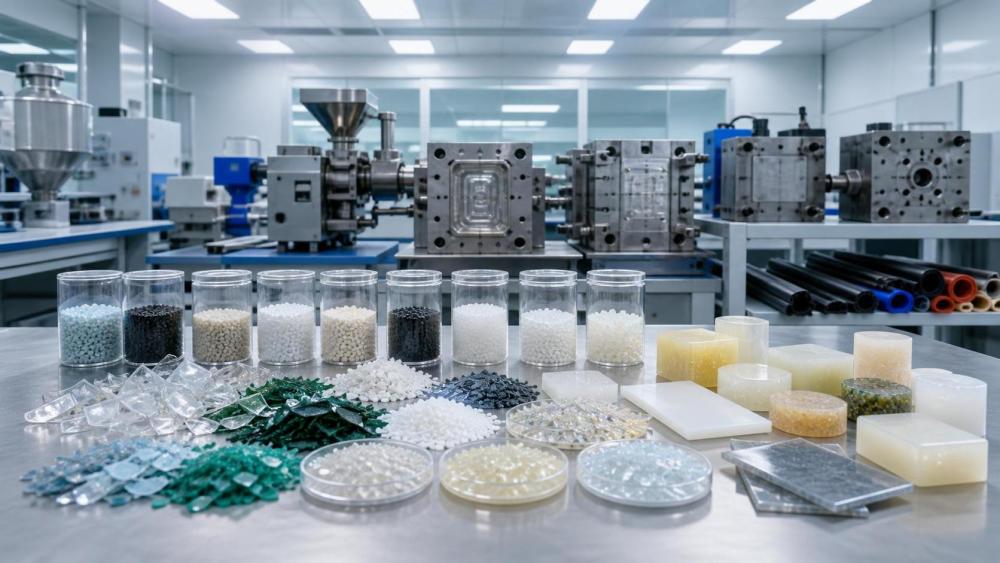
Finding emerging materials through patterns, not headlines
The strongest signal is usually a pattern of changes rather than one announcement. Technical evaluators can use a structured database to watch for several developments occurring at the same time.
First, look for specification convergence. An emerging material becomes more credible when several grades begin to address the same constraint: higher recycled content without severe impact loss, improved heat resistance in bio-based polyamides, or better processability in flame-retardant compounds. This suggests that suppliers are responding to a repeatable market requirement rather than showcasing a one-off formulation.
Then compare application migration. A polymer may first appear in lower-risk applications before moving toward more demanding ones. Recycled polypropylene, for example, may progress from non-critical consumer products into automotive trim or appliances as sorting, compounding, odor control, and quality assurance improve. Tracking where a material appears over time offers clues about its maturity.
Pay attention to processing compatibility. Materials that require entirely new equipment, unusual drying protocols, narrow temperature control, or major mold changes may still be valuable, but their adoption curve will likely differ from a drop-in or near-drop-in alternative. Processing data is therefore not an afterthought; it is one of the clearest filters for practical adoption.
Finally, follow the supply-side evidence. A promising grade can stall if feedstock availability is limited, certification chains are unclear, or production is concentrated in one region. Supplier references, trade information, production technologies, and market updates help evaluators assess whether a material’s momentum is supported by industrial capacity.
A screening method that reduces early-stage uncertainty
A database is most useful when it supports a repeatable evaluation process. The goal is not to replace laboratory validation, supplier qualification, or compliance review. It is to ensure that those expensive steps begin with better candidates.
Start by translating the project into non-negotiable requirements. These may include a minimum impact strength, a maximum processing temperature, a specified recycled-content range, an appearance requirement, contact with chemicals, end-of-life design criteria, or compatibility with an existing molding line. Separating “must have” requirements from “preferred” attributes prevents a trend-driven material from entering the shortlist simply because it sounds innovative.
Next, search beyond the current polymer family. A team replacing ABS may need to examine modified polypropylene, PC/ABS alternatives, recycled engineering compounds, or bio-attributed resins depending on the part’s actual function. Searching by application, process, and property range often surfaces options that a supplier-name search would miss.
Once a preliminary group is formed, compare candidates on a common basis. Normalize test conditions where possible. A tensile value measured under one standard or a melt-flow result reported under a different condition cannot be treated as directly interchangeable. Technical evaluators should also flag missing fields. Missing odor data, color stability information, recycled-content traceability, or thermal aging results may be more important than an attractive headline property.
The final early-stage output should be a ranked test plan, not a declaration of a winner. A useful shortlist identifies what needs to be verified: sample availability, lot-to-lot consistency, tooling adjustments, cycle-time impact, migration testing, weathering behavior, or regulatory documentation.
Why sustainability claims require deeper material intelligence
Sustainable plastics are a major source of market activity, but they also create one of the most common evaluation traps. “Recycled,” “renewable,” “circular,” and “low carbon” do not describe a single technical reality.
A recycled-content material may be mechanically recycled, chemically recycled, mass-balanced, post-industrial, post-consumer, or based on a blend of sources. Each route can affect consistency, traceability, color, odor, contaminant risk, cost exposure, and the evidence available for downstream claims. Likewise, a bio-based polymer may reduce reliance on fossil feedstocks while introducing different processing, moisture, heat-resistance, or disposal considerations.
For this reason, a plastics innovation database should connect sustainability descriptors to the underlying material and production context. Evaluators need to ask: What is the stated feedstock route? Is the claim tied to a certification framework? Does the grade maintain performance after reprocessing? Can the finished product still fit the intended recycling stream? These questions protect teams from selecting a material that performs well in a presentation but poorly in the full product system.
Using market intelligence to time the decision
Technical feasibility and market readiness do not always arrive together. A material may be ready for prototyping but not for a long-term sourcing program. Conversely, a growing supply base may make a previously niche resin more attractive than its data sheet alone suggests.
Market intelligence adds this missing dimension. Pricing movements can reveal feedstock sensitivity. Export patterns may point to changing regional availability. New compounding capacity can indicate a strengthening supply base, while repeated supply interruptions may justify dual-sourcing or a more conservative material choice. For global projects, these factors can influence the selection as much as a modest difference in modulus or melt flow.
Platforms such as GEMM are designed to make these connections easier to examine across product information, technical knowledge, supplier references, applications, trade developments, and pricing intelligence. For a technical evaluator, the value is not merely faster searching. It is the ability to move between a polymer’s technical profile and the industrial conditions surrounding it without treating those as separate research exercises.
Keep novelty in perspective
Emerging materials deserve attention, but novelty should not become the selection criterion. The right candidate is the one that solves a defined problem with evidence proportionate to the project’s risk. In a low-volume pilot, a less mature material may be worth exploring. In a safety-critical molded component or a globally distributed packaging format, documentation depth, process stability, and supply resilience may carry greater weight.
A well-used plastics innovation database helps teams make that distinction early. It reveals where material development is heading, which claims are supported by technical and market context, and which options need more proof before they advance. That is how evaluators can turn a crowded stream of plastics innovation into a practical, forward-looking materials strategy.
Related News
- 00
0000-00
Which sectors are driving demand in the chemical engineering market? - 00
0000-00
How to assess lifecycle emissions from CCUS for low-carbon cement - 00
0000-00
How do energy storage technologies compare for 8-hour discharge? - 00
0000-00
Do mill test reports prove industrial alloys meet ASTM standards? - 00
0000-00
How to verify plastic recycling system suppliers' throughput claims
Related tags
Weekly Insights
Stay ahead with our curated technology reports delivered every Monday.