




How Can Feedstock Contamination Be Prevented in Bioprocessing?




How Can Feedstock Contamination Be Prevented in Bioprocessing?
Contaminated feedstock can compromise fermentation performance, reduce product quality, and trigger costly batch losses before operators recognize the problem. The cause is not always an obvious microbial outbreak. Residual cleaning chemicals, inhibitory compounds, foreign particles, or deterioration during transport can also make an otherwise usable raw material unsuitable for a particular process.
Effective bio-processing feedstock contamination prevention therefore starts before the material reaches the fermenter. It combines supplier controls, representative sampling, suitable storage, validated treatment, and hygienic transfer. The practical question is not simply whether a feedstock is “clean,” but whether its hazards are understood and controlled well enough for the organism, equipment, and final product involved.
Define the hazard before choosing the control
Feedstock quality and contamination overlap, but they are not interchangeable. A lower sugar concentration may be a quality deviation rather than contamination. An unexpected solvent residue is a chemical hazard. Both can reduce yield, yet they require different investigations and corrective actions.
A useful assessment separates three hazard groups:
- Microbial hazards: unwanted bacteria, yeasts, molds, and, in susceptible bacterial processes, bacteriophages. These can compete for nutrients, change metabolite profiles, or disrupt the production culture.
- Chemical hazards: pesticide residues, cleaning agents, heavy metals, processing aids, and other compounds incompatible with the process. Biomass pretreatment can also generate fermentation inhibitors such as furfural and certain phenolic compounds.
- Physical hazards: stones, metal fragments, fibers, packaging debris, and other foreign matter that can damage pumps, block filters, or interfere with mixing and measurement.
The same material can be acceptable for one application and unacceptable for another. Industrial biofuel production, food fermentation, and pharmaceutical bioprocessing do not necessarily share the same specifications. Even within one sector, microbial tolerance depends on the production strain and operating conditions. Avoid adopting another facility’s limits without checking their basis.
Make supplier qualification specific to the feedstock
A supplier certificate of analysis is useful evidence, but it is not a complete contamination-control system. It may describe a sample taken before shipment and may omit hazards relevant to your fermentation. Qualification should establish how the material is produced, handled, tested, and protected during delivery.
For agricultural substrates, examine seasonal variation, drying practices, storage moisture, pest management, and the possibility of mold development. For liquid sugars, glycerol, or industrial side streams, ask about shared tanks, previous cargoes, cleaning verification, preservatives, and changes in upstream processing. Recovered or recycled inputs deserve particular attention to source segregation and traceability.
Specifications should connect each requirement to a process risk. “High purity” is too vague. Define the relevant identity, composition, microbial indicators, inhibitory substances, and foreign-matter limits, with agreed test methods. Establish how suppliers must communicate changes in source, processing aids, manufacturing location, or transport arrangements.
Price comparisons also need this context. A lower-cost feedstock may require additional clarification, detoxification, testing, or shorter storage. Those requirements can outweigh the purchase-price saving. Evaluate delivered usable material, not merely delivered tonnage.
Use incoming testing to make release decisions
Receiving inspection should begin with the delivery itself: seal condition, packaging integrity, cleanliness of unloading connections, lot identification, and any specified transport conditions. A discrepancy should trigger a defined hold or investigation rather than an informal decision to unload and hope that downstream treatment compensates.
Sampling is often the weak point. Bulk solids can contain localized pockets of moisture or mold, while liquids may stratify or carry settled solids. A convenient sample from the top of a container may not represent the shipment. Sampling locations, tools, mixing requirements, and sample preservation should match the material and the intended analysis.
Testing should be risk-based rather than exhaustive by default. Identity and composition checks establish that the correct material arrived. Microbial testing assesses specified organisms or bioburden. Chemical analysis targets plausible residues and inhibitors. Where analytical results do not fully predict fermentation performance, a controlled small-scale compatibility test can help evaluate a new source or a significant process change.
Negative test results do not prove that an entire shipment is contamination-free. Their value depends on sampling coverage, method sensitivity, and the organisms or chemicals being measured. Rapid methods can shorten decisions, but their suitability for the actual feedstock matrix must be demonstrated. Keep unreleased material physically or administratively segregated until the required evidence is available.
Treat storage and transfer as part of the process
A feedstock can meet its specification on arrival and deteriorate before use. Moisture ingress into dry materials, condensation in silos, uncontrolled temperature, and extended holding of diluted nutrient solutions can all change the risk. Storage limits should reflect the material’s stability under actual site conditions, not only a supplier’s general shelf-life statement.
Concentrated substrates may inhibit microbial growth under some conditions, but dilution can remove that protection. Dilution water, preparation tanks, and transfer lines therefore belong in the contamination assessment. Water quality must suit its intended use; a chemically acceptable water supply is not automatically microbiologically suitable for every bioprocess.
Map the route from receiving to the point of use, including temporary hoses, sampling valves, vents, recirculation loops, and drains. This often reveals overlooked interfaces where treated material can contact untreated equipment or where stagnant residues remain between campaigns.
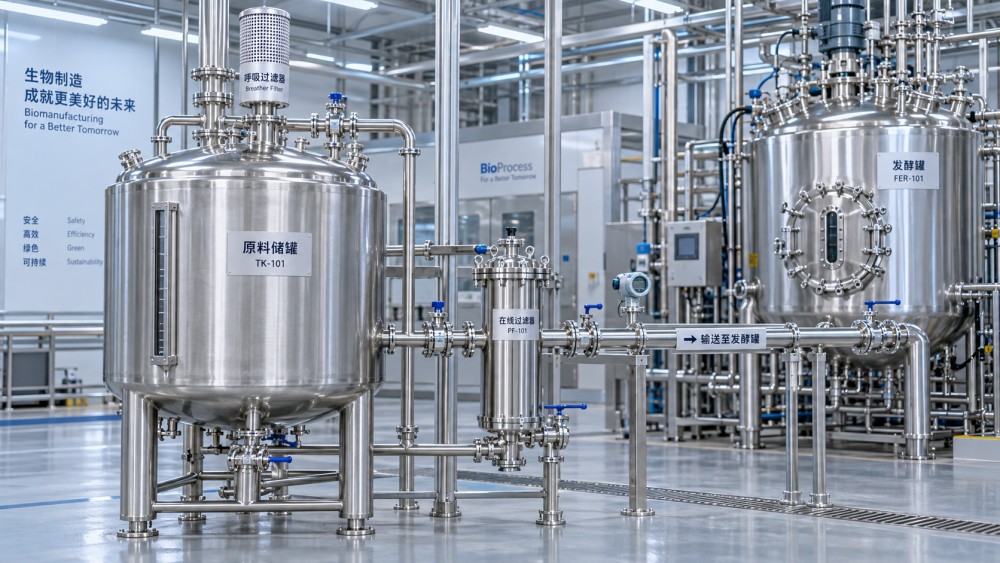
Closed transfer reduces exposure, but “closed” does not mean hygienic. Tanks need suitable vent protection; connections need controlled assembly; seals and valves need inspection. Where clean-in-place or sterilize-in-place systems are used, verification must address the complete feed path, including branches that receive inadequate flow or heating. Maximum hold times should cover prepared and treated feedstocks as well as raw materials.
Match pretreatment to the hazard—and its limitations
There is no single treatment that reliably removes every contamination risk. Screening, clarification, heat treatment, membrane filtration, and chemical conditioning solve different problems. Selecting equipment before defining the target hazard can leave a critical gap.
Heat treatment can reduce or inactivate microorganisms when the required conditions are achieved throughout the material. Validation should consider starting bioburden, organism resistance, viscosity, solids content, heat distribution, and residence time. A jacket temperature or outlet reading alone may not establish adequate exposure. Excessive heating can also degrade nutrients or create inhibitory reaction products.
Membrane filtration can be appropriate for compatible liquid feeds, especially when heat sensitivity matters. Suitability depends on the target organisms, filter retention performance, integrity testing, and operating conditions. High solids or viscosity can make filtration impractical without pretreatment. A filter described as sterilizing-grade should not be assumed to remove dissolved chemicals or every viral hazard.
Screening, magnets, and clarification address selected physical contaminants but do not establish microbiological control. Likewise, adsorbents or chemical conditioning used to reduce inhibitors require evidence that they work in the specific feedstock without introducing unacceptable residues or removing essential nutrients.
Importantly, killing microorganisms does not necessarily eliminate toxins or other compounds they have produced. Some contaminated lots should be rejected rather than “rescued.” Reprocessing needs an approved technical basis and must remain compatible with applicable product and market requirements.
Monitor trends and investigate deviations early
Contamination control should connect feedstock records with fermentation behavior. Changes in lag phase, unexpected acid formation, altered oxygen demand, or reduced substrate uptake can justify investigation, but none is proof of contamination on its own. Strain condition, nutrient imbalance, equipment faults, and measurement errors can produce similar symptoms.
Track incoming results by supplier and lot alongside storage duration, treatment records, transfer events, and batch performance. Trends within specification can still matter: a gradual rise in bioburden or increasing inhibitor concentration may expose declining control before a formal limit is exceeded.
When contamination is suspected, contain the affected material and preserve evidence before cleaning removes it. Compare raw feedstock, post-treatment samples, preparation water, and relevant downstream locations. Retained samples are useful only when their storage conditions preserve the attributes being investigated. Corrective action should address the entry point or control failure, not simply add a more aggressive treatment step.
Turn technical information into a defensible sourcing decision
Preventing feedstock contamination requires procurement, quality, engineering, and production to work from the same requirements. Before approving a new material, confirm its source variability, sampling plan, release criteria, treatment compatibility, storage limits, and delivery arrangements. Standards or certifications should be checked for their actual scope; they do not automatically establish suitability for a particular fermentation.
GEMM’s structured industry resources can support this evaluation by bringing together raw-material categories, technical specifications, supplier references, application guidance, and market intelligence across chemicals, biofuels, sustainable energy, and related equipment. That information helps narrow comparisons and identify questions for suppliers, but it does not replace site-specific qualification, laboratory evidence, or process validation.
A practical next step is to review one feedstock from supplier dispatch to the fermenter connection. At each handoff, ask what can enter, multiply, persist, or go undetected—and what evidence supports the control. The most urgent improvement is often not a new sterilizer, but an unverified transport tank, an unsuitable sampling method, or a holding period that nobody has validated.
Related News
- 00
0000-00
How energy costs are shaping the global heavy industry outlook - 00
0000-00
Which metal property standards apply to tensile testing of steel? - 00
0000-00
Can polymer processing simulation predict injection molding warpage? - 00
0000-00
An export controls compliance guide to checking U.S. license requirements - 00
0000-00
How Can Producers Assess Biofuel Feedstock Availability in 2026?
Weekly Insights
Stay ahead with our curated technology reports delivered every Monday.