




How to evaluate a carbon capture materials database for screening adsorbents




A reliable carbon capture materials database can do far more than list adsorbents—it should help technical evaluators compare performance, verify data quality, and narrow candidates for real-world screening. When assessing such a database, the key is not only how much information it contains, but how clearly it organizes material properties, test conditions, and application relevance for practical decision-making.
That distinction matters because adsorbent screening often fails at the interface between published material performance and process reality. A database may report impressive CO2 uptake values, but if those values come from dry gas, low-pressure, single-component tests at room temperature, they may have limited meaning for flue gas, biogas upgrading, direct air capture, or pre-combustion service. For a technical evaluator, the database is useful only if it helps separate “interesting literature material” from “serious engineering candidate.”
Start with the decision context, not with the material list
Before judging the database itself, define what screening decision it is supposed to support. Adsorbent selection criteria differ sharply across capture routes:
- Post-combustion capture usually requires tolerance to moisture, low CO2 partial pressure performance, cyclic stability, and manageable regeneration energy.
- Natural gas or biogas upgrading may prioritize CO2/CH4 selectivity, impurity tolerance, and pressure swing suitability.
- Direct air capture pushes attention toward ultra-low concentration capture, humidity effects, and long-cycle durability.
- Pre-combustion or high-pressure streams may shift the balance toward high-pressure isotherms, thermal stability, and multicomponent behavior.
A database that does not allow users to filter by application conditions is difficult to use for serious technical screening. Large data volume is not an advantage if the evaluator still has to manually reconstruct whether a result is relevant.
Data quality matters more than database size
Many materials databases look strong in headline numbers but weak in evidentiary quality. Technical teams should examine whether the platform distinguishes between raw literature extraction and validated comparative data.
At minimum, a useful database should show:
- the original data source;
- test method or measurement basis;
- temperature and pressure conditions;
- gas composition;
- whether the test was single-component or multicomponent;
- whether humidity was present;
- units used and any conversions applied.
If these fields are missing, comparison becomes risky. A CO2 capacity value without pressure context is not a screening metric. A selectivity value without method disclosure—ideal adsorbed solution theory, breakthrough testing, or another approach—can be misleading. Even density-dependent metrics such as volumetric capacity become hard to trust if crystallographic density, pellet density, and packed-bed density are mixed without clear labeling.
Technical evaluators should also look for signs of curation discipline. Does the database flag inconsistent units? Does it note duplicate reports of the same material under different names? Does it separate simulated performance from experimental performance? These details often determine whether the platform supports engineering judgment or simply accelerates confusion.
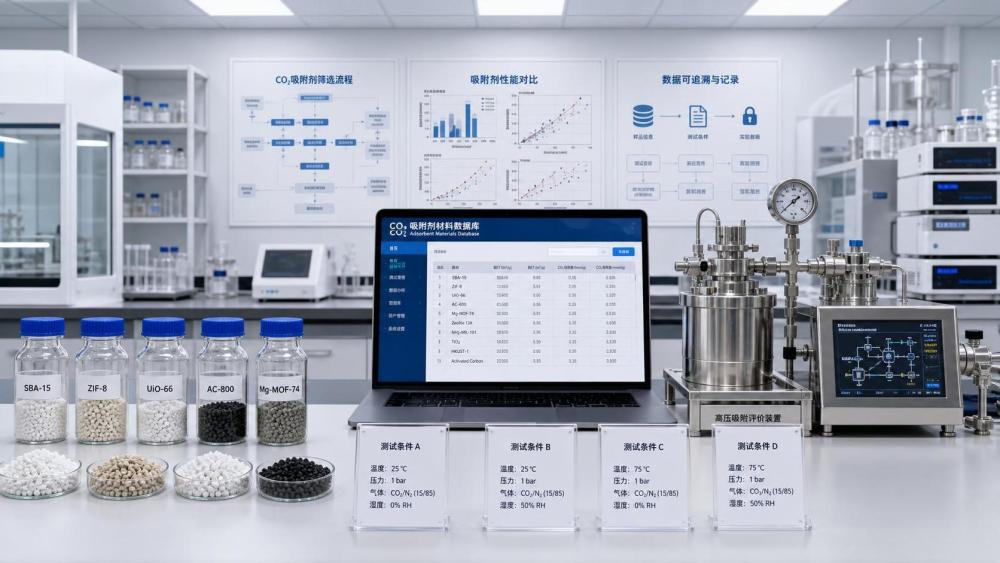
The most valuable databases make test conditions impossible to ignore
In carbon capture, performance is condition-sensitive to an unusual degree. For that reason, a good database should not present adsorption capacity as a standalone ranking field. It should force performance to be interpreted alongside conditions.
Look for structure in the way the database handles:
- Pressure range: especially low partial pressure data relevant to dilute CO2 streams.
- Temperature dependence: critical for realistic regeneration and process integration.
- Humidity exposure: essential for many flue-gas and air-capture applications.
- Impurities: SOx, NOx, H2S, hydrocarbons, and oxygen can strongly affect usable life.
- Cyclic testing: uptake alone is not enough without retention across repeated adsorption-desorption cycles.
Databases that treat these as optional annotations tend to be less useful than those that make them primary filters. In real screening work, one robust material with moderate capacity under humid cyclic conditions is often more valuable than ten high-performing materials tested only in ideal dry systems.
Material classes should be comparable, but not flattened into false equivalence
Most carbon capture materials databases cover multiple adsorbent families: zeolites, activated carbons, metal-organic frameworks, amine-functionalized solids, porous polymers, and hybrid sorbents. That breadth is helpful only if the platform preserves the differences in how these families should be judged.
For example, zeolites may offer strong affinity and mature manufacturing pathways, but can be moisture-sensitive depending on composition and operating mode. Activated carbons may show good robustness and impurity tolerance, but not always the same low-pressure CO2 affinity as functionalized alternatives. MOFs often attract attention due to tunable pore chemistry and strong literature momentum, yet data quality, shaping behavior, hydrothermal stability, and cost realism vary widely across structures.
A strong database should let the evaluator compare unlike materials without pretending they are directly interchangeable. If the only sortable fields are surface area, adsorption capacity, and selectivity, the platform is likely oversimplifying. A more decision-ready structure includes manufacturability, precursor availability, shaping compatibility, stability limits, and regeneration mode.
Process relevance is where many databases underperform
Technical screening does not end with material properties. It starts there. The next question is whether the database connects material data to process consequences.
Useful indicators include:
- working capacity rather than only equilibrium capacity;
- heats of adsorption or desorption-related indicators;
- kinetic data such as uptake rates or diffusion constraints;
- pelletization or structured-form information;
- mechanical stability under pressure swing or thermal cycling;
- evidence from breakthrough experiments or bench-scale units.
Without these fields, teams can over-select materials that look strong in batch characterization but perform poorly once cycle time, bed pressure drop, heat management, or regeneration energy enter the picture. A database does not need to be a process simulator, but it should help bridge the gap between materials science and separations engineering.
Check whether the database supports elimination, not just discovery
The best evaluation tools are often better at ruling materials out than at finding star candidates. In practice, technical teams need to narrow a broad literature universe into a manageable short list for validation.
A database is more useful when it allows fast exclusion based on constraints such as:
- instability above a relevant temperature window;
- loss of performance in humid gas;
- lack of reproducible synthesis information;
- dependence on expensive or supply-constrained precursors;
- absence of scale-up evidence;
- reported degradation after limited cycles.
This is especially important for cross-functional screening, where technical teams must justify why a promising academic material is not yet procurement-ready or project-ready. A database that captures failure modes is often more credible than one built only around best-case results.
Traceability and update discipline are strategic, not administrative
Carbon capture materials research evolves quickly. New MOFs, amine-grafted sorbents, porous organic materials, and modified carbons appear continuously, but not all deserve equal weight. A database should therefore show how often it is updated, how materials are classified, and whether outdated or contradicted results remain visible with context.
Version control and traceability are not minor features. They affect whether a screening record can be defended in internal review, partner discussion, or later project gating. If a shortlisted material is challenged, the evaluator should be able to trace the database entry back to the original source and understand any editorial normalization applied.
Where performance values are inferred, modeled, or converted, that should be transparent. Where data gaps exist, they should remain visible instead of being hidden behind composite rankings.
Be cautious with scoring systems that compress too much complexity
Some platforms offer ranking scores for “best carbon capture adsorbents.” These can be helpful for initial navigation, but they should never replace engineering review. Composite scores often hide assumptions about what matters most: capacity, selectivity, stability, cost, or ease of regeneration.
For a technical evaluator, a strong database is not one that tells you which material is best in general. It is one that makes it easy to identify which materials are best under your operating assumptions. If scoring logic is opaque, the platform may be more suitable for high-level browsing than for actual candidate screening.
A practical test: can the database support a defensible short list?
The most useful way to evaluate a carbon capture materials database is to run a realistic screening exercise. Choose a target application, define the key process conditions, and ask whether the platform can reduce hundreds of materials to a technically defensible short list of perhaps five to fifteen candidates.
If that exercise still requires extensive manual rework of test conditions, terminology, units, and source quality, the database is probably functioning as a literature repository rather than a screening tool.
For technical teams, the right database is not the one with the most entries. It is the one that helps connect material data to deployment logic: what survives humidity, what cycles well, what can be shaped, what can be sourced, and what remains promising after idealized results are stripped away. In carbon capture, that is the difference between data abundance and usable decision support.
Related News
- 00
0000-00
Which sectors are driving demand in the chemical engineering market? - 00
0000-00
How to assess lifecycle emissions from CCUS for low-carbon cement - 00
0000-00
How do energy storage technologies compare for 8-hour discharge? - 00
0000-00
Do mill test reports prove industrial alloys meet ASTM standards? - 00
0000-00
How to verify plastic recycling system suppliers' throughput claims
Weekly Insights
Stay ahead with our curated technology reports delivered every Monday.